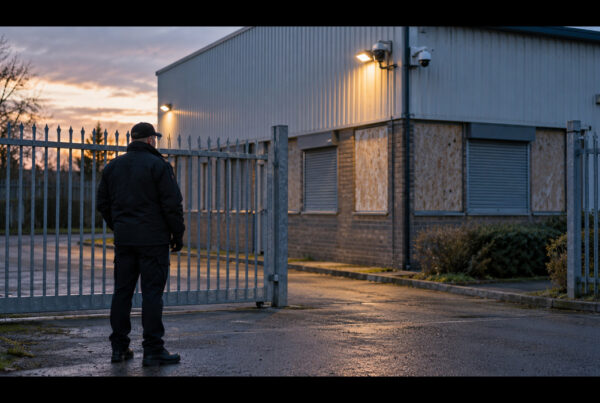
Walk down any UK high street this year and you’ll notice something. There’s a uniformed guard on the door of a shop that never used to need one. The empty unit on the corner has a mobile patrol van parked outside overnight. Your local venue has just added a security briefing to its events checklist. None of this is a coincidence. Across the country, businesses, landlords and event organisers are hiring professional security guard services at a pace we haven’t seen in years.
Retail theft is at a two-decade high, new counter-terrorism law is about to change what venues are legally required to do, and construction sites are losing over a billion pounds a year to organised crime, all while fewer people are entering the security profession just as demand keeps climbing.
In this article, we’ll unpack exactly why demand for security guard services is rising in the UK, what it means for your business, and how to choose a provider you can actually rely on.
The UK Security Guard Services Market at a Glance
Before we get into the “why,” it helps to see the scale of what’s happening. Here’s a quick snapshot of where things stand right now:
| Metric | Latest Figure |
|---|---|
| UK private security services market size | Close to £9 billion a year (2026 estimate) |
| Active SIA licence holders | 450,000+ — up from around 235,000 in 2008 |
| Shoplifting offences (year to March 2025) | 530,643 — the highest since current recording began in 2003 |
| Retail violence & abuse incidents | Over 2,000 per day, up 340% since 2020 |
| Annual cost of UK construction site theft | £1 billion+ |
| Martyn’s Law | Royal Assent April 2025; duties expected to bite from ~2027 |
6 Reasons Demand for Security Guard Services is Rising
The key reasons of the increasing demand for security guard services are discussed below.
1. Retail Crime and Violence Against Staff Have Hit Record Levels
If you run a shop, you’ve probably felt this already. Shoplifting offences in England and Wales hit 530,643 in the year to March 2025, a 20% jump and the highest figure since police began recording this way in 2003. The British Retail Consortium’s 2025 Crime Survey paints an even starker picture: violence and abuse against shop staff has risen more than threefold since 2020, with retailers now logging over 2,000 incidents a day, some involving weapons.
It’s not just opportunistic shoplifting either. Retailers increasingly report the same organised gangs hitting multiple stores across different towns, targeting high-value stock they can resell quickly. That’s why independent shops and national chains alike are turning to trained retail security officers rather than leaving staff to manage confrontations they were never trained to handle.
Picture this: a convenience store is losing hundreds of pounds a week to organised shoplifting. Once a uniformed retail security officer is brought in for peak trading hours, incidents drop sharply within weeks, often not because the guard is making arrests, but because a visible, trained presence changes who chooses to target the shop in the first place.
2. Martyn’s Law is Rewriting the Rules for Venues and Events
The Terrorism (Protection of Premises) Act 2025, better known as Martyn’s Law, received Royal Assent in April 2025 and will require certain premises and events to have proper security and emergency procedures in place. Venues expecting 200–799 people at once face a “standard” duty covering evacuation, lockdown and communication planning; larger venues or events expecting 800+ people face an “enhanced” duty that also covers monitoring, movement control and physical security measures.
Enforcement won’t begin until roughly two years after Royal Assent, but that’s exactly why forward-thinking hotels, retailers, schools and event organisers are acting now instead of waiting. Bringing in professional security guard services and a proper risk assessment early means you’re already compliant when enforcement lands, rather than scrambling to catch up.
3. Construction Sites are Losing Over £1 Billion a Year to Organised Theft
Construction remains one of the most targeted sectors in the UK. Industry research puts the cost of site theft at more than £1 billion a year, with roughly nine in ten construction firms reporting they’ve experienced theft on site. Diggers, generators, copper cable and tools disappear fast, sometimes within 15–30 minutes of a gang arriving and recovery rates are low once equipment is gone.
That’s pushing site managers to combine manned guarding, mobile patrols and, on larger or higher-risk sites, K9 units, rather than relying on fencing and padlocks alone.
4. Corporate and Commercial Security Needs are Evolving
Offices haven’t stood still either. Hybrid working means many buildings are busier on some days than others, which changes how reception, access control and out-of-hours cover need to work. Hospitals, schools, shopping centres and offices each carry their own specific risks, and increasingly want corporate security that understands their sector rather than a generic guard on a chair.
Many corporate clients now also want guarding to work alongside CCTV and access control rather than instead of it. They follow a hybrid approach that stretches a security budget further while keeping a trained person in the loop for anything a camera can’t handle alone.
5. Events, Hospitality and the Night-Time Economy Need More Cover
From festivals and conferences to weddings and club nights, anywhere with a crowd needs crowd management. Organisers are increasingly required, by insurers and licensing authorities as much as common sense, to have qualified door supervisors and event security on hand. The night-time economy especially has leant harder on professional door supervision as venues manage larger, later crowds under stricter licensing conditions.
Picture this: an events company running a large winter market finds their insurer won’t renew cover without a documented security plan and named, SIA-licensed event staff on site — a condition that’s becoming standard rather than exceptional.
6. A Tightening Labour Market is Pushing Businesses Toward Specialist Providers
Here’s a twist: demand for guards is rising just as fewer people enter the profession. First-time SIA licence applications reportedly fell by around 16% in 2025, even as the total number of licence holders hit a record high. It means growth is coming from renewals, not new recruits. With the National Living Wage rising to £12.71 an hour from April 2026, the gap between minimum wage and a typical guarding rate has narrowed, making recruitment and retention harder for any business trying to build a security team from scratch.
That’s a big reason more businesses are outsourcing to established security guard companies with their own recruitment pipelines, training programmes and SIA-vetted staff already in place, rather than competing for the same shrinking pool of licensed candidates themselves.
Matching the Right Security Guard Service to Your Risk
Not every business needs the same type of cover. Here’s a quick way to think it through:
| If your concern is… | The service that usually fits |
|---|---|
| Shoplifting and staff safety on the shop floor | Retail security officers |
| An empty unit between tenants or during redevelopment | Vacant property security + mobile patrols |
| A festival, conference or private function | Event security + door supervision |
| Staff and visitor safety at a head office or reception | Corporate security / manned guarding |
| Plant, tools and materials on a building site | Manned guarding + mobile patrols (+ K9 for high-risk sites) |
| Multiple sites needing alarm response out of hours | Keyholding & alarm response |
| A hotel, school or hospital preparing for Martyn’s Law | Manned guarding + CCTV + door supervision |
If you’re not sure which row applies to you, a good provider will run a proper site risk assessment rather than just quoting a headcount. It’s usually the clearest sign you’re dealing with specialists rather than a body-shop.
How to Choose the Right Security Guard Services Provider
Once you’ve decided you need cover, the provider you choose matters just as much as the decision itself. Here’s what to check before you sign anything:
| What to check | Why it matters |
|---|---|
| SIA Approved Contractor Scheme (ACS) status | Confirms independently audited standards, not just individually licensed guards |
| BS7858 vetting and screening | Ensures guards are properly background-checked before deployment |
| ISO 9001 and sector accreditations (e.g. Constructionline, CHAS) | Signals consistent quality management — useful if you need to show due diligence to your own clients or insurer |
| A written, site-specific risk assessment | Pricing and staffing should reflect your actual risk, not a flat rate |
| 24/7 response and keyholding capability | Matters if you need alarm response or out-of-hours cover, not just daytime presence |
| Clear contracts and regular reporting | Look for scheduled reviews and incident logs, not a “guard and forget” arrangement |
| Insurance and liability cover | Confirms the provider carries appropriate cover for your sector |
A few more actionable tips worth acting on:
- ✅ Ask to see a sample incident report or site log before signing — it tells you how seriously a provider takes documentation.
- ✅ Check how guards are trained beyond the SIA minimum (first aid, conflict management, fire safety).
- ✅ Ask what happens if your usual guard calls in sick — reliable short-notice cover is often the real test of a provider.
- ✅ If your venue is likely in scope for Martyn’s Law, ask specifically how a provider can help with your risk assessment now, not just guarding later.
What exactly do security guard services include?
Depending on the provider, this can cover manned guarding, mobile patrols, keyholding and alarm response, door supervision, retail security, event security, CCTV monitoring and installation, and specialist services like K9 units, often combined into one tailored contract.
How much do security guard services cost in the UK?
Costs vary by sector, location and hours. Reputable providers quote based on a site risk assessment rather than a flat rate, and London rates typically run higher than the rest of the country, reflecting local labour costs.
Do all security guards legally need an SIA licence?
Yes. Anyone carrying out licensable activities such as guarding, door supervision or public-space CCTV monitoring must hold a valid SIA licence, and reputable providers will also hold SIA Approved Contractor Scheme status.
What is Martyn’s Law and does it affect my business?
Martyn’s Law (the Terrorism (Protection of Premises) Act 2025) applies to premises and events that can reasonably expect 200 or more people at once, with extra duties for venues expecting 800+. If that sounds like your venue, it’s worth arranging a risk assessment well before enforcement begins.
What’s the difference between manned guarding and mobile patrols?
Manned guarding means a guard is based on-site continuously, while mobile patrols involve a guard visiting multiple sites on a scheduled or randomised route, a cost-effective option for sites that don’t need round-the-clock presence.
How do I know if my business actually needs a security guard?
If you’ve experienced theft, staff safety concerns, out-of-hours vulnerability, or you fall within scope of regulation like Martyn’s Law, it’s worth getting a professional risk assessment rather than guessing. It costs nothing to ask.
Final Words
Demand for security guard services in the UK isn’t rising because of one single factor. It’s the combination of record retail crime, new legislation like Martyn’s Law, costly organised theft on construction sites, and a labour market that’s making in-house recruitment harder than ever. Businesses that get ahead of these pressures, rather than reacting after an incident, are the ones that end up protecting their staff, stock and reputation most effectively.
At GSS Security Services, we’ve built our business around exactly this shift. We are SIA ACS-approved, ISO 9001 and CHAS accredited, providing security services across retail, corporate, construction, healthcare, hospitality and events. Whether you need manned guarding, mobile patrols, door supervision, event security, keyholding or a tailored combination of these services, our team begins with a detailed site survey and risk assessment to develop a solution that matches your specific requirements.
Get in touch for a quote today, and let’s work out exactly what “secure” should look like for your business.