
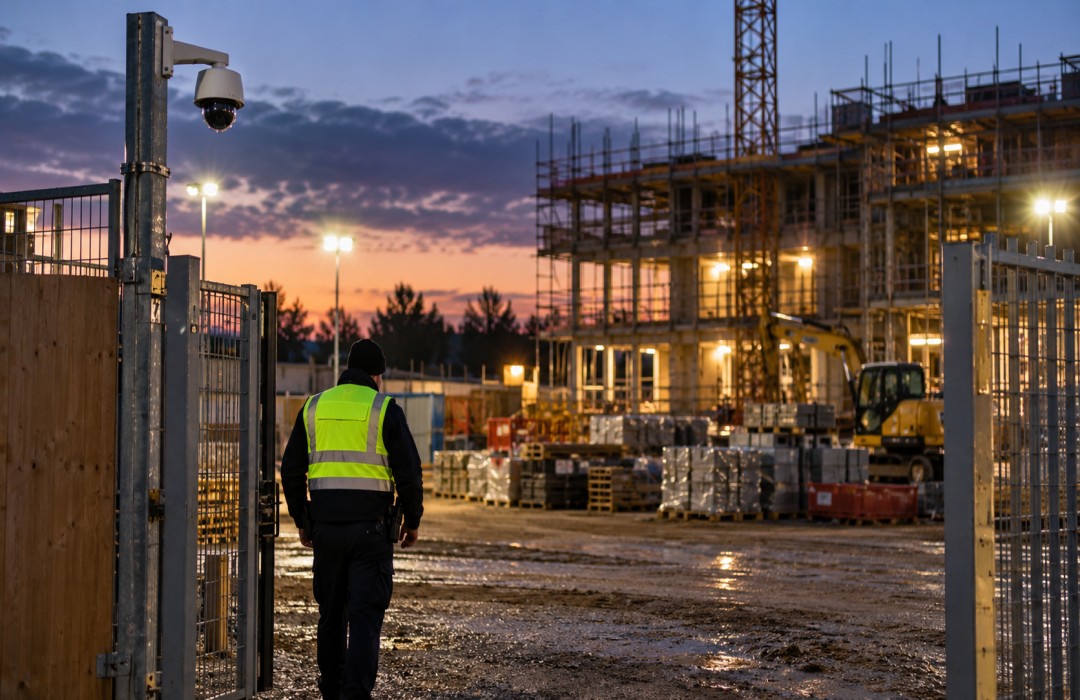
A construction site is full of valuable, portable equipment. It is also left empty every night, every weekend and over every holiday shutdown. For organised thieves, that is a gift. Industry estimates suggest UK construction firms lost between £800 million and £1 billion to on-site theft in 2025, and one survey found 92% of firms had experienced it.
This guide explains what site theft really costs, what the law expects of principal contractors, and how manned guarding, mobile patrols and CCTV work, alone and together. You will find comparison tables, a phase-by-phase security plan and a checklist you can use today.
| Need to secure a site? Tell us about your project and we will arrange a site survey and risk assessment, then build a security plan around what you actually need. Call 0203 599 8122 | info@gsssecurities.co.uk |
How big is construction site theft in the UK?
Exact figures vary by survey, but the picture is consistent: theft is widespread, costly and getting more organised.
| Measure | Figure | Source (industry survey) |
| Estimated annual loss to on-site theft | £800m to £1bn (2025) | Abax, via Project Plant |
| Firms that experienced site theft | 92% (2025) | Veritech Security, via Project Plant |
| Site workers who suffered financial loss due to crime | 38.7% (2026) | BauWatch Crime Report 2026 |
| UK tool theft rate | 57%, the highest of the markets surveyed (2026) | BauWatch Crime Report 2026 |
| Professionals who witnessed theft on site | 70% (2024) | BauWatch Construction Crime Index 2024 |
| Respondents who said crime has become more sophisticated | 62% (2024) | BauWatch Construction Crime Index 2024 |
Table 1: Construction site theft in numbers. Surveys use different methods, so treat figures as indicative.
What are thieves after?
Small tools and handheld equipment are the most frequently stolen items. Copper and cable are close behind, and plant machinery is the big-ticket target. Theft has also moved on from the quick grab of a drill or saw. Industry commentators describe organised operations that arrive with vans or trucks and take bulk hauls of high-value items.
| Target | Why it is attractive | Where sites are often exposed |
| Tools and handheld equipment | Easy to carry, easy to resell | Unsecured cabins, vans and site storage |
| Copper, cable and materials | High resale value, stored in bulk | Open compounds and unlit laydown areas |
| Plant and machinery | Single thefts can cost tens of thousands of pounds | Machines left with keys in, or unlocked, over weekends |
| Fixtures, appliances and fittings | Valuable and often delivered late in the build | Near-complete buildings with limited access control |
Table 2: Common theft targets and weak points. Based on industry reporting and our site experience.
The costs go well beyond the stolen kit
Replacing equipment is only the start. Theft hits programmes, budgets and people.
| Cost | What it means for your project |
| Project delays | In BauWatch’s 2024 survey, 31% said theft had delayed live projects, and in around one in ten cases work could not continue. |
| Replacement and downtime | Hire costs, lead times for specialist plant and idle labour while you wait. |
| Insurance | Excesses, claims handling time and possible pressure on future premiums. |
| Workers’ losses | Operatives who lose their own tools may lose income. BauWatch found 38.7% had suffered financial loss from crime. |
| Reputation and client confidence | Repeated incidents signal poor control to clients and neighbours. |
Table 3: The hidden costs of site theft.
Many of these costs are avoidable. The same survey found 47% of respondents think security should be considered before construction begins, yet more than a third said it was a low priority on their sites.
| Counting the cost of site theft? Prevention is usually far cheaper than recovery. Talk to our team about protecting your site before the next shutdown or holiday period. Call 0203 599 8122 | info@gsssecurities.co.uk |
It is also a legal duty
Site security is not just about theft. Under the Construction (Design and Management) Regulations 2015, construction sites must be kept secure so far as is reasonably practicable and in line with the level of risk. In practice, that means:
- Identifying the site perimeter with signs, and fencing it off where necessary.
- Principal contractors taking the necessary steps to prevent unauthorised people from entering.
- Contractors not starting work until reasonable steps to prevent unauthorised access have been taken.
- Including security arrangements in the construction phase plan.
The Health and Safety Executive takes this seriously. In June 2026 it urged construction firms to strengthen site security ahead of the school holidays, and in March 2026 it served an improvement notice after missing fencing let people onto a site. In an earlier case, a principal contractor was fined £10,000 plus costs after a two-year-old child got onto an unsecured development and fell into an open drain.
Guards, patrols and CCTV: how each one works
Manned guarding
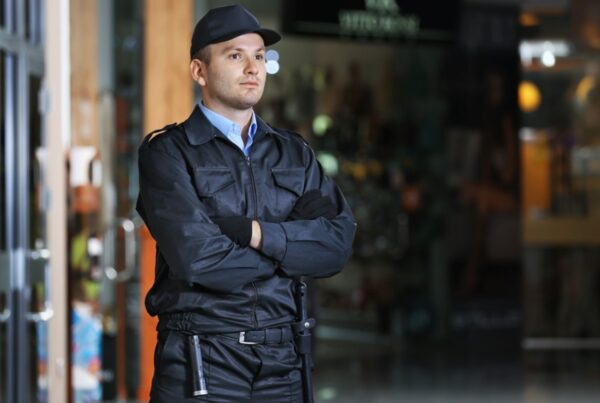
An SIA-licensed officer is on site for the hours you need. They provide a visible deterrent, control gates and deliveries, keep access logs and respond immediately if something happens. This is the strongest option for high-value sites, plant compounds and builds next to occupied homes or public routes.
Mobile patrols
Officers visit the site at scheduled or random intervals, checking perimeters, cabins and locks, and respond to alarms. This works well for smaller or lower-risk sites, or as out-of-hours cover where a permanent presence is not justified.
CCTV and security cameras
Cameras give real-time video feeds and detailed incident reporting. They deter opportunists, help detect incidents and provide evidence for insurers and police. On their own they only record what happens, so they work best when someone is ready to respond.
K9 units for higher-risk sites
For high-risk locations, trained K9 units add a strong deterrent and fast detection and response during patrols.
| Manned guarding | Mobile patrols | CCTV | |
| How it works | Officer stays on site | Officers visit and check the site | Cameras monitor and record |
| Best for | High-value, high-risk or occupied-neighbour sites | Smaller sites; out-of-hours cover | Detection, evidence and monitoring coverage |
| Strengths | Visible deterrent; immediate response; access control | Cost-effective; flexible visits; alarm response | Constant coverage; evidence for insurers and police |
| Limits | Highest ongoing cost | Gaps between visits | Needs a response plan to stop an incident |
| Pairs well with | CCTV, K9 | CCTV, keyholding | Guards or patrols |
| Cost profile | Staffed hours | Scheduled visits | Installation plus monitoring and upkeep |
Table 4: Comparing the three main options.
Layering security through the project
Good site security is a system, not a single measure. Industry guidance describes combining deterrence, detection and response, and risks change as the build progresses.
| Project stage | Main risks | Typical security approach |
| Pre-start and groundworks | Open boundaries, plant arriving on site | Define the perimeter, signage, lighting, early CCTV, access control |
| Structure and envelope | Materials, scaffolding, copper and tools | Out-of-hours patrols or guarding, secure storage, access logs |
| First and second fix | Cable, fittings and high-value tools | On-site guard and CCTV, tighter stock control |
| Finishing and handover | Appliances, fixtures and fittings | Guarding or patrols, keyholding, alarm response |
| Weekends, bank holidays, shutdowns | Empty site for long periods | Increased patrols or guarding, CCTV, checks on fencing and plant |
Table 5: An indicative approach by stage. Every site needs its own risk assessment.
How to choose the right level of security
Start with five questions:
- What is on site, and what is it worth? The more portable value, the stronger the case for guarding.
- How many entrances and how much perimeter? Large or open sites are hard to protect with cameras alone.
- Who is next door? Occupied homes, schools and rights of way raise the stakes and your legal exposure.
- When is the site empty? Nights, weekends and shutdowns drive the cover you need.
- What does your insurer expect? Check policy conditions on security before work starts.
Questions to ask a security provider
| Ask | Why it matters |
| Are all officers SIA-licensed, and is the company an SIA Approved Contractor? | Confirms legal compliance and an independent standard. |
| How are officers vetted? | Look for BS7858 screening on every officer you will have on site. |
| Will you carry out a site survey and risk assessment? | Cover should match your actual risk, not a fixed package. |
| Will officers have site-specific assignment instructions? | Everyone should know exactly what to check and what to do. |
| How is activity reported? | You need incident reports, logs and evidence you can use. |
| Is there a 24/7 support desk and a named contract manager? | Problems happen at night. Someone must answer. |
| Can cover scale up or down as the project changes? | Risk and hours change from groundworks to handover. |
Table 6: Questions to take to any security supplier.
Construction site security checklist
- Define and fence the perimeter, and keep signage clear and visible.
- Light entrances, compounds and laydown areas.
- Lock away tools and cable overnight, and immobilise plant with keys removed.
- Control and log everyone entering the site, including deliveries.
- Cover entrances and the plant compound with CCTV.
- Record serial numbers and photograph high-value items.
- Vary patrol times so thieves cannot predict them.
- Increase cover before weekends, bank holidays and shutdowns.
- Check fencing and gates daily and repair gaps quickly.
- Review security after any incident, and when the project moves to a new stage.
How GSS Security Services protects construction sites
GSS Security Services provides SIA-licensed, BS7858-vetted officers for sites across England and Wales, supported by a London head office and a 24/7 support desk. We are an SIA Approved Contractor and ISO 9001 certified, and we are trusted by more than 1,000 organisations.
Every contract starts with a site survey and risk assessment, so cover matches your risks and budget. Then we build the right mix of manned guarding, mobile patrols, K9 units and security camera installation, and we adjust guard numbers, patrol frequency or hours as the project moves forward. If a build pauses, our vacant property security and keyholding services can keep it protected.
| Protect your site before the next shutdown Request a quote and we will get back to you with a tailored security plan for your site, whatever its size or stage. Request a quote: gsssecurities.co.uk | Call 0203 599 8122 |
| GSS Security Services | Details |
| Phone | 0203 599 8122 |
| info@gsssecurities.co.uk | |
| Head office | CEME, Office 280–281, Marsh Way, Rainham, London, RM13 8EU |
| Coverage | England and Wales |
Contact details taken from the GSS Securities website.
Frequently asked questions
How much does construction site security cost?
It depends on the size of the site, the hours of cover, the number of officers and the level of risk. We do not use one-size-fits-all pricing. Every quote reflects a site survey and risk assessment.
Do I legally need security guards on a construction site?
The law requires reasonable steps to prevent unauthorised access, in proportion to the risk. That does not always mean guards, but guarding is one of the most effective ways to meet the duty on higher-risk sites.
Are mobile patrols enough for a construction site?
They can be for smaller or lower-risk sites, ideally with CCTV. High-value sites, or those near occupied homes, usually need an on-site presence at least outside working hours.
Does CCTV stop construction site theft?
It deters opportunists and provides evidence, but it works best when someone can respond quickly. Pairing cameras with patrols or guards gives the strongest protection.
When are construction sites most at risk?
Whenever they are empty for long periods: nights, weekends, bank holidays and shutdowns. Increase cover and check fencing before these periods.
Can I get security for a short-term build or a project on pause?
Yes. Contracts can be set up for a single phase or for the long term, and cover can be scaled up or down as your needs change.
| Ready to secure your site? Speak to GSS Security Services about guarding, patrols and CCTV that fit your project and your budget. Call 0203 599 8122 | info@gsssecurities.co.uk |