
Picture a quiet industrial estate at 2am. The yard is full of kit, the fence has seen better days, and your insurer has just asked what you are doing about out-of-hours theft. Someone suggests K9 security dogs, and a question lands that nobody in the room can answer: do security dogs need a licence?
It is a fair question, and the honest answer is more interesting than a simple yes or no. In England, Wales and Scotland, the dog itself does not need a licence. The person holding the lead usually does, the company supplying the team should meet recognised standards, and the law controls exactly how the dog is used on your site.
This guide explains what the rules say, what to ask before you sign anything, and how to spot the shortcuts that leave buyers exposed. It is general information, not legal advice, so take specific questions to a solicitor.
Quick answer: do K9 security dogs need a licence in the UK?
The word “licence” covers several different things, which is where most of the confusion starts. Here they are side by side.
| What are you asking about? | Licence needed? | What applies in practice |
|---|---|---|
| The dog (England, Wales, Scotland) | No | Microchipping is compulsory, and good providers train and assess dogs to BS 8517 |
| The dog (Northern Ireland) | Yes | A dog licence is still required, and the Guard Dogs Act 1975 does not extend there |
| The handler | Yes, in practice | An SIA licence for licensable work such as security guarding, plus dog handling qualifications |
| The security company | Not currently | The SIA licenses individuals, not businesses, but SIA Approved Contractor status is the best independent proof of quality |
| Your premises | No | You still have legal duties: a handler must be present and warning signs displayed |
So the short version is this: no dog licence in Great Britain, yes to a licensed handler, and a firm yes to using the dog lawfully.
What UK Law Says About K9 Security Dogs
No single Act covers security dogs. Several rules overlap, and a reliable provider works to all of them.
The Guard Dogs Act 1975
This is the key law for anyone using guard dogs in England, Wales or Scotland. A guard dog can only be used at premises if a handler who can control it is present on site, and the dog must stay under that handler’s control unless it is secured so it cannot roam freely. A warning notice must also be clearly displayed at each entrance. The Act does not extend to Northern Ireland.
In plain English, a “dog only” arrangement, where a dog is left loose or chained in a yard overnight with nobody on site, is a red flag. The Act also contains a licensing provision for guard dog kennels, so it is worth asking where and how the dogs are housed.
SIA licences for handlers
If you personally carry out a licensable activity under a contract for services, you need a front line SIA licence, whatever your job title. A handler patrolling your site to guard it against damage or theft is doing exactly that. Providers typically ask for an SIA licence in security guarding, door supervision or close protection, alongside a NASDU Level 2 or Level 3 award.
Here is the catch. An SIA licence shows the person has completed approved training and passed checks. It does not, on its own, prove the dog is sound or that the handler can control it. That gap is why dog standards matter.
BS 8517 and NASDU
BS 8517-1 is the British Standard code of practice for general security dogs, and BS 8517-2 covers detection dogs. The general standard covers records, kennelling, health and welfare, equipment, training and operations, and includes advice for people buying these services. It is voluntary, but NASDU, SSAIB and NSI inspect against it under ISO 9001. NASDU reported around 5,000 security dogs working in the UK when the standards launched in 2016.
Dog licences, microchips and liability
Dog licences were abolished in England, Scotland and Wales in 1987, but remain a legal requirement in Northern Ireland. Microchipping of dogs has been mandatory in England, Scotland and Wales since 6 April 2016. Welfare is covered by the Animal Welfare Act 2006 in England and Wales.
Liability matters too. Under the Animals Act 1971, a keeper is not liable for damage caused to a trespasser by an animal kept to protect people or property, provided keeping it for that purpose was not unreasonable. That defence is not a blank cheque, which is why insurance should name dogs specifically. BS 8517-1 now calls for specific reference to security dogs in insurance.
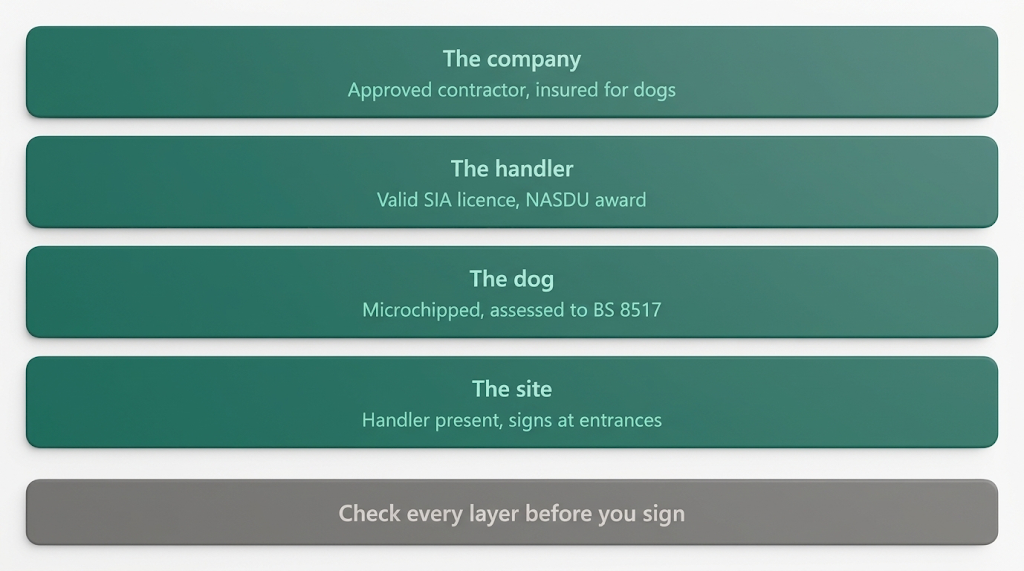
Put those rules together and a compliant K9 deployment has four layers. If one is missing, the whole arrangement is weaker.
Types of K9 security dogs and what they do
Most buyers need a general purpose team. Detection dogs are specialist assets, so ask for one only when your risk assessment calls for it.
| Type | What it does | Typical sites | Standard |
|---|---|---|---|
| General purpose (patrol) dog | Provides a visible deterrent, patrols, searches buildings and open areas, and supports the handler | Construction sites, industrial estates, retail parks, vacant property | BS 8517-1 |
| Detection dog | Finds specific scents such as drugs, firearms or explosives | Events, venues, entry searches, high-risk locations | BS 8517-2 |
BS 8517-1 deliberately excludes detector dogs such as drugs and explosives dogs, which is why detection work has its own code of practice.
How to check a K9 security provider
A glossy brochure proves nothing. Paperwork does. Use this checklist when you compare quotes.
| Check | What good looks like | Red flag |
|---|---|---|
| Handler licence | Valid SIA licence that matches photo ID and the public register | Handler cannot show a licence |
| Dog and handler training | NASDU Level 2 or 3 award, or an equivalent, with current assessment records | “Trained in-house” but no certificates |
| Handler presence | Handler on site, dog under control or secured | Dog left alone in a compound |
| Signage | Warning notice at every entrance | “We will bring a sign next week” |
| Company standing | SIA Approved Contractor, ISO 9001, BS 7858 vetting | No third-party accreditation |
| Insurance | Public liability cover that names dogs | Generic cover with no mention of dogs |
| Welfare | Documented kennelling, vet care and a compliant transport vehicle | Very long shifts, poor kennelling |
| Site planning | Site survey and written assignment instructions | A quote with no site visit |
Five practical tips
- Ask for copies, not promises. Request licence numbers, dog certificates and insurance schedules before the first shift.
- Walk the site together. A competent provider surveys the premises, spots weak points in fencing and lighting, and writes assignment instructions.
- Ask about subcontracting. SIA approved contractors may only subcontract to other approved contractors unless the SIA gives explicit permission, so a long subcontracting chain deserves questions.
- Agree your reporting. Daily logs, incident reports and regular review meetings show whether the service is working.
- Layer your security. K9 teams work best alongside guards, mobile patrols and CCTV, not instead of them.
Three real-world scenarios
These are illustrative examples, not case studies.
The out-of-hours construction site. A contractor in Leeds loses plant and cable every other weekend. A general purpose K9 team patrols after hours, working with the site’s CCTV. Before the first shift, the provider walks the site, writes assignment instructions and fixes warning signs to every gate. The dog is the deterrent, but the paperwork keeps you compliant.
The too-good-to-be-true quote. A warehouse manager in Birmingham is offered a dog on a long chain overnight, with no handler, at a bargain price. That leaves nobody on the premises, which is exactly what the Guard Dogs Act is designed to prevent. The Act applies to anyone who permits the use of a guard dog, so the cheap quote carries a legal risk that lands on you.
The event with a detection need. A venue in Manchester wants entry searches for a late-night event. A detection dog team assessed under BS 8517-2 supports licensed door staff, with a search policy agreed in advance. Specialist dogs plus licensed people plus written procedures make the searches defensible.
What affects the cost of K9 security services
No honest provider can quote without understanding your site. The main factors are:
- Hours of cover and shift pattern
- Number of dog and handler teams
- General purpose or detection capability
- Location, travel and site access
- Site size and risk level
- Notice period for short-term or urgent cover
Ask what each quote includes, such as the vehicle, insurance, kennelling and reporting. The cheapest price often reflects something missing from the compliance layers above.
How GSS Security Services approaches K9 security
At GSS Security Services, we are an SIA Approved Contractor, with BS 7858 vetting and ISO 9001 certification behind our guarding services. Our K9 security service supports patrols, events and high-risk locations, with dogs and handlers trained to detect intruders and illegal substances while staying professional around the public.
We are trusted by over 1,000 organisations. Every contract starts with a site survey and risk assessment, so your cover is built around real risks rather than a fixed package. If dogs are only part of the answer, we can combine them with manned guarding, mobile patrols or security camera installation.
Frequently Asked Questions (FAQs)
Here are answers to the questions we hear most often.
Do security dogs need a licence in the UK?
Not in England, Wales or Scotland, where dog licensing ended in 1987, although microchipping is compulsory. Northern Ireland still requires a dog licence. The handler needs an SIA licence for licensable security work.
Does a K9 handler need an SIA licence?
Yes, when carrying out licensable work such as security guarding under a contract. Ask to see the badge and check it against the SIA’s public register.
Is BS 8517 a legal requirement?
No. It is a voluntary code of practice, but it is the benchmark inspectors use and the best yardstick for comparing providers.
Can a guard dog be left alone overnight?
No. A handler who can control the dog must be present on the premises, and the dog must be under control or secured so it cannot roam.
Do I need warning signs?
Yes. The Guard Dogs Act requires a clear notice at each entrance to premises where a guard dog is used.
What is the difference between patrol and detection dogs?
Patrol dogs deter and search. Detection dogs find specific substances such as drugs or explosives. They fall under different standards, BS 8517-1 and BS 8517-2.
Who is responsible if a dog injures someone?
It depends on the circumstances. Keepers and users can face civil and criminal liability, so take legal advice and make sure your provider’s insurance names dogs.
Final Words
So, do security dogs need a licence? The dog does not, but everything around the dog is regulated: a licensed handler, a lawful deployment, recognised standards and proper insurance. Get those layers right and K9 security dogs become one of the most effective, visible deterrents you can buy. Get them wrong and the risk shifts onto you.
If you are weighing up K9 cover, request a quote or call 0203 599 8122. We will survey your site, explain what we would deploy and why, and show you the paperwork behind it.