
Picture a club landlord who has heard that Martyn’s Law means hiring door staff, buying scanners and finishing a stack of paperwork by Christmas. Almost none of that is true. Yet the rumours are spreading faster than the facts.
Martyn’s Law is the common name for the Terrorism (Protection of Premises) Act 2025. It is real, it is coming, and it will reach far more venues than most owners expect. Acting on the wrong rumours wastes money. Ignoring the right facts leaves real gaps.
We have read the Home Office statutory guidance, the regulator’s own page and the government’s myth buster so you do not have to. Below are seven myths that keep circulating among venue owners, what the official documents actually say, and what to do instead. We also explain where security guard services genuinely help, and where they do not.
Martyn’s Law in Plain English
Martyn’s Law requires the people in charge of certain public premises and events to be ready to keep people safe if an attack happens. It applies across England, Wales, Scotland and Northern Ireland, and the Security Industry Authority (SIA) is the regulator.
Premises are likely to be in scope if they include a building, are mainly used for a listed purpose such as a pub, shop, hotel, gym, hall or place of worship, are not excluded, and can reasonably expect 200 or more people, staff included, at the same time from time to time. Events work differently. They come into scope at 800 or more people when attendees face entry checks such as tickets.
Use this quick flow to find your tier.
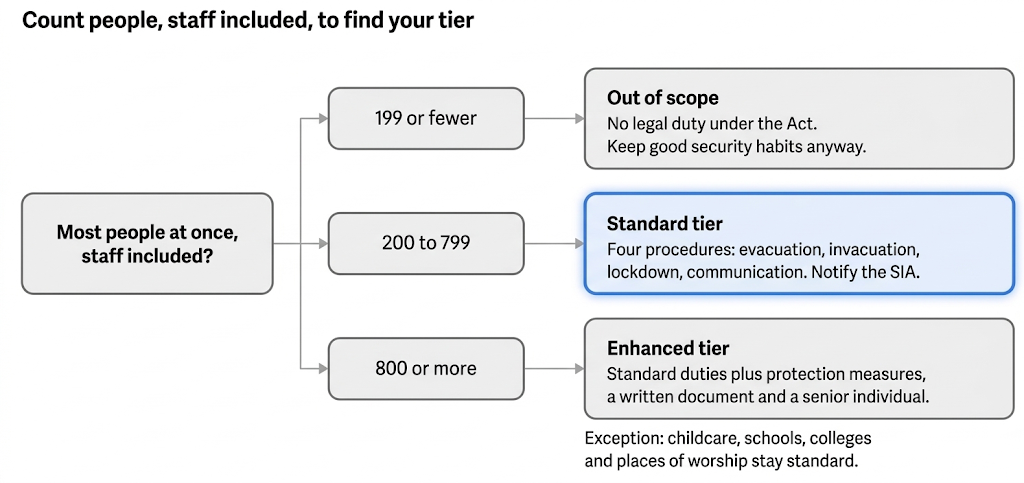
Most venue owners will land in the standard tier, where the focus is on simple, well-practised procedures.
The Seven Myths at a Glance
| Myth | The reality |
| 1. It is already law, so we are in breach | Duties are not in force yet; spring 2027 is expected |
| 2. It only affects stadiums and arenas | Pubs, shops, hotels and halls count at 200 people, staff included |
| 3. Our capacity is the fire certificate figure | It is the number you can reasonably expect, peaks included |
| 4. We must buy kit or hire guards | The standard tier needs procedures, not purchases |
| 5. A security firm takes on our duty | You can delegate tasks, never the legal responsibility |
| 6. The landlord or hirer will deal with it | Whoever controls the premises is responsible |
| 7. A plan in a drawer will do | Staff must know it, and the SIA can inspect |
Myth 1: It is already law, so we are already in breach.
The Act became law on 3 April 2025, but its duties do not bite yet. The SIA expects Martyn’s Law to come into force in spring 2027 and will confirm the exact date. The Home Office myth buster is clear that there is no legal requirement to comply until then. That is not a reason to wait, because the statutory guidance has been public since 15 April 2026.
Here is where things stand.
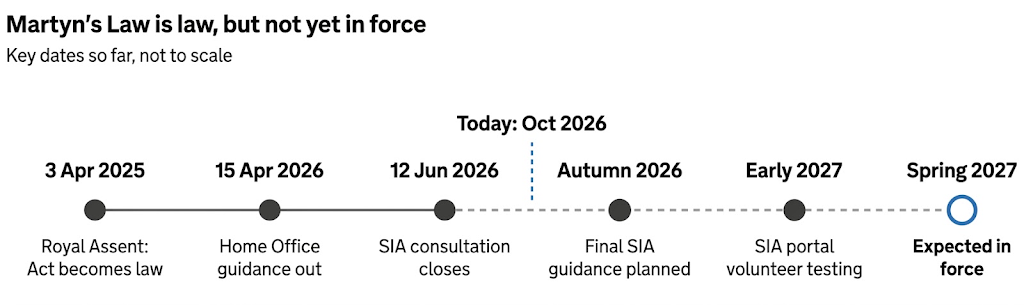
The law exists and the guidance is public, but the duties start only when the commencement date arrives.
Tip: Sign up for SIA updates and book a readiness review for January 2027, so nothing is left to the last month.
Myth 2: It only affects stadiums, arenas and big clubs.
The Act lists 17 kinds of use, including shops, restaurants, gyms, halls, hotels, places of worship, hospitals, schools and visitor attractions. If you can reasonably expect 200 or more people, staff included, at the same time from time to time, you are in the standard tier. Ticketed events at premises not otherwise in scope can be drawn in at 800 or more.
Example: A community hall that hosts a weekly club night and regularly sees 220 people, volunteers included, is in the standard tier, even though nobody would call it a big venue.
Myth 3: Our capacity is whatever the fire certificate says.
The test is how many people you can reasonably expect at once, and it must include staff, contractors and volunteers. It is not a copy of your fire or licence limit. The statutory guidance describes a shop with a safe occupancy of 300 that usually holds far fewer than 200, but has passed 200 several times during sales over three years. Because those peaks are foreseeable, the shop is in scope. A genuinely unforeseeable one-off surge does not draw you in.
Tip: Gather three years of ticket sales, footfall counts and staff rotas, write down your method and keep it. Your method must be evidenced, because the SIA can ask how you reached your figure.
Myth 4: We will need to spend thousands on kit or hire a security firm.
Standard tier premises must have reasonably practicable procedures for evacuation, invacuation, lockdown and communication. The Home Office says there is no requirement to buy physical measures. Its impact assessment put the cost at about £330 a year for standard premises over ten years, mostly staff time, and £5,210 a year for enhanced premises. The Home Office, the SIA and the police counter-terrorism office do not endorse private products, and the government intends that you can comply without buying specialist services.
That does not make guards pointless. Enhanced tier venues must consider measures such as monitoring and movement control, and trained people can be part of them. But useful is not the same as required, so be wary of any supplier who calls a purchase mandatory.
Example: A 250-capacity bar could meet the standard duty with a one-page plan, a staff briefing, clear exit signage and a practised lockdown routine, with spending limited to staff time.
Myth 5: If we hire a security company, the duty becomes theirs
The statutory guidance says the responsible person cannot delegate their legal responsibility to a contracted service provider, although they may delegate tasks. Its own example is a local authority that keeps control of part of a park during a concert. It stays the responsible person even if contractors provide the stewarding and security.
Tip: Write down who does what in the contract: who briefs staff, who secures doors, who calls 999 and who keeps records. Review it at least once a year.
Myth 6: The landlord or the hirer will sort it out
The responsible person is whoever has control of the premises for the use that brings them into scope, usually the occupier who decides who may stay on site. In the Home Office’s pub example, the tenant is responsible, not the brewery that holds the licence. A correction slip dated 6 August 2026 fixed that example, so older summaries may be wrong. In a retail park, each occupier answers for their own unit. People who hire a hall do not become responsible, the operator usually stays so, although hire contracts can include terms about the Act. Where several responsible persons share a building, they must co-ordinate so far as is reasonably practicable.
Tip: Ask your landlord or centre manager for the evacuation and lockdown plans for shared areas now, and add Martyn’s Law terms to your hire agreements.
Myth 7: A plan in a drawer will do, and nobody will check
Staff must know the procedures, understand them and be able to act on them, which usually means some training. The SIA says it will use desk-based assessments and on-site inspections, typically giving at least 72 hours’ notice, and will look at whether you took reasonable steps. It plans to lead with advice, and the Home Office says powers to restrict premises are for exceptional cases with a clear risk of harm. Penalties still exist.
| Tier | Maximum penalty | Daily penalty |
| Standard | £10,000 | Up to £500 |
| Enhanced and qualifying events | £18 million or 5% of qualifying worldwide revenue, whichever is greater | Up to £50,000 |
Example: Imagine a venue whose plan names a manager who left last year and assumes a fire door is open when it is chained shut at night. An inspector would spot both gaps in minutes.
Tip: Run a short drill every quarter, update names and numbers, and keep dated notes of each briefing.
Your Martyn’s Law Action Plan
Whether you are in scope or not, these steps are cheap and sensible. Tick them off as you go.
- Count your people at the busiest times, staff included, and record your method
- Name the responsible person, and a senior individual if you are in the enhanced tier
- Write simple procedures for evacuation, invacuation, lockdown and communication
- Brief and rehearse every member of staff, including part-timers and contractors
- Check contracts with landlords, hirers and suppliers so tasks and responsibilities are clear
- Join the SIA mailing list and get ready to notify the SIA when its online portal opens
Re-check your numbers every year, because attendance changes and a venue can move between tiers or out of scope.
Where Security Guard Services Fit
Martyn’s Law does not require you to hire security guard services. But the duty includes tasks that trained, SIA-licensed officers perform every day, especially on busy nights and at ticketed events. You stay responsible, and officers carry out the tasks you give them.
| Martyn’s Law task | How trained officers can help | Who stays responsible |
| Lockdown and evacuation | Secure and check doors, guide people to exits, support staff in drills | You |
| Communication | Relay instructions, brief guests, liaise with emergency services | You |
| Entry and movement (enhanced tier and events) | Ticket checks, queue and crowd management, access control | You |
| Monitoring (enhanced tier) | Patrols and CCTV monitoring | You |
At GSS Security Services we supply event security, door supervision, manned guarding and mobile patrol officers, and we install security cameras. We are an SIA Approved Contractor, we vet every officer to BS 7858, and we build each contract around a site assessment and written Assignment Instructions. We will not tell you a guard is mandatory. Neither the SIA nor the Home Office endorses any supplier, so treat claims of official Martyn’s Law approval with caution.
Frequently Asked Questions (FAQs)
Here are the answers of your most asked queries.
When does Martyn’s Law come into force?
It is expected in spring 2027. The SIA will confirm the exact date nearer the time, so keep an eye on its updates.
Do schools and places of worship have to comply?
Yes, if they can reasonably expect 200 or more people at once. They are always in the standard tier, even when numbers reach 800 or more.
Do I need to notify the SIA now?
No. Notification only starts once the relevant provisions commence, and the Home Office says the SIA will not charge for them. Standard tier premises tell the SIA who the responsible person is. Enhanced tier premises and qualifying events must also send a document setting out their procedures and measures.
What if my venue holds fewer than 200 people?
You are outside the Act and have no legal duty under it. Good security habits are still worth having, and you should re-check your numbers each year in case they grow.
Do weddings and private parties count?
A private event with invited guests is not a qualifying event, because the public cannot attend. Your venue can still be in scope as premises, and its procedures should cover those events too.
Final Words
Martyn’s Law is not a trap for the unwary, and it is not a reason to panic-buy. It is a plain legal duty to be ready. The venues that cope best will count their people honestly, name who is responsible, write simple procedures and practise them until they are second nature.
If you want a hand with the tasks that sit around that duty, from event crowds to door control and site patrols, talk to GSS Security Services. Call 0203 599 8122, email info@gsssecurities.co.uk or request a quote, and we will shape a plan around your venue.
Related reading: How Technology Is Improving Event Security Guard Services in the UK