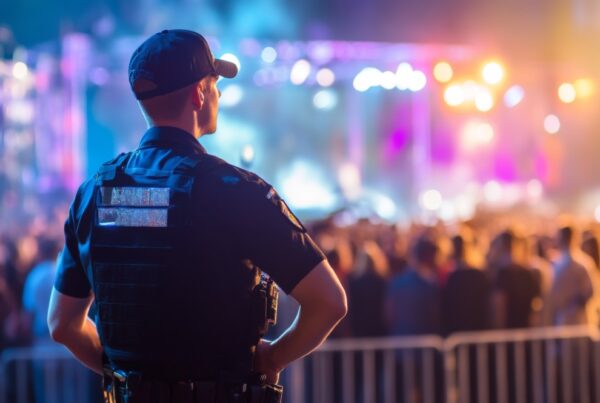
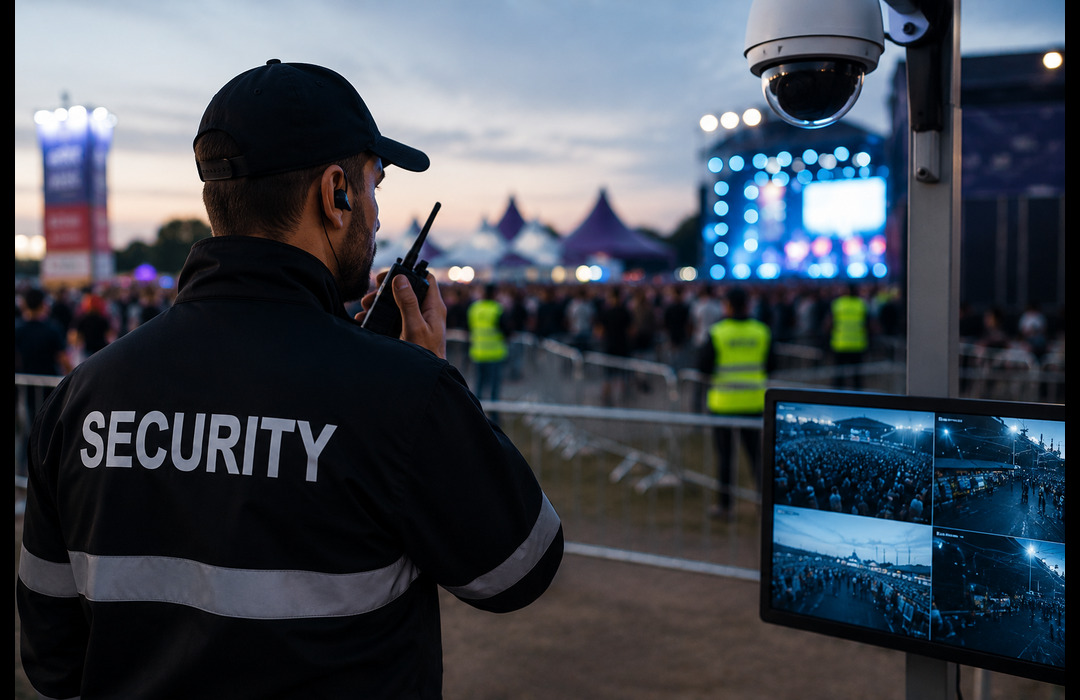
Picture a summer festival field at nine o’clock on a Saturday night. Forty thousand people are spread across six stages, the bar queues are three deep, and the headline act is about to start. Twenty years ago, keeping that crowd safe meant guards on foot, crackling radios, and a lot of educated guesswork. Today, that same field is covered by AI cameras that spot a dangerous crowd surge before it happens, wristbands that track exactly how many people are in each zone, and a control room that sees the whole site on one screen.
This is the quiet revolution happening across event security in the UK. From village fetes to stadium concerts, technology is changing what an event security guard’s job looks like, pushed along by new legislation, rising public expectations, and smarter tools.
In this article, we look at how technology is reshaping event security guard services across the UK, the rules now driving that change, and what it means if you are planning an event of your own.
Why Event Security in the UK Is Changing
For a long time, event security meant guards on the gate, a few radios, and a first aid tent. That is no longer enough for the events UK organisers run today.
Crowds are bigger, and the industry has grown to match them. More than 450,000 people now hold an active SIA licence across the UK, and organisers increasingly need properly trained, technology-literate teams rather than a handful of extra bodies on the door.
Expectations have shifted too. After well-publicised crowd safety failures and terrorist attacks at public venues over the past decade, attendees, local authorities, and insurers all expect a visible, professional standard of protection. UK law is catching up as well, with new rules placing a legal duty on many venues to plan for the worst rather than hope it never happens.
Martyn’s Law: The Legal Backdrop Driving Tech Adoption
You cannot talk about event security in the UK in 2026 without talking about Martyn’s Law.
Formally known as the Terrorism (Protection of Premises) Act 2025, Martyn’s Law received Royal Assent in April 2025. Named after Martyn Hett, one of the 22 people who died in the 2017 Manchester Arena attack, it places a legal duty on venues and events to prepare for a possible terrorist attack.
The Home Office published its statutory guidance in April 2026, and the Security Industry Authority has been confirmed as the regulator. Full enforcement is expected from spring 2027, but organisers are already being asked to show they are prepared.
What This Means for Event Organisers
Martyn’s Law works on a tiered system based on how many people are reasonably expected on site at once.
| Tier | Capacity | What’s Generally Expected |
|---|---|---|
| Standard Tier | 200 to 799 people | Low-cost procedures: staff briefed on what to do, plus clear evacuation and lockdown plans. |
| Enhanced Tier | 800 people or more | Written risk assessments, a named senior compliance lead, and documented access control, monitoring, and vehicle mitigation measures. |
Martyn’s Law at a glance: standard and enhanced tier duties
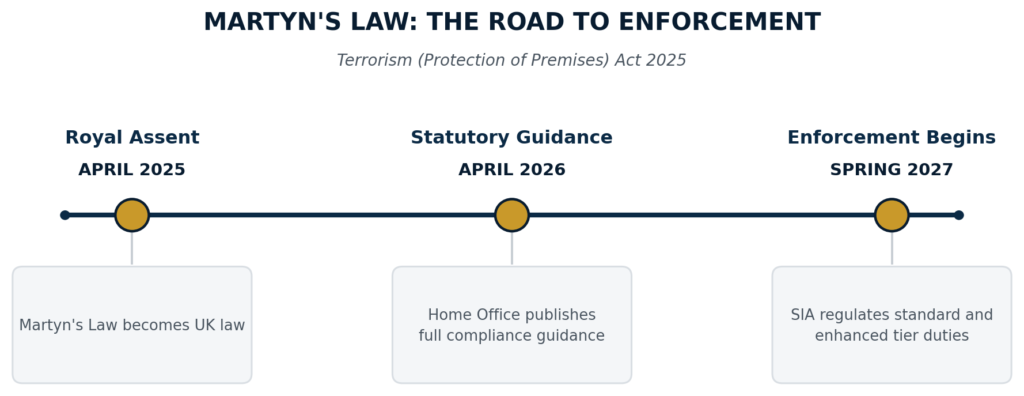
The road to enforcement: Royal Assent to full Martyn’s Law compliance
This is exactly where technology earns its keep. Digital risk assessments, automated monitoring, and searchable incident logs make it far easier to prove, not just claim, that an event met its duties on the day. For a closer look at building that evidence, our guide to conducting a risk assessment for event security guards walks through the practical steps.
The Key Technologies Transforming Event Security
Good event security has always rested on trained people making sound judgement calls. What has changed is what those people can now see, hear, and act on before a problem escalates. Here are the tools doing the heavy lifting.
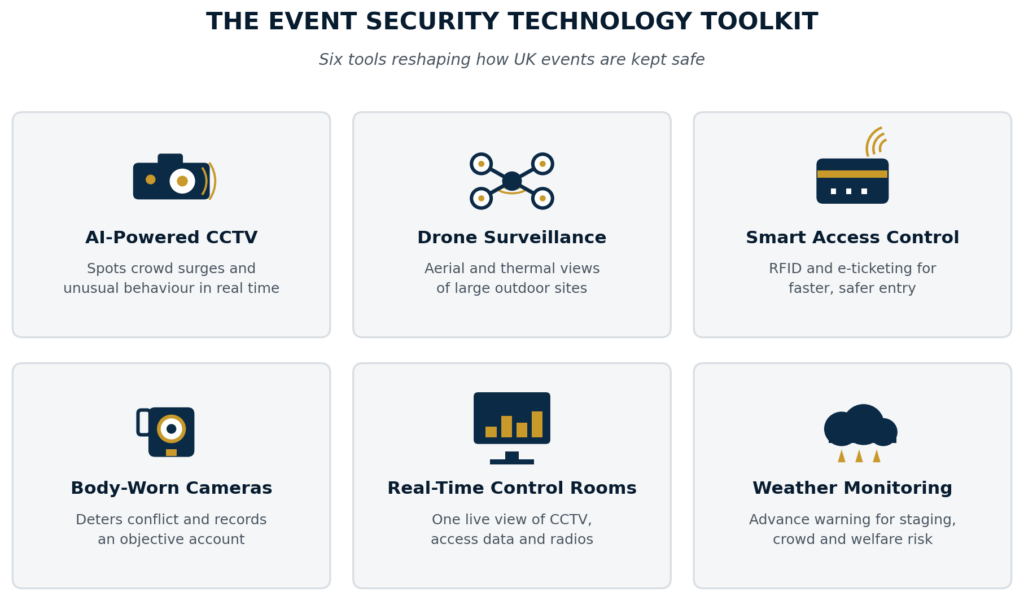
The event security technology toolkit at a glance
AI-Powered CCTV and Crowd Analytics
Modern CCTV no longer just records footage for later. AI-powered systems watch live feeds and flag what a human eye might miss across dozens of screens, such as a crowd building up faster than normal near one exit, or a queue that has quietly stopped moving.
Crowd analytics tools take this further, building a live picture of density across the site. Some systems generate colour-coded heat maps, so an operator can see a zone turning from green to amber before it becomes a genuine crush risk, and redirect stewards in good time.
Drone Surveillance for Large and Outdoor Events
For sprawling outdoor sites, a drone with a good camera does what dozens of extra guards cannot. It gives a clear aerial view of entrances, exits, car parks, and pinch points that ground-level cameras simply cannot reach.
Fitted with thermal imaging, drones come into their own after dark, spotting people in areas they should not be or crowds forming in blind spots. Across a festival site spanning several fields, one operator can give the ground team information that would otherwise take several guards to gather on foot.
Smart Access Control, RFID and E-Ticketing
Queuing at the gate is often an attendee’s first experience of an event, and a badly managed queue creates the exact crowd pressure that a good risk assessment tries to avoid.
RFID wristbands and smart e-ticketing scan in seconds, cut down on forged tickets, and give organisers a live, accurate count of exactly how many people are on site. That live number matters: it is the difference between guessing whether a venue is nearing capacity and knowing for certain.
Facial Recognition: Powerful, But Only When Used Responsibly
Facial recognition is now used at some UK stadiums and large venues to check arrivals against a watchlist of individuals subject to banning orders. Used well, it can flag a known risk at the gate before that person even reaches a steward.
It is also one of the most sensitive technologies on this list. Using it lawfully means carrying out a proper data protection impact assessment, keeping any watchlist tightly controlled, and making sure a trained person, not the software alone, makes the final call on a possible match. A responsible provider can explain how they meet these requirements before a camera is switched on.
Body-Worn Cameras for Frontline Guards
Originally borrowed from policing, body-worn cameras are now standard kit for many event security guards, particularly at busy bars, entry points, and anywhere alcohol is involved.
Their biggest benefit is often the simplest one: people behave differently when they know they are being recorded, so situations are less likely to escalate. When something does happen, the footage gives an objective record for the venue, the police, and the guard involved.
Real-Time Control Rooms and Communication Tools
Every camera, wristband scanner, and drone feed is only useful if the right person sees it at the right moment. Modern event security runs through a central control room that pulls CCTV, access data, and radio communication onto one set of screens.
Digital incident reporting apps have replaced the paper logbook too. A guard can log an issue from a handheld device in seconds, complete with time, location, and photos, giving supervisors a live, transparent picture of the event rather than a summary written up after the doors close.
Weather and Environmental Monitoring
British weather is famously unpredictable, and outdoor events live or die by it. Live monitoring, from wind speed sensors near staging to lightning detection and heat stress alerts, gives organisers advance warning to pause performances or open welfare points before conditions turn dangerous.
Here is how those six technologies stack up at a glance:
| Technology | Primary Benefit | Best Suited For |
|---|---|---|
| AI-powered CCTV | Real-time detection of crowd surges and unusual behaviour | Any event with fixed camera coverage |
| Drone surveillance | Aerial view of large or hard-to-reach areas | Festivals, outdoor sites, car parks |
| RFID / smart access | Faster entry and accurate live headcounts | Ticketed events of any size |
| Facial recognition | Flags known risks against a watchlist | High-profile venues, with strict data controls |
| Body-worn cameras | Deters conflict and records evidence | Bars, entry points, busy queues |
| Control rooms and apps | Combines every data feed into one live view | Multi-zone or multi-day events |
Traditional vs Technology-Enabled Event Security
The table below sums up how far the day-to-day job has moved on.
| Area | Traditional Approach | Technology-Enabled Approach |
|---|---|---|
| Entry and ticketing | Manual ticket checks and paper wristbands | RFID or e-ticket scanning with live capacity counts |
| Monitoring | Guards patrolling on foot, fixed CCTV | AI-analysed CCTV, drones, and live heat maps |
| Communication | Handheld radios only | Radios plus app-based incident reporting and a control room |
| Evidence and records | Handwritten incident logs | Body-worn camera footage and timestamped digital logs |
| Capacity management | Estimated headcounts | Real-time, verified attendance data |
| Compliance | Paperwork filed and reviewed occasionally | Searchable digital records, ready for Martyn’s Law reporting |
Technology in Action: Practical Examples From UK Events
- A city-centre music festival fits RFID wristbands at every gate, feeding a live headcount into the control room. When density near the main stage creeps past a set threshold, stewards are alerted automatically and reroute the queue before anyone feels the crush.
- A corporate conference in central London pairs AI-monitored CCTV at the entrance with SIA-licensed door supervisors checking accreditation. The cameras handle the repetitive job of scanning faces against an attendee list, while guards focus on judgement calls, such as a visitor without the right badge.
- A major UK sporting event, such as this year’s Commonwealth Games in Glasgow, shows the scale this can reach: multiple venues across one city, hundreds of thousands of spectators, and a security operation leaning on AI-assisted surveillance and coordinated monitoring to keep everyone moving safely between sites.
Actionable Tips for Choosing the Right Event Security Partner
Not every provider that mentions “technology” is actually using it well. Here is what to check before you book.
- Ask what technology is actually deployed, not just referenced in a brochure. Request specifics: which CCTV analytics, what access control system, and whether drones are used on site or subcontracted.
- Check SIA Approved Contractor Scheme status and wider accreditations, such as ISO 9001, CHAS, or Constructionline. Together, they signal that a provider’s training, vetting, and management meet a recognised standard.
- Ask about Martyn’s Law readiness. A provider who can talk you through standard and enhanced tier duties for your venue is already ahead of most of the market.
- Confirm data protection practices. If facial recognition or any biometric tool is on the table, ask how they handle impact assessments and watchlist management.
- Look for technology paired with trained people, not technology instead of them. Cameras and sensors flag problems. Experienced guards resolve them.
- Request a site-specific risk assessment before the event, not a generic template reused from the last job.
How GSS Securities Blends Technology with Experienced Guarding
At GSS Securities, we have watched event security shift from a purely physical job into one where technology and trained personnel work as a single team. As an SIA-approved, ISO 9001-certified, and CHAS-registered provider trusted by several organisations, our event security services are built around exactly this combination.
Every event starts with a proper risk assessment and a security plan shaped around your venue, audience, and risk profile, not a generic package. From there, our SIA-licensed guards handle crowd management, access control, and emergency response, backed by the surveillance technology needed to spot problems early. Whether it is a private function, a corporate gala, or a large-scale festival, our aim stays the same: seamless operations that let you focus on the event, while we focus on everyone’s safety.
If your event also needs protecting before or after the big day, our manned guarding and CCTV installation teams can extend that same protection well beyond opening night.
What’s Next for Event Security Technology in the UK
The direction of travel is clear. Expect deeper integration between the tools covered here, with CCTV, access control, and communication systems increasingly sitting on one platform. Compliance software built specifically for Martyn’s Law reporting is likely to become standard for larger venues, turning a paperwork burden into a few clicks.
Crowd analytics will keep improving too, with some developers already experimenting with systems that read crowd mood, not just density, to try to predict problems before they start. None of this replaces the guard on the gate. It simply gives that guard better information, faster, so their judgement goes further than ever.
Frequently Asked Questions
Does technology replace event security guards?
No. Technology is a tool that supports trained guards, not a substitute for them. Cameras and sensors flag potential problems, but a licensed, trained person still makes the judgement call on how to respond.
Is facial recognition legal at UK events?
It can be, but only when used proportionately, with a proper data protection impact assessment, a clear lawful basis, and human review of any match. Reputable providers will explain their process before deploying it.
What is Martyn’s Law and does it apply to my event?
Martyn’s Law is UK legislation requiring venues and events expecting 200 or more people to prepare for a possible terrorist attack. Full enforcement begins in spring 2027, and requirements scale up for events of 800 or more.
Do event security guards in the UK need an SIA licence?
Yes. Most frontline roles, including door supervision and event security, legally require a valid SIA licence, alongside proper vetting and specific training.
Does adding technology make event security more expensive?
Not necessarily. Technology often reduces the number of guards needed to cover the same ground effectively, and it can lower long-term costs by preventing incidents rather than just responding to them.
Final Words
Event security in the UK has moved a long way from a guard, a radio, and a torch. Today’s events are protected by AI cameras that spot trouble before it spreads, drones that watch entire sites from above, wristbands that track capacity in real time, and control rooms that bring it all together on one screen. Martyn’s Law is pushing that shift further still, turning good practice into a legal requirement for tens of thousands of UK venues.
None of this technology works on its own. It is only as good as the trained, licensed people using it, which is exactly why the right partner matters so much.
If you are planning an event and want security that combines the latest technology with genuinely experienced guards, get in touch with GSS Securities for a tailored quote.