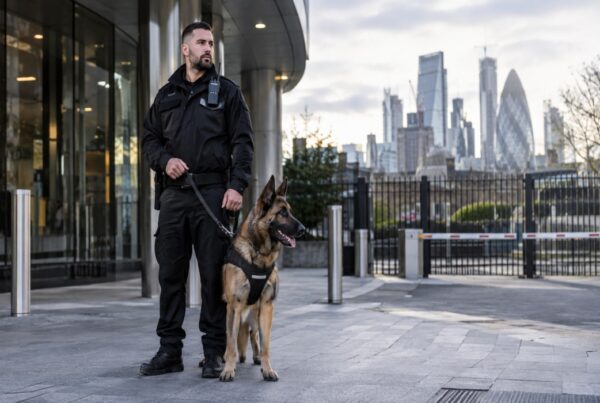
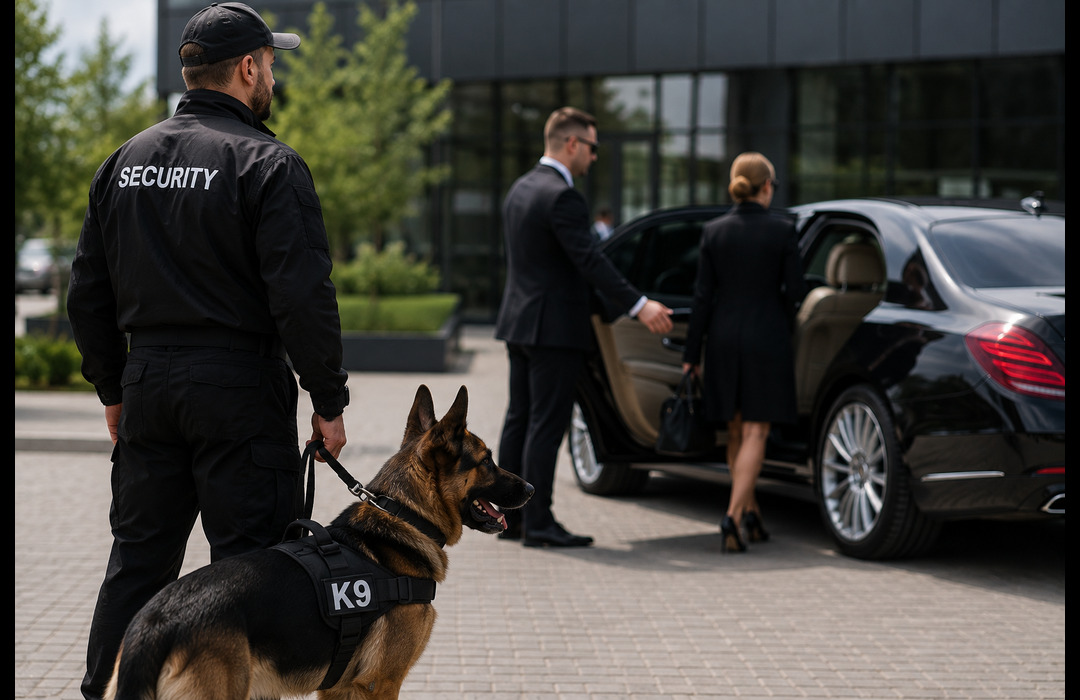
Picture a close protection team moving a high-profile client from a car into a venue. Officers scan the crowd, check the exits, and stay close to the principal at every step. Now picture a dog working that same venue an hour earlier, nose down, checking a car boot or a function room before a single guest has arrived. That is the role K9 security dogs play in VIP protection, and it is why more UK protection teams now build them into the plan rather than treating them as an extra.
VIP protection has always relied on layers: trained people, careful planning, and technology, all working together to keep one person safe. K9 security dogs add a layer that cameras and extra guards on the ground cannot fully replace. In this guide, we will look at why K9 units have become part of serious VIP protection planning in the UK, where they fit into a wider security operation, what UK law expects of handlers, and how to choose a provider you can trust with a principal’s safety.
What Does VIP Protection Actually Involve?
VIP protection, sometimes called close protection or executive protection, focuses on safeguarding a person rather than a building or a site. That person might be a company chief executive, a touring performer, a diplomat, a member of a high-net-worth family, or anyone else whose profile, wealth, or role puts them at greater risk than the general public.
A protection operation usually covers several things at once: route planning, venue checks, close-quarters cover, and a rapid response if something goes wrong. Every one of those tasks depends on early, accurate information. The team needs to know, before the principal arrives, whether a venue is clear, whether a vehicle has been tampered with, and whether anyone nearby poses a risk. That is precisely the gap K9 security dogs are trained to close.
| Quick Facts: K9 Security Dogs at a GlanceA trained dog’s sense of smell is widely reported to be many thousands of times more sensitive than a human’s.A detection dog can search a vehicle or a function room in minutes, work that would take a human team far longer to do thoroughly.A visible K9 unit is one of the strongest deterrents available to a protection team, often stopping trouble before it starts.UK handlers deployed on protection work are generally SIA licensed, alongside their close protection colleagues. |
Why K9 Security Dogs are Becoming Essential in VIP Protection
Human senses are good. A trained dog’s senses are simply better, and in a protection context, sharper senses translate directly into more warning time.
A Sense of Smell Human Guards Cannot Match
Dogs process scent through an enormous network of receptors, with a large part of the canine brain dedicated to interpreting what they smell. In practical terms, a detection dog can pick up traces of explosives, firearms residue, or narcotics that would go completely unnoticed during a visual sweep. Ahead of a private dinner, an awards ceremony, or a boardroom meeting, that gives a protection team a level of assurance a torch and a checklist simply cannot match.
A Visible and Psychological Deterrent
A dog working beside a principal, or patrolling the edge of a property, changes the calculation for anyone thinking about causing trouble. Opportunists and would-be intruders are far less likely to test a location where they can see a working dog and its handler. This deterrent works alongside close protection officers rather than replacing them, giving the whole team a stronger presence without adding extra bodies to the group.
Faster Reaction Than Technology Alone
CCTV and access control are valuable, but they mostly tell you what has already happened or confirm who has walked through a door. A well-handled K9 security dog reacts in real time to something a camera cannot pick up, such as unusual behaviour, a concealed item, or an unfamiliar scent on a vehicle. That immediacy is a large part of what protection teams are paying for when they bring a K9 unit onto a job.
Types of K9 Security Dogs Used in VIP Protection
Not every dog on a protection detail does the same job. Providers typically draw on a small number of specialisms, and understanding the difference helps you brief a provider properly and ask the right questions.
| Dog Type | Typical Breeds | Main Role | Common Settings |
|---|---|---|---|
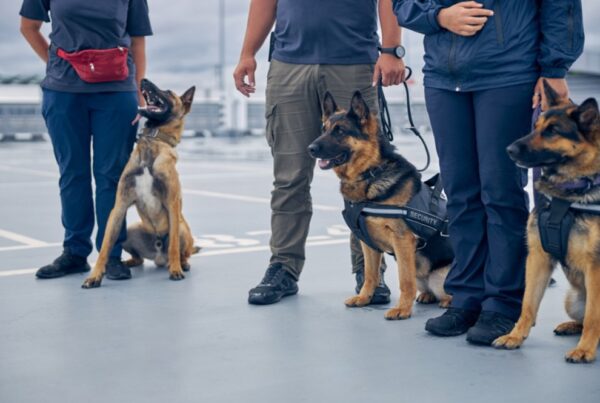
| Protection / Patrol Dogs | German Shepherd, Belgian Malinois, Dutch Shepherd | Perimeter security, handler protection, controlled response to a direct threat | Private residences, motorcade routes, venue perimeters |
| Explosive Detection Dogs | Springer Spaniel, Labrador Retriever, Cocker Spaniel | Sweeping vehicles, venues and luggage for explosive traces before arrival | Red carpet events, conferences, award ceremonies |
| Narcotics Detection Dogs | Labrador Retriever, Springer Spaniel | Screening venues, vehicles and hospitality areas for illegal substances | Private parties, corporate hospitality, hotel suites |
| Search and Escort Dogs | Belgian Malinois, German Shepherd | Building searches ahead of arrival, escorting the principal between secure zones | Corporate offices, hotels, backstage areas |
Many UK providers, GSS Securities included, mix these specialisms depending on the risk assessment for the client or event, rather than sending the same type of dog to every job. If you would like a deeper look at how these roles differ, our guide to Patrol Dogs vs Detection Dogs covers this in more detail.
Where K9 Security Dogs Support VIP Protection in the UK
Private Residences and Estates
For high-net-worth families, a patrol dog covering the grounds overnight, or a detection dog sweeping the property ahead of a private event, adds a layer of security that cameras alone cannot match. Dogs cover open ground quickly and can pick up on an intruder long before they reach the house.
Corporate Events and Executive Functions
Company AGMs, product launches, and board dinners increasingly attract protest activity, uninvited guests, or reputational risk. A detection sweep before doors open, paired with a visible patrol presence, reassures attendees and gives organisers one less thing to worry about. This sits naturally alongside our Corporate Security Services and Event Security, where K9 units are often used as one part of a wider plan.
Public Appearances and Red Carpet Events
Film premieres, award shows, and public appearances put a principal in front of large, largely unscreened crowds. K9 teams working the perimeter and entry points add a layer of screening that keeps the event moving without turning it into an obvious security operation. Discretion matters here almost as much as detection.
Travel, Transport, and Hotel Security
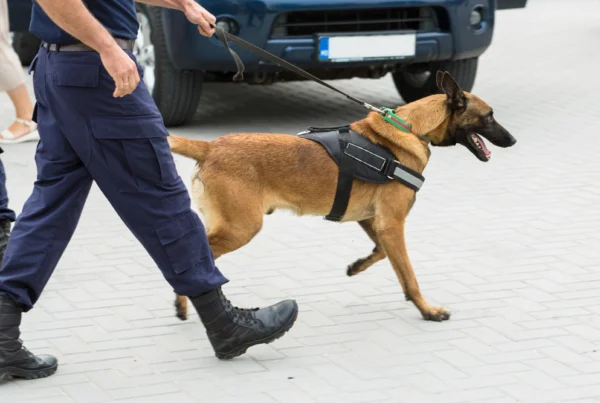
Vehicles, hotel suites, and transit routes are all places a threat could be introduced before a principal even arrives. A quick, professional sweep of a car or a room by a detection dog takes only minutes and closes a gap that would otherwise rely on guesswork.
How K9 Units Fit into a Wider VIP Protection Team
K9 security dogs are rarely the whole answer on their own. They work best as part of a coordinated close protection plan, alongside trained officers, route planning, and venue liaison. A typical VIP protection sequence looks something like this:
Advance Sweep → Arrival & Live Cover → Ongoing Monitoring → Departure Sweep
| Stage | What Happens | Where the K9 Unit Fits In |
|---|---|---|
| Advance Sweep | Venue, vehicles and the route are checked before the principal arrives | Detection dog sweeps rooms, vehicles and access points |
| Arrival & Live Cover | The principal moves through the venue with close protection officers | Patrol dog reinforces the perimeter and entry control |
| Ongoing Monitoring | The event runs, with guests and staff moving around the site | Handler and dog patrol boundaries, watching for anything unusual |
| Departure | The principal leaves via a planned route | Dog and handler sweep the exit route and vehicle one final time |
Handled well, this sequence means the K9 team has already done its job before the officers standing closest to the principal ever need to react to something.
Legal and Welfare Standards for K9 Security in the UK
Anyone hiring K9 security dogs for VIP protection should ask about two things: licensing and welfare.
Handlers working on a UK protection detail generally fall under the Security Industry Authority’s licensing regime, most often the Security Guarding licence, while officers working in direct contact with a principal typically hold a Close Protection licence. A reputable provider will confirm this without being asked twice, and you can check the licence categories yourself on the official SIA licensing guidance, published by the Security Industry Authority.
Welfare standards matter just as much as licensing. Working dogs in England and Wales are protected under the Animal Welfare Act 2006, which places a legal duty on handlers and employers to meet an animal’s needs, including a suitable diet, a proper environment, and freedom from unnecessary suffering. A provider that cannot explain how its dogs are housed, rested, and looked after between shifts is not one to trust with a VIP contract.
Actionable Tips: Choosing the Right K9 Provider for VIP Protection
A poorly matched dog or an inexperienced handler can become a liability rather than an asset on a VIP job. Before you sign a contract, it is worth working through a short checklist:
- Ask for a written risk assessment before the event or contract begins, not after.
- Confirm handler SIA licensing, and ask how long they have worked in close protection or high-profile event settings, not only general site patrol.
- Request references from previous corporate or VIP clients, ideally from a similar type of event to yours.
- Check the provider’s animal welfare policy, including rest periods, transport arrangements, and veterinary care.
- Match the dog to the job. A patrol dog is not a substitute for a detection sweep, and a detection dog is not trained for perimeter defence.
- Ask how the K9 team will communicate and coordinate with your existing close protection officers on the day.
- Confirm insurance and industry accreditation, including membership of recognised bodies such as NASDU.
Frequently Asked Questions
What is the difference between VIP protection and standard event security?
Standard event security focuses on a venue or a crowd as a whole. VIP protection focuses on one person, or a small group, and every decision, from route planning to K9 sweeps, is built around keeping that individual safe.
Do all close protection teams in the UK use K9 security dogs?
No. Many close protection details operate without a dog, particularly for lower-risk assignments. K9 units are typically brought in for higher-profile clients, larger venues, or situations where explosive or narcotics detection is a specific concern.
Are K9 security dogs safe to have around guests and staff?
Yes, when they come from a reputable provider. Professionally trained protection and detection dogs are conditioned for public interaction and worked under close handler control at all times. A good handler will also assess the setting and adjust how visible the dog is, so the deployment fits the tone of the event.
How much does K9 VIP protection cost in the UK?
Costs vary with the number of dogs, the length of deployment, the level of risk, and whether patrol dogs, detection dogs, or both are required. It is best to request a tailored quote based on a proper risk assessment rather than rely on a flat rate.
Can K9 units work indoors, such as at a hotel or private venue?
Yes. Detection dogs regularly sweep hotel rooms, function suites, and offices ahead of a principal’s arrival. Providers plan the timing of these sweeps carefully so they are finished well before guests arrive.
What qualifications should a K9 handler have?
Look for SIA licensing appropriate to the role, documented training records for the dog, and demonstrable experience in close protection or high-profile event settings, rather than general site patrol work alone.
Final Words
VIP protection is ultimately about closing gaps before anyone can exploit them, and K9 security dogs close gaps that people and technology cannot reach on their own. A trained dog’s nose, presence, and speed of reaction give a protection team more warning, stronger deterrence, and greater confidence that a venue, vehicle, or route is genuinely clear.
If you are planning protection for a private client, an executive, or a high-profile event in the UK, it is worth asking whether a K9 unit belongs in the plan rather than treating it as an afterthought. GSS Security Services provides SIA-approved K9 Security Services alongside Event Security and Corporate Security Services, and our team can help you work out exactly where a dog and handler add the most value to your existing plan. Contact GSS Securities today to discuss a tailored K9 protection plan for your next event or assignment.