
Picture a Tuesday morning at a busy secondary school. A Year 10 pupil has a vape in her blazer pocket, bought from an older friend. A teacher catches a sweet, fruity smell in the corridor but cannot trace it. Nothing dramatic has happened, yet everyone feels the same low-level worry.
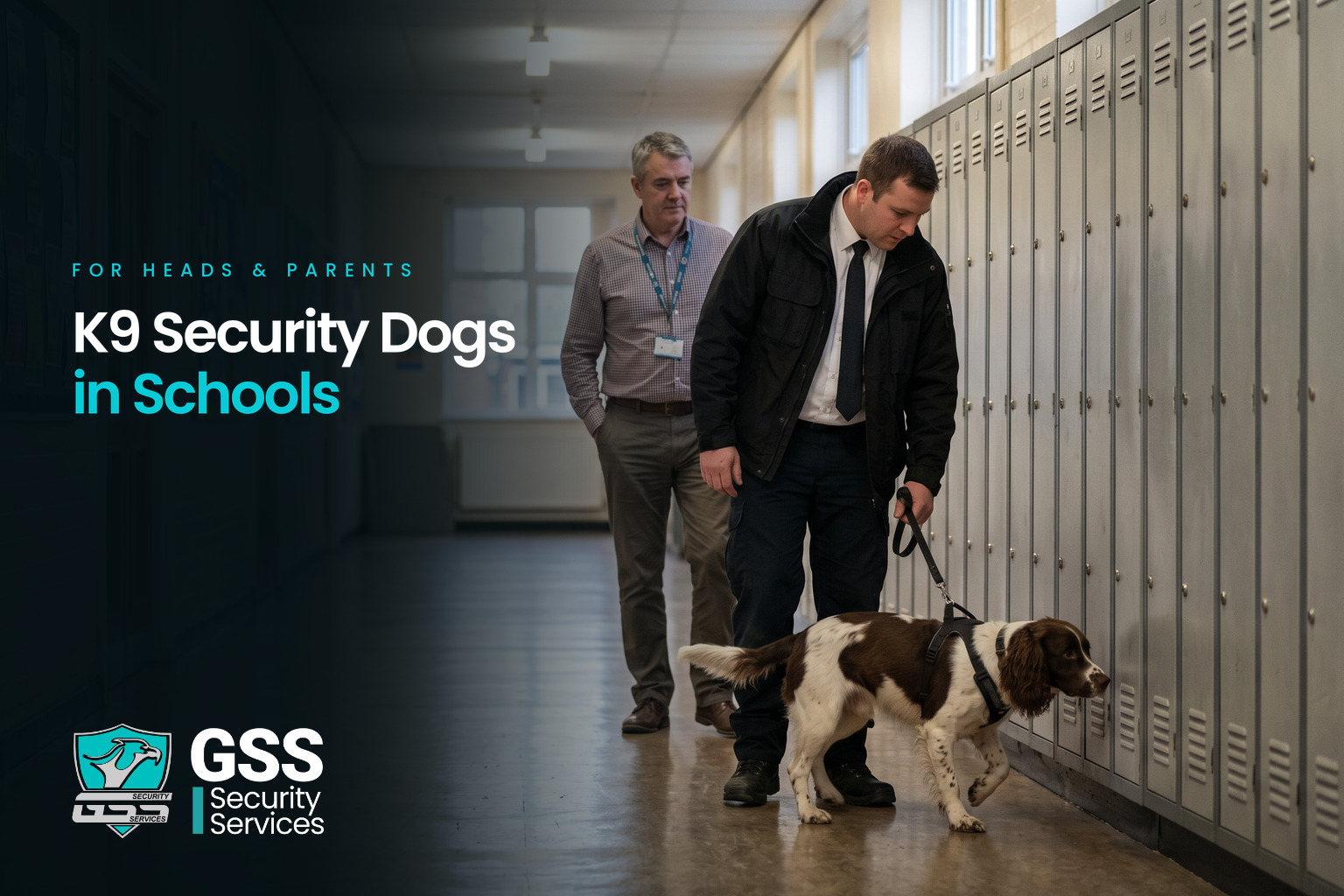
That worry is why more heads are asking whether K9 security dogs belong in schools. The idea is simple: a calm, friendly dog walks the site and signals if it smells a target substance. The reality is more complicated, with legal limits, pupil trust and parental concerns to weigh.
This guide gives heads, governors and parents a straight answer. We cover the latest figures, what the law allows, how detection dogs work, and what a sensible visit looks like.
Why Schools Are Asking About K9 Security Dogs
The numbers are mixed, so read them calmly. The latest NHS England survey, published in October 2024, found that 9% of pupils aged 11 to 15 vape regularly or occasionally, and a quarter have tried it. It also found that 13% had ever taken drugs, down from 18% in 2021, with cannabis the most common at 7%. A separate ASH youth survey for 2025 put current vaping at 5% among 11 to 15 year olds and 12% among 16 to 17 year olds. The surveys use different methods, so treat them as a range. The House of Commons Library notes that 2023 is still the latest data in the NHS series.
Two shifts matter for school leaders. First, single-use vapes have been illegal to sell since 1 June 2025, and ASH reports that only 13% of young vapers now mainly use disposables, down from 42% in 2025. Vaping has not gone away, but the products are changing. Second, vapes and drugs now overlap. A 2024 test of vapes confiscated in English schools found 16.6% contained spice. That is not a national rate, but it explains why heads worry about more than nicotine.

Table 1: Key figures at a glance
| Measure | Figure | Group and year | Source |
|---|---|---|---|
| Current vaping | 9% | Pupils aged 11 to 15, England, 2023 | NHS England |
| Ever taken drugs | 13% (18% in 2021) | Pupils aged 11 to 15, England, 2023 | NHS England |
| Current vaping | 5% (11 to 15), 12% (16 to 17) | Great Britain, 2025 | ASH |
| Vapes containing spice | 16.6% | Confiscated vapes tested, 2024 | Tes |
| Mainly use disposables | 13% (42% in 2025) | Young vapers aged 11 to 17, 2026 | ASH |
What the Law Says About Searching and Sniffer Dogs in Schools
Here is the part many sales pages skip: a detection dog is not a legal power. It sits alongside the search powers schools already hold.
The powers heads hold
Under the DfE’s searching, screening and confiscation guidance (July 2022 PDF), a headteacher, or staff they authorise, can search a pupil’s possessions where they have reasonable grounds to suspect a prohibited item. That list includes illegal drugs, knives and weapons, alcohol and stolen items. A pupil can also agree to a search of anything.
Vapes need a note. The guidance says the tobacco and cigarette papers on the list do not cover e-cigarettes, so schools wanting to search for vapes must name them in their school rules. Searches need a same-sex searcher and a witness, and only outer clothing and possessions may be searched. Only police can carry out strip searches, and parents should always be told when a search for a prohibited item takes place.
Where detection dogs fit
The guidance does not mention detection dogs, so it neither bans nor authorises them. Some schools settle the question in policy. The Ormiston Academies Trust searching policy has a dedicated section on the use of sniffer dogs, and Bryanston School’s policy says the school may authorise their use to search for illegal substances.
Our advice is to treat the dog as a deterrent and screening aid, and to keep every search decision with trained school staff. Because the guidance does not say whether a dog’s indication counts as reasonable grounds, ask your trust or local authority adviser to settle that in writing.
Table 2: Who does what
| Role | Responsibility |
|---|---|
| K9 handler and dog | Sweep the agreed areas and report any indication to the school lead |
| Headteacher or authorised staff | Decide whether to search, following consent, witness and recording rules |
| Designated safeguarding lead | Told of searches for prohibited items, then assesses welfare and next steps |
| Police | Take controlled drugs and carry out any strip search |
The DfE also says a head can require security staff to carry out a search, but a permanent member of school staff must witness it.
How Drug Detection Dogs Work in a School
Here are the simplified working principles of K9 security dogs.
Passive detection, explained
ICTS UK says its school dogs are principally spaniels and labradors, trained to alert passively rather than make a fuss. They are working for a reward toy, not for the drugs themselves. That is very different from a patrol dog, whose job is deterrence and protection, as our patrol versus detection guide explains.
Can K9 security dogs find vapes?
Dogs can be trained on many odours, and some schools have brought one in specifically to deter vaping. City of Norwich School planned a day with a passive deterrence dog in February 2024, alongside assemblies and signposting, and said adaptations would be made for anyone afraid of dogs. The school also said it had no current vaping problem and wanted to act early.
Even so, we found no independent evaluation of how reliably dogs find vapes in schools. Ask any provider for its own training and detection records, and for assessment against BS 8517-2, the standard for detection dogs.
Three ways schools use dogs
K9 Deployment describes pre-term sweeps of boarding houses, classrooms and changing rooms. ICTS UK pairs its dogs with PSHE and drug awareness sessions. Twelve schools in Gosport and Fareham signed up for unannounced visits twice a year. The below graphic shows how any of them should run.
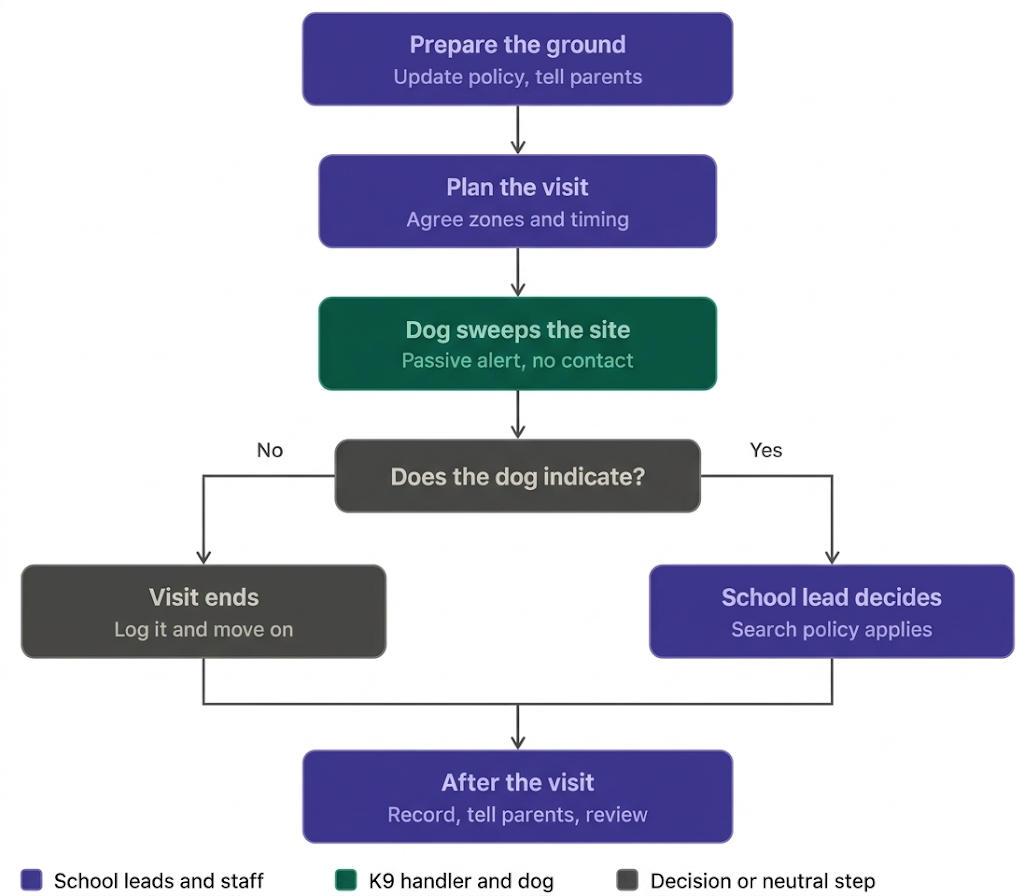
Flowchart of a school K9 visit.
Table 3: Common visit models
| Model | What happens | Best for | Watch out for |
|---|---|---|---|
| Pre-term sweep | Dog searches empty buildings and grounds before pupils return | Boarding houses, lettings | Says little about daily behaviour |
| In-day visit | Dog walks corridors and bag areas | Schools with known supply concerns | Pupil anxiety and trust |
| Visit plus education | Dog visit paired with PSHE or drug awareness sessions | Prevention-first schools | Staff time, quality of content |
What Heads and Governors Should Do First
Treat the dog as one tool in a wider plan. These steps come first:
- Start with evidence. Review confiscations, incident logs and pupil surveys. If you have no problem yet, prevention may fit better than detection.
- Update your policy. Name vapes in your school rules, add a section on dogs, and say what an indication means.
- Tell everyone first. The DfE expects behaviour and search policy to reach pupils, parents and staff.
- Plan for individual needs. Consider pupils with a fear of dogs, allergies, anxiety or autism, and families with religious views about dogs.
- Vet the provider. Check the handler’s SIA licence, BS 8517-2 assessment, insurance that names dogs, and DBS arrangements under KCSIE. Our licensing guide and school security guide explain the checks.
- Record and review. Log every search, and check that searches do not fall unfairly on one group, as the DfE advises.
- Back it with support. Finding a prohibited item may signal a pupil who needs early help, so link every outcome to your pastoral and safeguarding team.
Listen to the critics too. Drug education charity DrugScope has warned that sniffer dogs can break trust and push drug use underground. That criticism is not new, but the trust risk is real, so involve pupils in the plan.
What Parents Need to Know
If your child’s school plans a visit, here is what to expect.
- What the dog does. A detection dog walks the site and sniffs bags and areas. It signals by sitting or freezing. It is not a guard dog.
- What you can ask for. Ask to see the school’s searching policy. The DfE says parents should always be told when a pupil is searched for a prohibited item, and what happened.
- If your child is nervous. Tell the school early and ask what adjustments are available. Ask how it will support pupils, not only punish them.
Talking at home helps more than any dog. Stay calm and ask open questions, such as “What do people at school say about vapes?” Explain that nicotine is addictive, and that an unknown vape could contain something worse, since some confiscated vapes have contained spice. Agree a simple plan: say no, walk away, tell an adult. For facts without judgement, point older children to Talk to FRANK.
How K9 Security Dogs Compare with Other School Security
K9 security dogs work best as one layer. Here is how they compare.
Table 4: School security options
| Measure | Strength | Limit | GSS service |
|---|---|---|---|
| K9 security dogs | Fast sweeps of bags and open areas, visible deterrent | Raises trust and legal questions, vape detection less proven | K9 security service |
| Gate and reception officers | Controls visitors, supports staff, reassures parents | Does not detect substances | Manned guarding |
| Out-of-hours patrols | Checks empty grounds, responds to alarms | Not present during the school day | Mobile patrol |
| Keyholding | Alarm response, secure opening and closing | Reactive | Keyholding |
| CCTV | Evidence at entrances and car parks, and the DfE says footage can inform a search decision | Does not prevent an incident alone | Security camera installation |
Layering matters more than any single measure. Event security can also cover parents’ evenings and lettings.
How GSS Security Services Can Help
GSS Security Services is an SIA Approved Contractor, vets officers to BS 7858 and holds ISO 9001. Our K9 security service uses dogs and handlers trained to detect illegal substances, intruders and other threats while staying professional around the public. Every contract starts with a site survey and risk assessment, so we would talk through what a visit should and should not do at your school before anything is agreed.
If dogs are only part of the answer, we can combine them with manned guarding, mobile patrols or camera installation. Our team is based in London, and we also serve Greater London and the wider region. Related reading: Security Dog Hire in London.
Frequently Asked Questions (FAQs)
Here are answers to the questions we hear most often.
Are sniffer dogs allowed in UK schools?
Nothing in the DfE search guidance bans them, and some schools and trusts include them in policy. Because the guidance does not address them directly, take advice from your trust or local authority before a visit.
Can K9 security dogs detect vapes?
They can be trained to find specific scents, and some schools have tried it. Independent evidence on reliability is limited, so ask providers for their own records.
Will the dog bite or frighten pupils?
Detection dogs are trained to work calmly on a lead and to alert passively. Patrol dogs do a different job. Tell the school about any pupil with a fear of dogs so it can plan adjustments.
Can a school search a pupil because a dog indicates?
The DfE requires reasonable grounds or the pupil’s agreement for a search. Whether an indication meets that test is a question for your legal adviser, so put the answer in policy.
How often should a school use a dog?
There is no standard. Norwich planned a single day, while the Gosport and Fareham scheme planned two visits a year. Match frequency to your evidence and review the impact each term.
Do dog handlers need an SIA licence?
Handlers usually need an SIA licence for licensable security work, alongside dog handling qualifications. Our licensing guide explains the rules.
Final Words
K9 security dogs can help schools deter vapes and drugs, reassure parents and open a conversation about risk. They cannot replace trusted staff, clear policy or good drug education. Schools that get it right start with evidence, follow the DfE search rules, tell families early and judge success by pupil wellbeing, not by the number of finds.
If you are weighing up a visit, GSS Security Services can talk through what is sensible for your site. Call 0203 599 8122, email info@gsssecurities.co.uk or request a quote, and we will survey your school before suggesting any cover.