

If you buy security guarding, a price-review letter may already be heading your way. On 1 April 2027 the National Living Wage rises to £13.21 an hour, and every contract built on a guard’s pay will feel it.
The rise is smaller than the last two, which is welcome. But it lands on a UK security market already coping with frozen tax thresholds, a tight labour pool and new duties under Martyn’s Law.
This article explains what the new rate does to security guard prices, shows the arithmetic, and offers practical ways to control costs without weakening protection.
In short
- The National Living Wage rises 3.9% to £13.21 on 1 April 2027.
- By our calculation, that adds about 66p to each covered hour of a floor-rate guard, or roughly 3% to 4% on a typical charge rate.
- Your own exposure depends on your hours, shift pattern and contract wording.
What is changing on 1 April 2027?
On 28 October 2026 the Government accepted the Low Pay Commission’s recommendations in full, and the National Living Wage for workers aged 21 and over rises 3.9% to £13.21, an extra 50p an hour. Around 2.3 million workers will benefit, and the new rates apply from the first pay period that starts on or after 1 April 2027.
| Rate | From April 2026 | From April 2027 | Rise |
|---|---|---|---|
| National Living Wage (21 and over) | £12.71 | £13.21 | +50p |
| 18 to 20 rate | £10.85 | £11.27 | +42p |
| Under 18 and apprentice | £8.00 | £8.31 | +31p |
Table 1. Sources: GOV.UK and The Employment Law Solicitors.
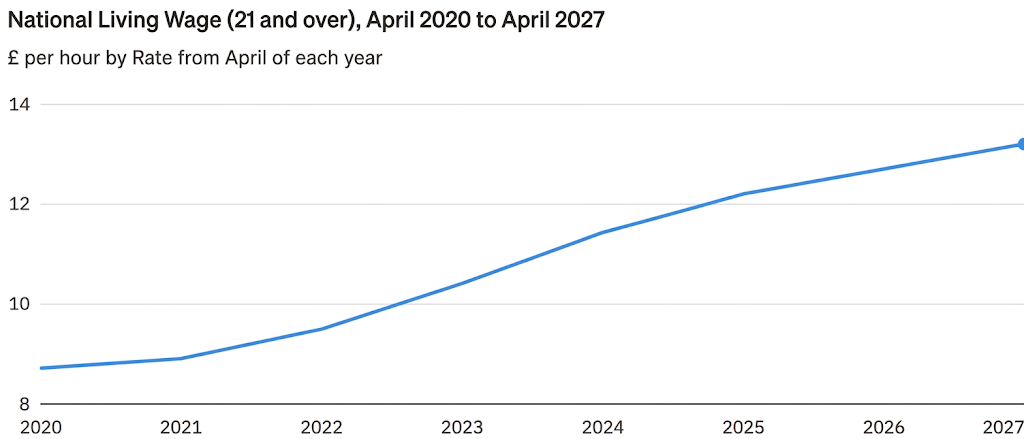
The floor has risen about 51% since 2020 (our calculation from the published annual rates). The two previous rises were bigger: 6.7% in April 2025 and 4.1% in April 2026. So 2027 brings a gentler step, but it follows a steep climb.
Why the UK security market feels wage rises so sharply
The UK security market is worth about £10.1 billion across 6,572 businesses, and it runs on people. For a wider view of demand, read our UK security market trends guide. Four forces make wage rises bite harder here than in most sectors.
Security is sold by the hour
A guard’s time is the product. In IPSA’s costed guarding model, holiday pay was the third highest cost, after hourly pay and employer National Insurance. When the biggest lines move, the invoice follows.
Pay clusters around the floor
The regulator’s 2022 snapshot survey found pay rates were usually the National Living Wage, so the whole market moves when the floor does. IPSA’s consultation also found many in the industry saw the legal minimum as too low for a sustainable business, so its guide costs the Real Living Wage as well.
A frozen threshold adds to the bill
Employer National Insurance stays at 15% on earnings above £5,000 in 2027 to 2028, and the Budget offered no relief on employer costs. With the threshold frozen until 2031, every extra pound of pay carries the full 15%, so a guard’s total cost grows slightly faster than the wage.
Labour is scarce
There are 506,063 active front line SIA licences held by 446,828 people, yet door supervisor licence applications fell by about a quarter in early 2026 compared with a year earlier. When labour is scarce, providers compete on pay, which pushes wages above the legal floor.
What the rise does to an hourly security price
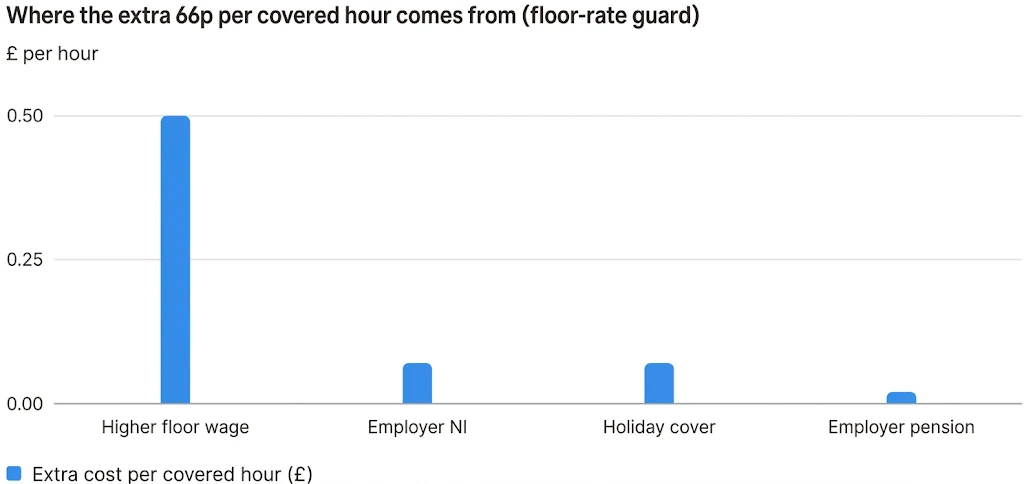
Here is the arithmetic. We modelled one full-time guard on 2,080 paid hours a year, paid exactly the floor rate. We added employer National Insurance, the minimum 3% employer pension contribution and the cover needed because workers are entitled to 5.6 weeks of paid holiday. A post staffed every hour has to pay someone to cover those leave hours too.
| Cost line (per hour) | 2026 to 2027 | 2027 to 2028 | Change |
|---|---|---|---|
| Floor wage | £12.71 | £13.21 | +£0.50 |
| Employer NI (15% above £5,000) | £1.55 | £1.62 | +£0.07 |
| Employer pension (3% of qualifying earnings) | £0.29 | £0.31 | +£0.02 |
| Cost per paid hour | £14.55 | £15.14 | +£0.59 |
| Cost per covered hour, including holiday cover | £16.30 | £16.96 | +£0.66 |
Table 2. Our calculation. It excludes sickness cover, training, vetting, uniform, supervision, insurance, SIA licence fees and margin.
The covered-hour cost rises about 4.1%, slightly above the headline 3.9%.
These are floor costs, not prices. IPSA’s costed minimum for 2025 was £17.54 an hour at the national minimum wage and £18.09 at the Real Living Wage, and its specification included contract management as well as wages. Our security guard costs guide shows how the other layers build up.
So what does 66p do to your rate? If a provider passes on only this wage-related rise, it adds about 3.7% to an £18 rate, 3.3% to £20 and 3.0% to £22 (our calculation). Other costs may justify more, but a letter asking for much more should come with workings.
What it could mean for your annual bill
Multiply the 66p by the hours you buy and you get your likely wage-driven exposure.
| Cover pattern | Covered hours a year | Extra cost excluding VAT | Extra cost including 20% VAT |
|---|---|---|---|
| Weekday day post, 40 hours a week | 2,080 | £1,375 | £1,650 |
| 12-hour nights, seven nights a week | 4,380 | £2,896 | £3,475 |
| 24/7 cover | 8,760 | £5,792 | £6,950 |
Table 3. Our calculation: covered hours multiplied by 66p. Many VAT-registered businesses can reclaim VAT, so check the GOV.UK VAT guidance and speak to your accountant.
A retail unit
A shop trading ten hours a day, seven days a week needs 3,650 covered hours, so a floor-based rise adds about £2,413 a year. Placing officers where theft risk peaks, with CCTV covering the rest, can limit that exposure. Our retail security team begins with a site survey before suggesting hours.
A corporate reception
An office with a ten-hour weekday reception post needs 2,600 covered hours, adding about £1,719 a year. Corporate security can be built around core hours, with out-of-hours risk handled by patrols or keyholding.
A vacant property
A vacant building with a 12-hour static night post carries about £2,896 of wage-driven exposure. Many owners ask whether patrols and keyholding could manage the risk for less. Sometimes they can, and sometimes they cannot, which is why the risk assessment comes first. See our vacant property security service.
Other costs stacking on top of wages
The statutory rate is not the only number to watch.
| Pay basis | Hourly pay | Floor cost per covered hour | Compared with 2027 NLW |
|---|---|---|---|
| National Living Wage, April 2027 | £13.21 | £16.96 | Baseline |
| Real Living Wage, UK | £14.10 | £18.14 | +£1.18 (7.0%) |
| Real Living Wage, London | £15.45 | £19.93 | +£2.97 (17.5%) |
Table 4. Our calculation, using the method in Table 2.
The Living Wage Foundation raised the voluntary Real Living Wage to £14.10 across the UK and £15.45 in London in October 2026. If a tender specifies it, the cost step is far bigger than the statutory rise.
- Employment law: Statutory Sick Pay became payable from the first day of absence in April 2026, and a six-month unfair dismissal qualifying period is expected from January 2027.
- Licensing: The SIA licence fee has been £204 since 1 April 2026, when the £20 rebate ended.
- Martyn’s Law: The SIA will regulate it, and it is expected to start in spring 2027. Demand for compliance-related security may rise just as costs do. Read our Martyn’s Law guide for healthcare sites.
Seven ways to keep security costs under control in 2027
You cannot change the law, but you can change how you buy.
- Ask how the rise will be handled before you sign
Check the review date, notice period and whether the clause passes on only the statutory wage change. An itemised quote should show hours, rate, supervision and VAT.
- Audit your hours against real risk
Use incident logs and footfall data to find hours that no longer earn their keep. Our guide to measuring guard performance lists the KPIs worth tracking.
- Match the service to the site
Static manned guarding suits sites needing constant presence. Mobile patrols and keyholding suit lower-risk sites or out-of-hours cover. For higher-risk sites, K9 units add a strong deterrent.
- Let technology share the load
A well-planned CCTV installation can reduce reliance on static hours. See our CCTV cost guide for typical prices.
- Book short-term cover early
Event security and door supervision often carry night and weekend premiums, so booking ahead gives you time to compare.
- Be wary of rates near the floor cost
At the new floor wage, wages and on-costs alone come to about £17 per covered hour, before overheads and margin. A quote near that figure suggests something is missing, so ask about SIA licensing, BS 7858 vetting and insurance.
- Check credentials
Look for SIA Approved Contractor status. You can see our own entry on the SIA’s approved contractor register.
Frequently Asked Questions (FAQs)
Here are answers to the questions we hear most often.
Will security guard prices rise in April 2027?
Most providers will pass on at least the direct wage cost. By our calculation, that is about 66p per covered hour for a floor-rate guard, or roughly 3% to 4% on a typical charge rate. Fixed-price contracts depend on their review clauses.
Does £13.21 apply to every security guard?
It is the legal minimum for workers aged 21 and over. Guards aged 18 to 20 have a minimum of £11.27. Many guards are paid above the minimum, especially where licences, experience or specialist skills are needed.
What is the difference between the National Living Wage and the Real Living Wage?
The National Living Wage is the legal minimum for workers aged 21 and over. The Real Living Wage is a voluntary rate set by the Living Wage Foundation, at £14.10 across the UK and £15.45 in London from October 2026. Some clients specify it in tenders.
Can my provider raise prices mid-contract?
Only if your contract allows it. Check the price review and notice clauses, and speak to your provider early. We are not lawyers, so take advice on the wording of your own agreement.
Is the cheapest quote the best way to offset the rise?
Rarely. A rate close to the floor cost leaves little room for supervision, training or insurance. Compare what each quote includes before comparing prices.
How can GSS Securities help me plan for April 2027?
We survey your site, assess the risk and quote for the hours you actually need, and we aim to reply within one business day. Call 0203 599 8122 or request a quote online.
Final Words
The £13.21 National Living Wage will not break the UK security market, but it will move prices, and the buyers who plan early will feel it least. For a floor-rate guard, the wage-related cost of each covered hour rises by about 66p. What that means for your invoice depends on your hours, your service mix and your contract wording.
Start this month with three actions: read the price review clause in your contract, compare your hours with your real risk, and ask for an itemised quote that shows the pay assumption behind the rate.
If you would like a second opinion, talk to the GSS Securities team or request a quote. From our London head office we support sites across England and Wales, and we begin every quote with a site survey, so the price reflects your premises, not a standard package.