
You have booked the venue, confirmed the headline act and sorted the catering. Then someone asks the question that stops the planning meeting: “How much will event security cost?”
It is a fair question, and a tricky one. Event security costs in the UK vary widely because no two events carry the same risk. A 150-guest charity dinner needs a very different team from a 3,000-capacity outdoor festival. Yet in both cases, the guards, stewards and search staff you hire will shape how safe, smooth and profitable the day turns out.
This article walks you through event security costs in the UK for 2026 in plain English. You will see typical hourly rates, what pushes a quote up or down, three worked budget examples and the hidden extras that catch organisers out. By the end, you will know how to budget with confidence and what to ask before you sign anything.
What Drives Event Security Costs in the UK in 2026?
Three things set your price: what staff cost to employ, how risky your event is and how much notice you give. Understand all three and any quote becomes much easier to read.
Labour is most of the bill
Wages typically make up 70 to 80% of a guarding contract, so any rise in employment costs reaches your quote fast. The National Living Wage for staff aged 21 and over rose to £12.71 an hour on 1 April 2026. Employer National Insurance now stands at 15% above a £5,000 threshold. Every frontline operative also needs an SIA licence, which costs £204 to apply for or renew. Add training and first aid, and it is easy to see why rates have crept up.
Your event’s risk profile
Risk, not guest numbers alone, decides how many people you need. Alcohol, late finishes, standing crowds, outdoor sites, several entrances and bag searches all push staffing up. Our planning table suggests one security staff member per 100 to 150 guests at a dry indoor event, but one per 50 or fewer on a high-risk night such as New Year’s Eve.
Timing and notice
Autumn and December are peak season, and good teams book up. GSS advises booking three to four months ahead for peak dates. Late requests can cost more or limit your choice, and one London supplier says staff shortages mean it cannot take short-notice door supervisor bookings at all.
Typical Event Security Rates in the UK for 2026
Expect to pay roughly £16 to £22 an hour for a steward and £18 to £30 an hour for an SIA-licensed door supervisor in 2026, before VAT. The table turns that into role-by-role planning ranges.
| Role | Typical charge (£ per hour, excl. VAT) | SIA licence needed? | Typical use at events |
| Event steward | £16 to £22 | No, for guiding and ticket checks | Directing guests, queue help, safety information |
| SIA door supervisor | £18 to £30 | Yes | Entry control, bag and body searches, ejections |
| SIA security officer | £18 to £25 | Yes | Site guarding, build and breakdown, overnight cover |
| Team leader or supervisor | £24 to £35 | Yes, usually | Briefings, radio control, incident lead |
| K9 detection or patrol team | £25 to £45 | Handler is licensed | Screening at entry, perimeter deterrence |
Planning ranges combine GSS’s published rate guides for door supervisors and guards and K9 teams with current UK pay advertisements. London, nights and short-notice bookings sit towards the top. Treat them as a starting point, not a quote.
Why the charge is higher than the wage
Advertised pay for event stewards runs from about £12.50 to £15 an hour, with G4S and Showsec listings in that band. SIA door supervisors are advertised at roughly £15 to £20, according to Get Licensed. But pay is not what you pay.
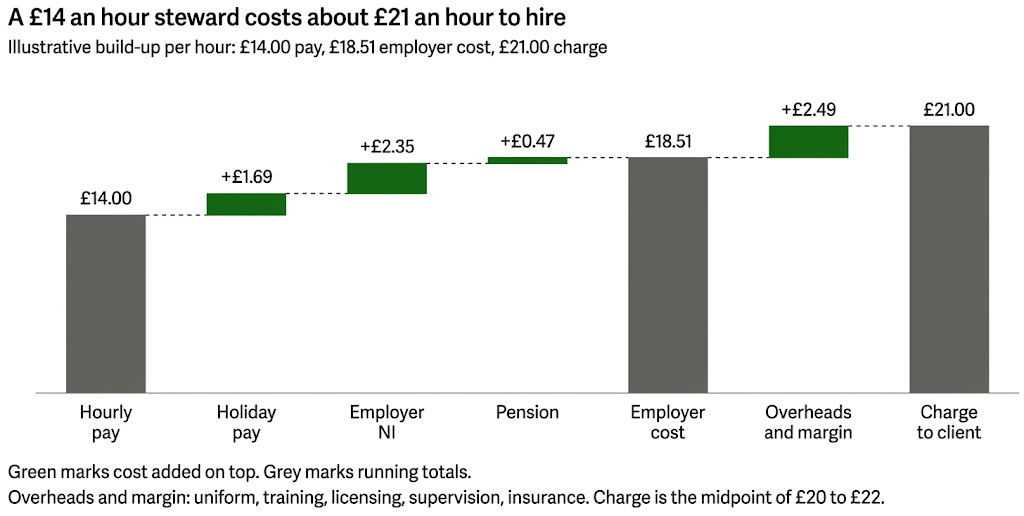
Take a steward on £14 an hour. Holiday pay, employer National Insurance and a pension contribution lift the employer cost to about £18.50. Uniform, training, licensing, supervision, insurance and a sustainable margin then bring a realistic charge to £20 to £22. For a public benchmark, one university events office charges £21 an hour for stewards from 1 August 2026.
Minimum shifts and premium hours
Most providers bill per person per hour with a minimum booking. One London supplier sets a six-hour minimum for door supervisors. Nights, bank holidays and short-notice dates can carry a premium, so ask for a rate card that matches your exact hours.
Guards, Stewards and Search: Who Does What at an Event?
Each role has a different job, a different licence position and a different price. Mixing them up is the quickest way to overspend or fall short of the law.
Stewards: guidance, not security
Stewards guide guests, check tickets, share safety information and keep queues moving. Event guidance says they do not need an SIA licence as long as they only check tickets or guide the public. They are your lowest-cost option for those tasks, but they cannot stand in for licensed staff.
Door supervisors and guards: control and response
Anyone contracted to guard against unauthorised access or disorder, search people or bags, or remove guests needs an SIA licence, as SIA events guidance explains. At licensed events that means a door supervisor licence, and elsewhere a security guard licence. Door supervisors handle entry, conflict and ejections. Security officers, through manned guarding, cover the site itself, including build, breakdown and overnight hours.
Search teams: the cost organisers forget
Search needs more than people. A bag-search lane processes guests slowly, so an event with full bag searches may need far more staff on the gates than one with a visual check. Add tables, signage, hand-held wands and a clear bag policy to the plan. Searchers must hold an SIA licence, so price them as licensed security staff, not stewards.
K9 teams where screening matters
Detection dogs can help screen guests at entry points without slowing queues too much, and they add a visible deterrent. GSS supplies K9 security teams, which typically cost £25 to £45 an hour for a handler and dog.
How Event Type Changes Your Security Budget
Front-line security costs from about £1.30 a guest at a daytime conference to £6.50 on New Year’s Eve, using staffing ratios from GSS’s planning table.
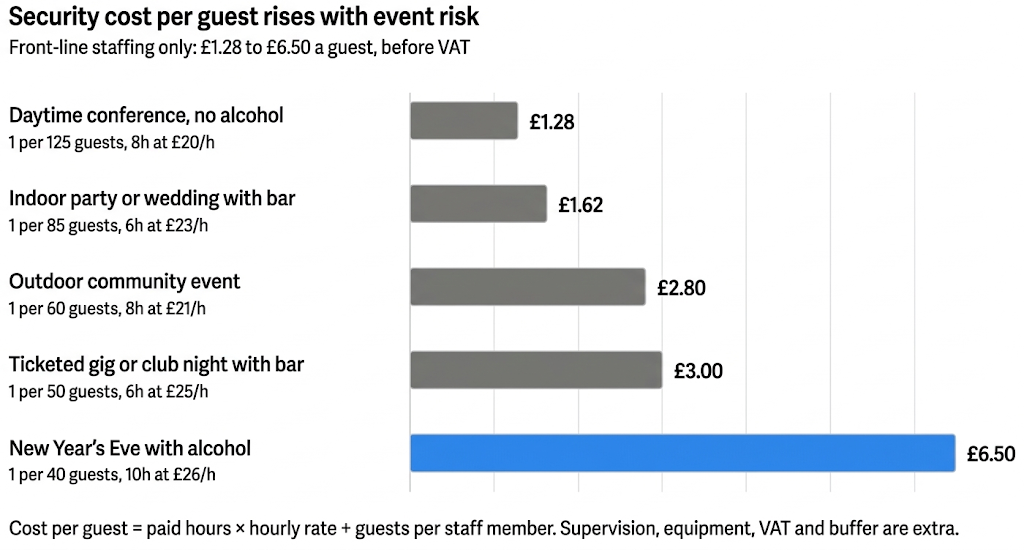
Alcohol, standing crowds, late finishes and tighter ratios drive the climb. These figures cover front-line staff only. Supervision, equipment, VAT and a buffer typically add 50% to 75%, as the worked examples below show.
How to Build Your Event Security Budget, Step by Step
Start with risk, then work out people, hours and extras. Here is a simple seven-step method any organiser can follow.
- Run a risk assessment. Note capacity, alcohol, finish time, entrances, site type and guest profile. GSS’s guide to event security risk assessments is a useful starting point.
- Set a first headcount. Use ratios as a baseline: one per 100 to 150 guests for dry indoor events, one per 50 to 75 outdoors and one per 50 or fewer for high-risk nights. Then adjust for layout and searches.
- Split the roles. Decide which tasks need an SIA licence (entry control, search, ejections) and which a steward can do.
- Count paid hours, not event hours. Add briefing, setup, breakdown and any minimum shift. A six-hour party often means seven or eight paid hours.
- Multiply. Staff × paid hours × hourly rate gives your core cost. Then add supervisors and equipment.
- Add VAT and a buffer. Add 20% VAT unless you can reclaim it, then around 10% for overruns and extra staff.
- Compare like with like. Send every supplier the same brief and ask for itemised quotes.
Worked Examples: What Three UK Events Might Pay
A 150-guest charity dinner can be secured for around £560, while a 3,000-guest outdoor day event runs to roughly £17,300 once VAT and a buffer are included. The table shows how each total is built, using mid-range rates from the table above.
| Budget line | A: 150-guest charity dinner (indoor, bar) | B: 800-guest ticketed gig (indoor, bar) | C: 3,000-guest outdoor day event |
| SIA door supervisors | 2 × 6h × £22 = £264 | 10 × 8h × £23 = £1,840 | 20 × 10h × £22 = £4,400 |
| Stewards | 1 × 6h × £18 = £108 | 4 × 8h × £19 = £608 | 30 × 10h × £18 = £5,400 |
| Team leaders | None | 2 × 8h × £28 = £448 | 5 × 10h × £28 = £1,400 |
| Overnight site guarding | None | None | 2 × 10h × £20 = £400 |
| Radios, search kit, barriers | £50 | £350 | £1,500 |
| Subtotal before VAT | £422 | £3,246 | £13,100 |
| VAT at 20% | £84 | £649 | £2,620 |
| Buffer at 10% | £51 | £390 | £1,572 |
| Total | £557 | £4,285 | £17,292 |
| All-in cost per guest | £3.71 | £5.36 | £5.76 |
Illustrative planning figures, not quotes. Example B assumes a premises licence is in place. First aid, medical cover and traffic management are separate lines.
Notice how the cost per guest rises with the risk. Standing crowds, alcohol and bag searches need more people per guest than a seated dinner, and that is where most of the budget goes.
Hidden Event Security Costs Organisers Often Miss
The hourly rate is only part of the bill. Budget for these extras too.
- Setup and breakdown hours. Staff arrive before doors and leave after the last guest, so paid hours often exceed event hours.
- Minimum shifts and cancellation terms. Suppliers set minimum bookings, and one university events office charges the three-hour minimum for late cancellations. Read the terms before you sign.
- Overnight site cover. Staging, bars and kit left between build day and show day need guarding.
- Premium hours. Nights, bank holidays and December dates often cost more.
- Other safety roles. First aid, medical cover, traffic management and fire marshals are usually separate lines, not part of security rates.
- Martyn’s Law preparation. The law is not yet in force, but organisers of events and venues with a capacity of 200 or more should start planning. Allow time for risk assessment, staff briefings and record keeping. GSS explains how trained staff support preparation.
Practical Ways to Save on Event Security Without Cutting Corners
You lower event security costs by buying more precisely, not by buying less safety.
- Book early. Three to four months ahead for peak dates widens your choice and avoids short-notice premiums.
- Let the risk assessment set the numbers. A documented assessment shows where each person is needed and why.
- Use stewards for non-licensable tasks. Wayfinding and ticket checks do not need an SIA licence. Keep licensed staff on entry control and search.
- Match shifts to the crowd. Put more people on at arrival and exit and fewer in the quiet middle, rather than a flat team all night.
- Cut entry friction. Publish a bag policy, use online ticketing and stagger arrival times. Fewer bags mean faster lanes and fewer search staff.
- Ask about repeat bookings. If you run a series of events, agree a fixed rate across the dates.
- Distrust the bargain. Wages, tax and licences set a floor, so a quote far below the rest usually means corners are being cut somewhere.
How to Choose an Event Security Provider and What to Ask in Your Quote
A good quote tells you who is turning up, what they will do and exactly what you are paying for. Before you sign, check these points.
- Accreditation. Look for SIA Approved Contractor Scheme status, and check individual licences on the SIA register.
- Itemised pricing. Roles, hours, hourly rates, VAT and extras should each appear as a line.
- Event experience. Ask for examples and references from events of a similar size and risk.
- Briefing and site visit. Staff should know your layout, exits and escalation routes before doors open.
- Insurance. Confirm public liability cover that suits your venue and licence conditions.
- Support. You want a named contact and a team reachable on the day.
GSS Security Services is an SIA Approved Contractor, ISO 9001 certified, and vets every officer to BS7858. Its event security team builds each quote from a site and risk assessment instead of a fixed package, and aims to reply to quote requests within one business day.
Frequently Asked Questions (FAQS)
Here are answers to the questions we hear most often.
How much does event security cost per hour in the UK in 2026?
Plan on roughly £16 to £22 for a steward and £18 to £30 for an SIA door supervisor, before VAT. Team leaders and K9 teams cost more. London, nights and short notice sit at the top of each range, so always request a written quote.
How many security staff does my event need?
It depends on risk. GSS’s planning table suggests one per 100 to 150 guests for dry indoor events, one per 75 to 100 with alcohol, one per 50 to 75 outdoors and one per 50 or fewer on high-risk nights. A risk assessment fine-tunes the figure.
Do event stewards need an SIA licence?
Not if they only guide guests and check tickets. Anyone contracted to guard against unauthorised access, search people or bags, or remove guests needs one: a door supervisor licence at licensed events, or a security guard licence elsewhere.
Is VAT included in event security quotes?
Security services normally attract 20% VAT, and many quotes show prices excluding it, so check. VAT-registered organisers may be able to reclaim it.
How far ahead should I book event security?
Aim for three to four months ahead for peak dates such as December. Shorter notice may be possible, but it can cost more or limit your choice of staff.
Does Martyn’s Law apply to my event?
It covers qualifying venues and events with a capacity of 200 or more, with extra duties from 800, and it is not yet in force. Weddings and private staff events generally fall outside it, but read the Home Office guidance for your own case.
How do I get an event security quote from GSS Securities?
Call 0203 599 8122, email info@gsssecurities.co.uk or use the quote form on the event security page. We review your venue and risks, then send a tailored, customised plan.
Final Words
Event security is not the place to find savings you cannot defend. The smart move is to control the number without weakening the plan: assess your risk, separate licensed and unlicensed roles, count paid hours and keep a buffer for the unexpected.
Do that, and your 2026 event security budget becomes a clear set of lines you can explain to a finance director, a licensing officer or a sponsor. Whether you are running a 150-guest dinner or a 3,000-guest day event, the same principles hold.
If you would like a figure built around your own venue, date and guest list, GSS Securities can help. Its SIA-licensed, BS7858-vetted teams cover crowd management, access control and emergency response for events of every size.
Get your free event security quote or call 0203 599 8122.