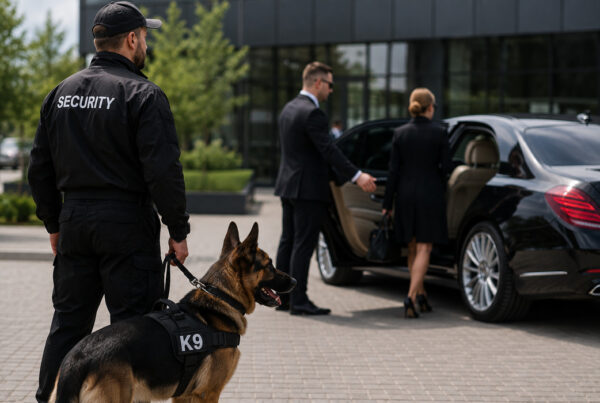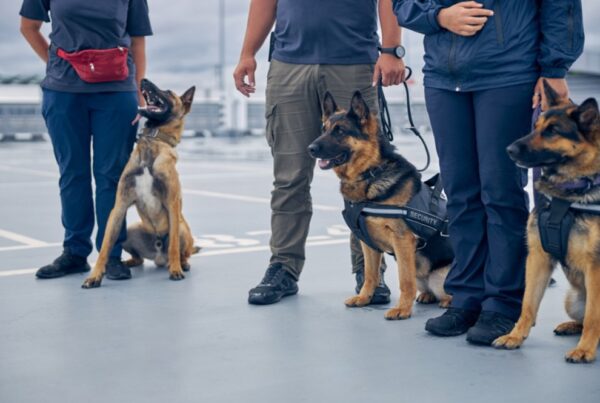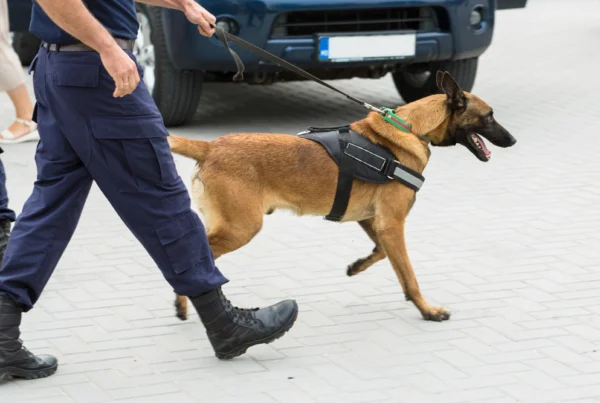

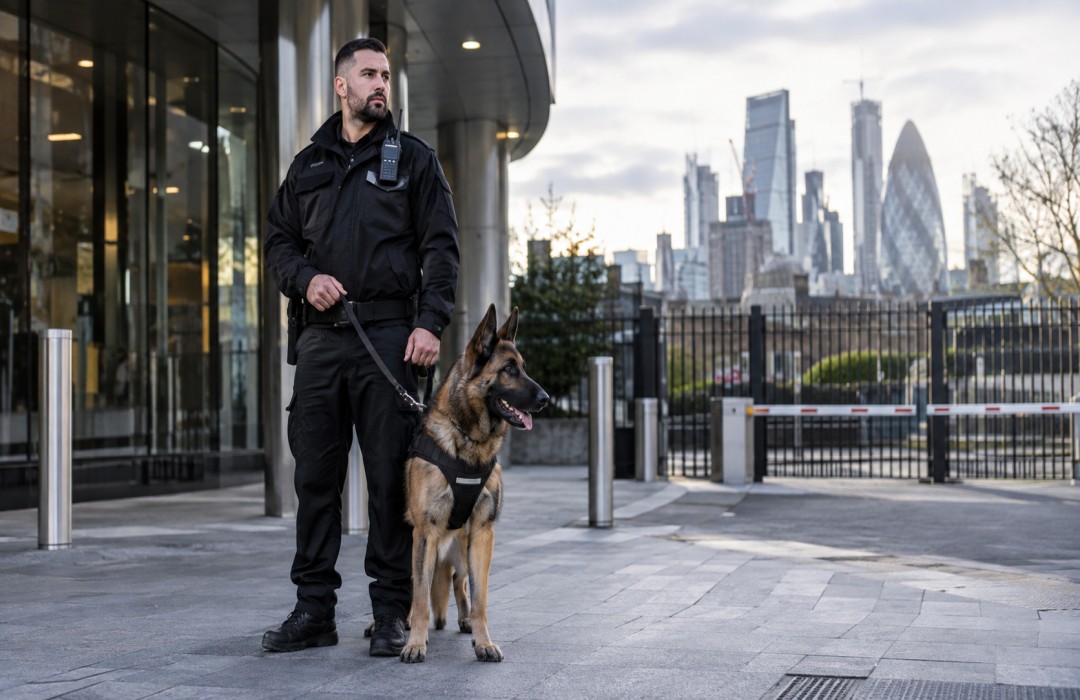
Walk past a construction site in Stratford after dark, or a distribution yard in Park Royal in the small hours, and you might catch a glimpse of a handler and dog working the perimeter together. K9 security dogs have moved from a niche add-on to a mainstream part of how London businesses protect their sites, stock and staff.
Hiring one is not as simple as calling a kennel and asking for the biggest dog available. There are legal duties, welfare standards and real differences between the dogs on offer, and getting it wrong can leave you exposed rather than protected. This article walks through everything a London business needs to know before hiring a K9 security dog service, from the law to the cost to the questions worth asking before you sign anything.
In this article, you will find:
- What K9 security dogs actually do, and the difference between patrol and detection dogs
- Where London businesses use them, with practical examples
- The legal and welfare rules that apply to security dog hire in the UK
- What K9 security dog hire typically costs in London
- How to choose a provider you can trust, and what to expect once you sign up
Why More London Businesses are Hiring K9 Security Dogs
London’s security landscape has shifted. Retail theft, break-ins on vacant sites and out-of-hours vandalism have pushed many businesses to look beyond CCTV and static guarding alone. A camera records an incident after it happens. A trained security dog often prevents one from happening at all.
The logic is straightforward. A dog’s sense of smell and hearing outperform a human’s by a wide margin, so a K9 security dog will usually detect an intruder long before a guard on foot does. Just as importantly, the sight of a working dog on patrol is one of the strongest deterrents the security industry has. Most trespassers simply choose an easier target instead of testing their luck.
For businesses with large or complex sites, such as construction yards, distribution centres or multi-building estates, one handler and dog can often cover ground that would otherwise need two or three static guards. That is why K9 security dogs are increasingly used alongside a wider security plan rather than as a replacement for it.
What are K9 Security Dogs?
“K9 security dogs” is the term used across the private security industry for professionally trained dogs, working alongside a licensed handler, deployed to protect property, people and premises. They fall broadly into two categories, and knowing the difference matters when you decide what your business actually needs.
Patrol Dogs
Patrol dogs, sometimes called general-purpose security dogs, are trained to deter, detect and, where necessary, help contain intruders. Breeds commonly used include German Shepherds, Belgian Malinois and Dobermans, chosen for their intelligence, stamina and commanding presence. You will typically find patrol dogs working construction sites, vacant properties, industrial estates and large events, anywhere a visible deterrent is the priority.
Detection Dogs
Detection dogs work differently. Rather than deterring through presence, they use their sense of smell to search for something specific, most often drugs, explosives or weapons. Springer Spaniels and Labrador Retrievers are common choices, prized for their focus and reward-driven work ethic. Detection dogs suit corporate events, venues, schools and any site where screening matters more than perimeter defence.
| Feature | Patrol Dogs | Detection Dogs |
|---|---|---|
| Main purpose | Deterrence and perimeter protection | Searching for specific substances |
| Typical breeds | German Shepherd, Belgian Malinois, Doberman | Springer Spaniel, Labrador Retriever |
| Best suited to | Construction sites, vacant properties, industrial estates | Events, offices, schools, transport hubs |
| Working style | Visible patrol, active response | Systematic searching, passive or active indication |
| Public interaction | Limited, kept at a controlled distance | Often works close to people and bags |
Where K9 Security Dogs are Used Across London
London’s mix of construction booms, retail pressure and vacant commercial stock creates plenty of scenarios where a K9 unit earns its keep. The table below sets out some of the most common examples.
| Business Type | Typical Risk | How K9 Security Dogs Help |
|---|---|---|
| Construction sites | Plant and cable theft, break-ins overnight | Overnight patrol deters opportunistic theft when human guards are stretched thinnest |
| Vacant properties | Squatting, vandalism, fly-tipping | Regular patrols show a property is actively managed, not abandoned |
| Warehouses and logistics | Perimeter breaches, cargo theft | One handler and dog can cover a large site more efficiently than several static guards |
| Retail and hospitality | Shoplifting, antisocial behaviour | A visible dog on site is a strong deterrent during busy trading periods |
| Events and venues | Prohibited items, unauthorised access | Detection dogs screen efficiently at entry points without slowing queues too much |
Many providers, including established security dog services in London, combine K9 patrols with mobile patrol visits or manned guarding, so the dog is never working in isolation but as part of a layered plan.
The Legal Side of Hiring Security Dogs in London
This is the part many businesses skip, and it matters more than any other section in this guide. Using a security dog in the UK is governed by several pieces of legislation, and a responsible provider should be fluent in all of them.
Under the Guard Dogs Act 1975, a trained handler capable of controlling the dog must be present at all times the dog is guarding a premises, and warning signs must be clearly displayed. A dog cannot simply be left to roam a site unsupervised. The Animal Welfare Act 2006 places a duty of care on the handler and provider to look after the dog’s welfare, covering everything from rest periods to living conditions. The Dangerous Dogs Act 1991 sets out the consequences if a dog is allowed to become dangerously out of control, which is why proportionate, well-supervised deployment matters so much.
There is no separate SIA licence specifically for dog handling. Instead, handlers carrying out licensable security work need the relevant SIA licence, most commonly a Security Guarding or Door Supervision licence, alongside recognised dog-handling training, usually mapped to the British Standard BS 8517-1 for general-purpose security dogs. When vetting a provider, ask to see both the handler’s SIA licence and evidence of their dog-handling qualification.
Insurance is worth checking closely too. Standard public liability policies do not always cover incidents involving a working dog, so ask whether a provider’s insurance explicitly names K9 operations.
| Law or Standard | What it Covers |
|---|---|
| Guard Dogs Act 1975 | Requires a capable handler present at all times and warning signage clearly displayed |
| Animal Welfare Act 2006 | Sets the duty of care for the dog’s health, wellbeing and living conditions |
| Dangerous Dogs Act 1991 | Covers offences where a dog is allowed to become dangerously out of control |
| BS 8517-1 | Industry standard for training, welfare and deployment of general-purpose security dogs |
| SIA licensing | Handlers need the relevant frontline SIA licence for the guarding activity they perform |
| Quick tip: Ask any prospective provider for their handler’s SIA licence number and check it on the SIA public register before you sign anything. |
How Much Does K9 Security Dog Hire Cost in London?
Pricing varies with risk level, site size, shift pattern and how long you need cover, but as a general guide, London businesses should expect K9 security dog hire to sit above national average security rates, reflecting the specialist training involved and London’s wider security wage premium.
| Service | Typical Hourly Rate (excl. VAT) |
|---|---|
| Static SIA-licensed guard | £18 to £25 |
| Mobile patrol visit | £30 to £45 per visit |
| K9 security dog and handler | £25 to £45 |
| Close protection / VIP K9 team | £45 to £80 |
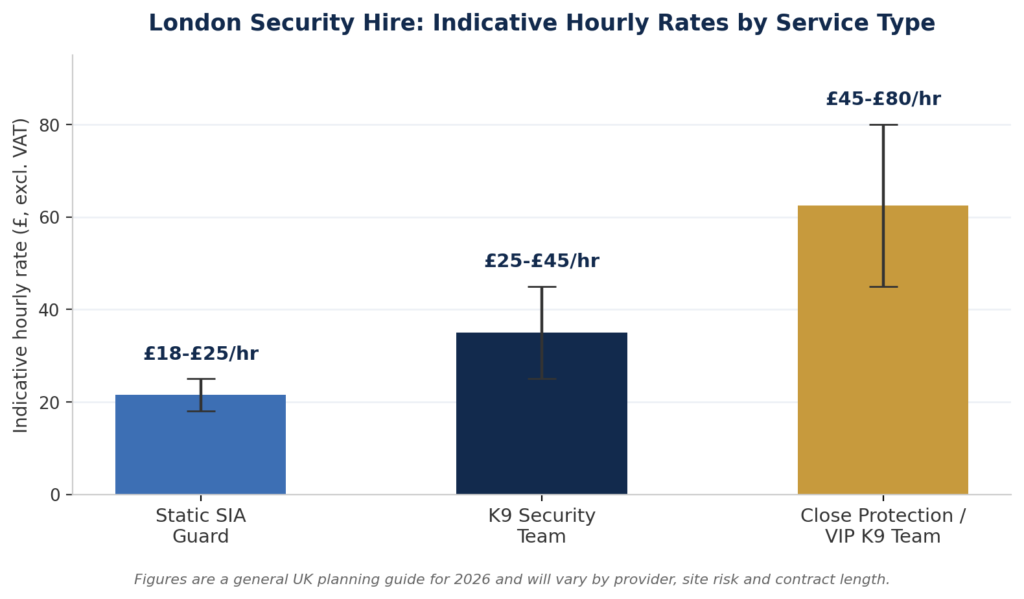
Figures are a general UK planning guide for 2026 and will vary by provider, site risk and contract length. Always ask for a written, site-specific quote.
A few things typically move a quote up or down:
- The number of dog teams needed to cover the size of your site
- Whether you need day, night or 24/7 cover
- The risk profile of your sector, since a high-value warehouse costs more to protect than a low-risk void property
- Contract length, as longer-term contracts usually bring the hourly rate down
- Emergency or short-notice callouts, which usually carry a premium
How to Choose the Right K9 Security Provider
Not every business offering K9 security dogs is equal, and the wrong choice can leave you exposed both operationally and legally. Work through the following checklist before signing a contract.
Check Accreditations First
Look for SIA Approved Contractor Scheme status, ISO 9001 certification and membership of a recognised body such as NASDU. These are not just badges. They show a provider has been independently assessed against real standards.
Ask About Handler Experience
The dog is only half the team. Ask how long handlers have worked in the industry, whether they hold the correct SIA licence for the activity, and whether they have experience in your sector specifically, whether that is construction, retail or vacant property security.
Check Vetting Standards
Reputable providers screen their staff to BS7858, the British Standard for security screening. That matters just as much for a handler with site access as it does for any other guard.
Ask About Welfare Standards
A provider who cannot clearly explain how their dogs are transported, rested, housed and monitored by a vet is not one to trust with your site. Good welfare and good performance go hand in hand: a tired or stressed dog is an unreliable one.
What Happens When You Hire a K9 Security Team
Most reputable providers, including GSS Security Services, follow a broadly similar process from first enquiry to dogs on site.
- Site assessment: a representative visits your premises to understand the layout, risk level and access points.
- Tailored plan: you receive a proposal setting out patrol or detection dog cover, shift patterns and reporting.
- Handler briefing: handlers are briefed on your site rules, emergency contacts and any sensitive areas.
- Deployment: patrols begin, usually with a short settling-in period so the dog becomes familiar with the site.
- Ongoing reporting: you should receive regular incident reports and performance reviews, not just an invoice.
Getting the Most from Your K9 Security Service
A few practical habits help businesses get better value from a K9 contract long after the paperwork is signed.
- Brief your own staff so employees and visitors know a dog patrols the site, for their comfort as well as their safety.
- Review incident reports monthly, not just when something goes wrong, to spot patterns early.
- Keep signage current under the Guard Dogs Act 1975, especially if patrol times or areas change.
- Reassess coverage seasonally. Retailers often increase K9 patrols around Christmas, while construction sites may need more cover once expensive plant machinery arrives.
Frequently Asked Questions
Do I need a licence to hire K9 security dogs in London?
You do not need a personal licence to hire the service. The handler working on your site must hold the appropriate SIA licence for the guarding activity, along with recognised dog-handling training such as NASDU.
Are K9 security dogs dangerous to staff or the public?
Not when supplied by a reputable provider. Handlers are trained to keep dogs under close control at all times, and the dogs themselves are selected and trained specifically for calm, controlled behaviour around people.
What is the difference between a patrol dog and a detection dog?
A patrol dog deters and responds to intruders through visible presence and controlled intervention, while a detection dog is trained to search for specific substances such as drugs or explosives using its sense of smell.
How quickly can a K9 security team be deployed in London?
This varies by provider, but many can arrange emergency or short-notice cover within 24 to 48 hours, particularly for existing clients or urgent situations such as a break-in.
Can K9 security dogs work alongside CCTV and static guards?
Yes. Most successful security strategies combine K9 patrols with technology and manned guarding rather than relying on any single measure alone.
How much does it cost to hire a security dog in London?
Costs typically range from around £25 to £45 per hour for a handler and dog team, though this varies with site risk, shift pattern and contract length. Always ask for a written quote based on your specific site.
Final Words
K9 security dogs are not a gimmick bolted onto a contract to make a site look impressive. Used properly, with a licensed handler, clear welfare standards and a plan that matches your actual risk, they are one of the most effective deterrents available to London businesses today.
Before you hire, do your homework. Check the legal basics, ask for accreditations, and choose a provider who can explain their welfare standards as confidently as their patrol schedules. Get that right, and a K9 security team can become one of the most valuable parts of your wider protection plan.
GSS Security Services is an SIA Approved Contractor and ISO 9001 certified provider, trusted by more than 1,000 organisations across England and Wales. To talk through K9 security dog hire for your London site, get in touch for a free site assessment and a tailored proposal. Call 0203 599 8122 or email info@gsssecurities.co.uk.