
Picture a quiet Tuesday night at your site. The car park is empty, the lights are on, and the guard has logged another uneventful shift. Nothing happened, so everything must be fine. Or is it?
Many UK businesses judge their security guard services this way: no incident, no problem. That is a bit like judging a smoke alarm by the absence of fire. Good security is often invisible, so it is hard to tell a strong service from one that is simply present.
The fix is measurement. This article shows you what to track, how to track it, how often to review it and what good looks like. You will also get a simple scorecard to start using this month, whether you already work with a security guard company in the UK or are choosing one.
Why measuring your security guard services matters
You pay for protection, so you should be able to see what you are getting. Measuring your security guard services gives you three things.
- Evidence, not opinion. “I think the guards are fine” becomes “patrols were completed 96% of the time this month”.
- Better conversations. Reviews with your provider focus on facts and fixes rather than frustration.
- Proof for others. Insurers, landlords and auditors like to see that security is checked, not just paid for.
At GSS Security Services, our contracts managers review each assignment periodically and clients are encouraged to complete satisfaction surveys. Measurement works best when both sides want it.
Start by defining what good looks like
You cannot fairly judge a service against expectations that were never written down.
Set clear objectives for your site
Begin with the risk you want to reduce. Different sites need different measures.
| Site type | Main objective | Example measure |
| Retail | Reduce theft and protect staff | Theft incidents per month |
| Construction | Stop out-of-hours entry and material theft | Unauthorised entries logged |
| Vacant property | Prevent squatting and damage | Verified patrol visits |
| Corporate office | Control visitors and access | Visitor log accuracy |
| Events | Keep crowds safe and moving | Queue times and incidents handled |
Put it in the Assignment Instructions
Assignment Instructions are the site-specific document that sets out each officer’s duties: patrol routes, access rules, who to call and what to do in an emergency. If a duty is not in there, you cannot fairly measure it. At GSS, we build ours from a site assessment covering entry points, foot traffic and asset value, so every officer knows what to look for on your site.
The core KPIs for security guard services
A useful set of measures mixes two types. Activity measures show whether guards did what they were asked. Outcome measures show whether it worked. You need both.
| KPI | What it tells you | How to measure it | Example target* |
| Attendance and punctuality | Whether posts are filled on time | Digital clock-ins or signed shift logs | Every post filled; 98% on time |
| Patrol completion | Whether rounds happen as instructed | Checkpoint scans or GPS logs | 95% or more within the set window |
| Incident response time | How quickly officers act | Time from alert to arrival | Agreed for each site |
| Report quality | Whether records are useful | Monthly sample audit | All filed before shift end |
| Licence and training compliance | Whether the right people are on site | SIA register checks, training records | 100% valid |
| Client feedback | How staff and visitors feel | Short surveys, complaint log | 8 out of 10 or above |
| Incident trend | Whether risk is falling | Three to six months of data | Downward over time |
*Targets are illustrative. Agree yours with your provider based on your site’s risk.
Activity measures: did the work get done?
Attendance and patrols are the easiest measures to check, provided someone actually checks them. Checkpoint tags or GPS tracking give every round a timestamp, and industry KPI guides commonly pair patrol completion with attendance and missed-shift rates (Belfry Software).
Look at the pattern, not only the total. If every checkpoint is scanned within three minutes each night, the route was probably not walked properly. For mobile patrol security, compare time on site with the instruction. A visit that lasts four minutes when fifteen were specified is a gap the monthly percentage will hide.
Response and reporting: how did they handle it?
Incident response time runs from the moment an alert is raised to the moment an officer arrives or acts. Set it for each site, because a guard already on the premises and a patrol vehicle crossing London cannot be held to the same number.
Reports matter just as much. A good one covers who, what, when, where and what happened next, ideally with photographs. Read three at random each month. If you cannot picture the incident from the report, it is not good enough.
People and compliance: who is on your site?
Anyone carrying out licensable guarding work must hold a valid SIA licence, and a badge alone is not proof. The SIA’s public register is free to use and shows a licence’s status, sector and expiry date. Check that the sector matches the role too, because a security guard licence and a door supervisor licence cover different work. Ask for confirmation of BS 7858 vetting and training records as well. At GSS, every officer is SIA licensed and vetted to BS 7858 before deployment.
Outcomes and satisfaction: is it working?
Track incidents over three to six months rather than week to week, and expect a twist: numbers often rise first. Better reporting means more attempts get logged in month one, which is a good sign, not a bad one. Then ask the people who see your guards daily, such as reception, tenants and shop-floor staff. Two questions are enough: do you feel safer, and do officers seem to know what they are doing?
A worked example: a retail unit in East London
Imagine a clothing store in a retail park that adds weekend manned guarding and a night mobile patrol. The figures below are invented for illustration.
| Measure | Before | Month 1 | Month 3 |
| Theft incidents logged per month | 6 | 9 | 3 |
| Patrol completion | Not tracked | 91% | 97% |
| Average response to flagged incident | Not tracked | 6 minutes | 4 minutes |
| Reports filed same day | Not tracked | 80% | 100% |
In month one, logged thefts rose from six to nine. Crime had not risen. Officers were simply recording attempts that used to go unnoticed. Patrol completion sat at 91%, so the manager asked why and found a locked service door blocking one checkpoint. A keyholder arrangement fixed it. By month three, thefts were down to three and patrols hit 97%. Without measurement, the month one rise would have looked like failure, and the locked door would never have been found.
Build a simple security guard scorecard
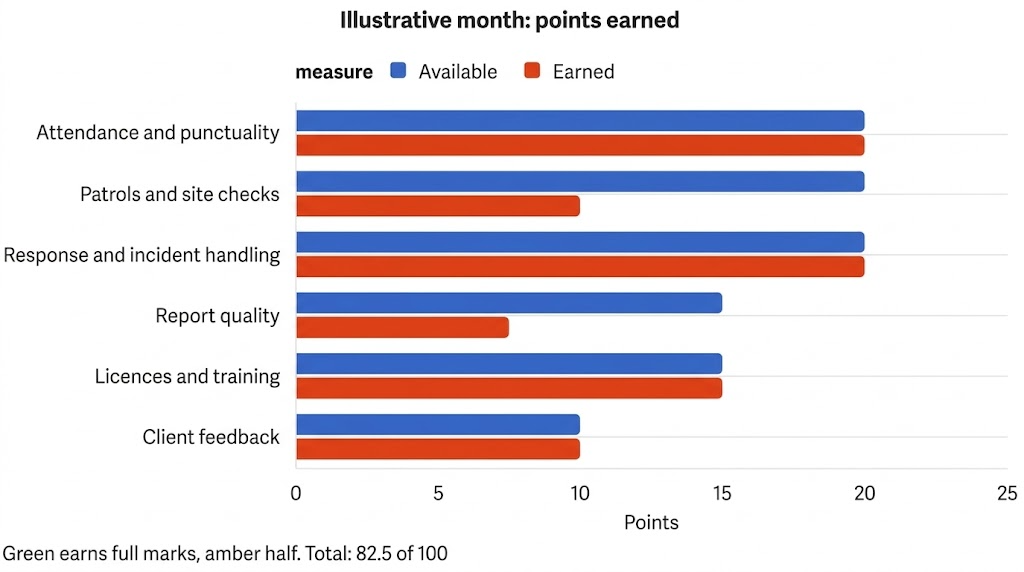
Once you have the data, pull it into one page. Score each category monthly: green earns full marks, amber earns half and red earns none.
| Category | Weight | Green | Amber | Red |
| Attendance and punctuality | 20% | 98% or above | 95 to 97.9% | Below 95% |
| Patrols and site checks | 20% | 95% or above | 90 to 94.9% | Below 90% |
| Response and incident handling | 20% | Within agreed time | Slightly over, with reason | Repeatedly over |
| Report quality | 15% | Complete and on time | Minor gaps | Late or unclear |
| Licences and training | 15% | All valid | Renewal pending | Any lapse |
| Client feedback | 10% | 8 out of 10 or above | 6 to 7.9 | Below 6 |
Add the results for a score out of 100. As a rule of thumb, 90 or above is strong, 75 to 89 needs attention and anything lower needs a recovery plan. Adjust the weights to suit your site: for door supervision, licence compliance deserves more.
The chart shows a sample month in which patrols and report quality were amber, giving 82.5 out of 100: a score that needs attention and points straight to where.
The traffic-light method is well established. A published government template for security contracts grades each KPI by colour, asks for a monthly performance report and schedules regular meetings between contract managers. The BS 7499:2020 code of practice for static guarding also contains a performance evaluation section.
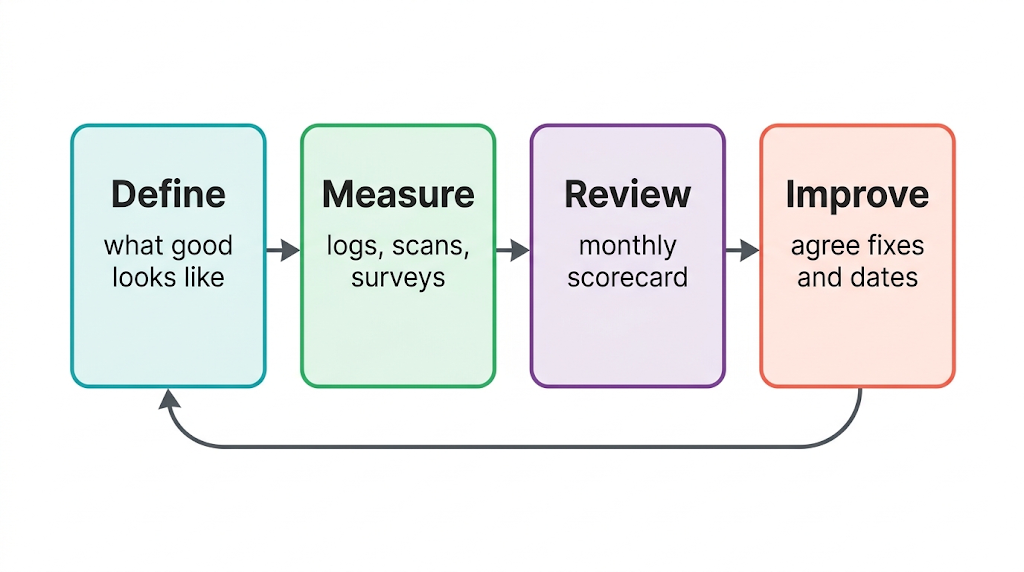
How often to review your security guard services
| Frequency | What to check | Who is involved |
| Daily | Shift log, attendance, any incidents | Site manager |
| Weekly | Patrol summary and open actions | Site manager and supervisor |
| Monthly | Full scorecard | You and the contracts manager |
| Quarterly | Site walk-through, risk and staffing levels | Senior stakeholders and provider |
Agree an escalation path at the start, so a problem moves from officer to supervisor to contracts manager without delay. Regular reviews with checklists and defined escalation routes are widely recommended for managing security contractors (Double Check Security Group).
Practical tips for getting honest data
- Visit unannounced. Drop in at 2am or on a bank holiday once a quarter and see what a normal shift looks like.
- Ask for the raw logs. Summaries are useful, but timestamps show what actually happened.
- Test the response. Agree a drill with your provider, such as a simulated alarm, and time it.
- Talk to the officers. Ask what is unclear in the Assignment Instructions. Confusion there shows up in your results later.
- Share the scorecard early. No provider likes surprises. Show them the criteria before the first review, not after the first problem.
- Recognise good work. Praise costs nothing and keeps good officers motivated.
Watch for these warning signs: repeated late arrivals, patrol logs with identical times, vague reports, officers who cannot describe their duties, and frequent changes of personnel on your site.
What to expect from a security guard company in the UK
A good provider makes measurement easy. When you assess one, look for independent assurance, not just promises. The SIA Approved Contractor Scheme measures companies against independently assessed criteria and inspects them annually (ACS Pacesetters). GSS Security Services is an SIA-approved contractor. As security service specialists, we deliver tailored security guard solutions, from manned guarding services to retail security services and vacant property security. Our officers are SIA licensed and vetted to BS 7858, backed by ISO 9001 standards, a 24/7 support desk, dedicated contracts managers and regular performance reviews.
Frequently Asked Questions
What is the most important KPI for security guard services?
No single measure tells the whole story, but attendance, patrol completion and response time are the best starting trio because they show whether officers are present, active and reacting. Add outcome measures once you have a baseline.
How often should I review the performance of my security guards?
Check logs daily or weekly and hold a formal scorecard review monthly. Add a quarterly site walk-through to reassess risk, hours and staffing.
Can I measure performance without expensive software?
Yes. A signed logbook, numbered checkpoint tags and a monthly spreadsheet are enough to start. Software adds convenience and real-time alerts, but the discipline of reviewing the data matters more than the tool.
What is a reasonable incident response time?
It depends on the site, the risk and whether officers are on the premises or travelling. Agree a figure in writing for each site, then measure against it.
How do I check that my guards are licensed?
Search the SIA’s public register using the officer’s 16-digit licence number or their name and other details. It returns the status, sector and expiry date.
What should I do if performance drops?
Document the issue with dates and evidence, raise it with your contracts manager and agree a corrective plan with a deadline. If nothing improves, escalate using the route set out in your contract.
Final Words
Measuring your security guard services is not about catching anyone out. It is about making sure the protection you pay for shows up, night after night, in ways you can see and prove. Define what good looks like, track a handful of activity and outcome measures, check licences on the official register, and review the scorecard every month. Small, steady habits beat occasional panic.
If you would like security guard services that come with clear reporting and regular reviews built in, talk to the team at GSS Security Services. Call 0203 599 8122, email info@gsssecurities.co.uk or request a quote, and we will shape a plan around your site.
Related Reading: Why Demand for Security Guard Services Is Rising in the UK