Martyn’s Law is expected to come into force in spring 2027. Until then, venues and event organisers have time to prepare simple, practical procedures that could help keep people safe if a terrorist attack ever happened.
Trained security staff can play an important part in that preparation. They are often the first people to notice something unusual, and the people visitors look to for direction when something goes wrong.
It is important to be clear from the start, though. Legal responsibility under Martyn’s Law stays with the “responsible person” for the premises or event, and it cannot be handed over to a contracted service provider. This guide explains what the law requires, where trained security staff fit in and the practical steps you can take now.
Key takeaways
- Martyn’s Law is expected to commence in spring 2027, and there is no legal duty to comply before then.
- Premises for 200 to 799 people fall into the standard tier, and premises for 800 or more fall into the enhanced tier, with some exceptions.
- Every in-scope premises and qualifying event needs public protection procedures for evacuation, invacuation, lockdown and communication.
- Security providers can carry out tasks, but the responsible person keeps the legal responsibility.
What Is Martyn’s Law and Why Preparation Starts Now
Martyn’s Law in Brief
Martyn’s Law is the common name for the Terrorism (Protection of Premises) Act 2025. It is named after Martyn Hett, one of the 22 people killed in the Manchester Arena attack in 2017. His mother, Figen Murray OBE, led the campaign for the law.
The Act received Royal Assent on 3 April 2025. It requires those responsible for certain premises and events to prepare for a potential terrorist attack and help keep people safe if one happens. The Security Industry Authority (SIA) will be the regulator.
Martyn’s Law Standard Tier vs Enhanced Tier
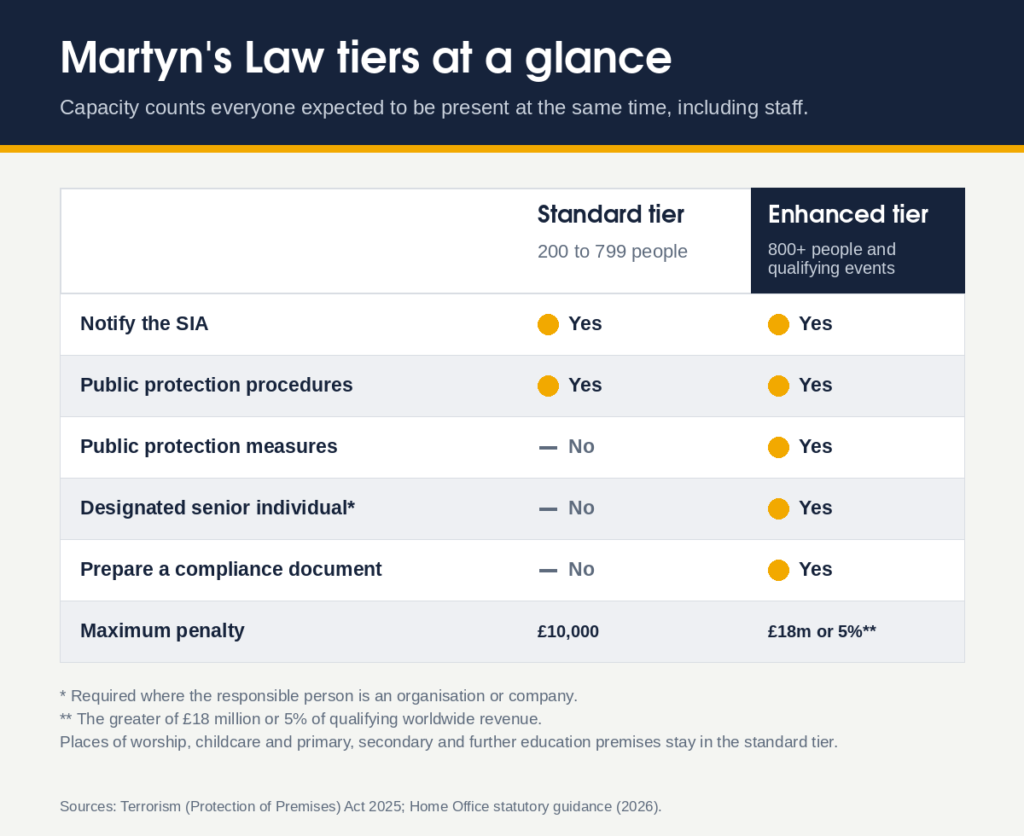
Martyn’s Law standard tier vs enhanced tier requirements and penalties
Which requirements apply depends on how many people can reasonably be expected to be present at the same time, from time to time. This figure must include staff, and the guidance defines staff as employees, contractors, volunteers and others working at the premises or event.
| Requirement | Standard Tier (200 to 799 people) | Enhanced Tier (800+ people) and Qualifying Events |
|---|---|---|
| Notify the SIA | Yes | Yes |
| Public protection procedures | Yes | Yes |
| Public protection measures | No | Yes |
| Designated senior individual | No | Yes, where the responsible person is an organisation or company |
| Prepare a compliance document | No | Yes |
| Maximum non-compliance penalty | £10,000 | The greater of £18 million or 5% of qualifying worldwide revenue |
Places of worship, childcare settings and primary, secondary and further education premises stay in the standard tier even if 800 or more people are expected. Qualifying events are publicly accessible events expecting 800 or more people at the same time, with checks on entry such as tickets, passes or membership.
Key Martyn’s Law Dates
| Date | Milestone |
|---|---|
| 3 April 2025 | The Act receives Royal Assent |
| 15 April 2026 | Statutory guidance presented to Parliament |
| August 2026 | SIA explains how notification will work |
| 11 September 2026 | SIA update on scope, templates and the notification portal |
| New year (2027) | SIA online tool to check whether premises or events are in scope |
| Spring 2027 (expected) | Martyn’s Law expected to come into force |
Once the relevant section comes into force, those responsible for qualifying premises will have three months to notify the SIA. For qualifying events, notification will usually be required within 14 days of the event date being made public.
Why Preparation Matters Now
In May 2026, MI5 announced that the UK national terrorism threat level had been raised from SUBSTANTIAL to SEVERE, meaning an attack is highly likely. Threat levels can change, so check the MI5 website for the current level.
There is no legal requirement to comply until the Act comes into force, but the guidance has been published early so organisations can prepare.
Where Trained Security Staff Fit into Martyn’s Law
The Responsible Person Stays Accountable
The responsible person is the individual, organisation or company in control of the premises or event. They cannot delegate their legal responsibility to a contracted service provider, but they can delegate tasks.
The statutory guidance gives the example of a local authority that remains in control of an event area. It stays the responsible person even if it contracts other organisations to provide stewarding and security. In practice, the best results come when venue management and the security provider plan together and write down who does what.
What the Guidance Says About Staff Instruction and Training
The Act focuses on outcomes rather than a specific course. The statutory guidance says the responsible person should be confident that procedures can be carried out quickly and effectively. That includes making sure staff know the procedures and how to implement them.
It also notes that an evacuation procedure will not work if nobody at the premises understands how to follow it, so staff should receive instruction and/or training as needed. Supporting guidance adds that training, learning, instruction or counter-terrorism awareness will usually be necessary.
The guidance is also clear that nobody is expected to take actions that would compromise their own safety.
Be Cautious of “Compliance” Claims
The government has strongly advised against using third-party providers who claim they can make premises or events compliant with the Act at this time. No third-party product is endorsed by the Home Office or the SIA.
A good security provider should help you prepare and deliver procedures, not promise compliance. The Home Office statutory guidance should always be your starting point.
Why the Manchester Arena Inquiry Matters
The first volume of the Manchester Arena Inquiry report focused on security arrangements at the Arena. It set out missed opportunities, including a dedicated section on hostile reconnaissance before the attack. The statutory guidance notes that the report’s recommendations included introducing legal requirements to improve the safety and security of public venues.
How Security Staff Support the Four Public Protection Procedures
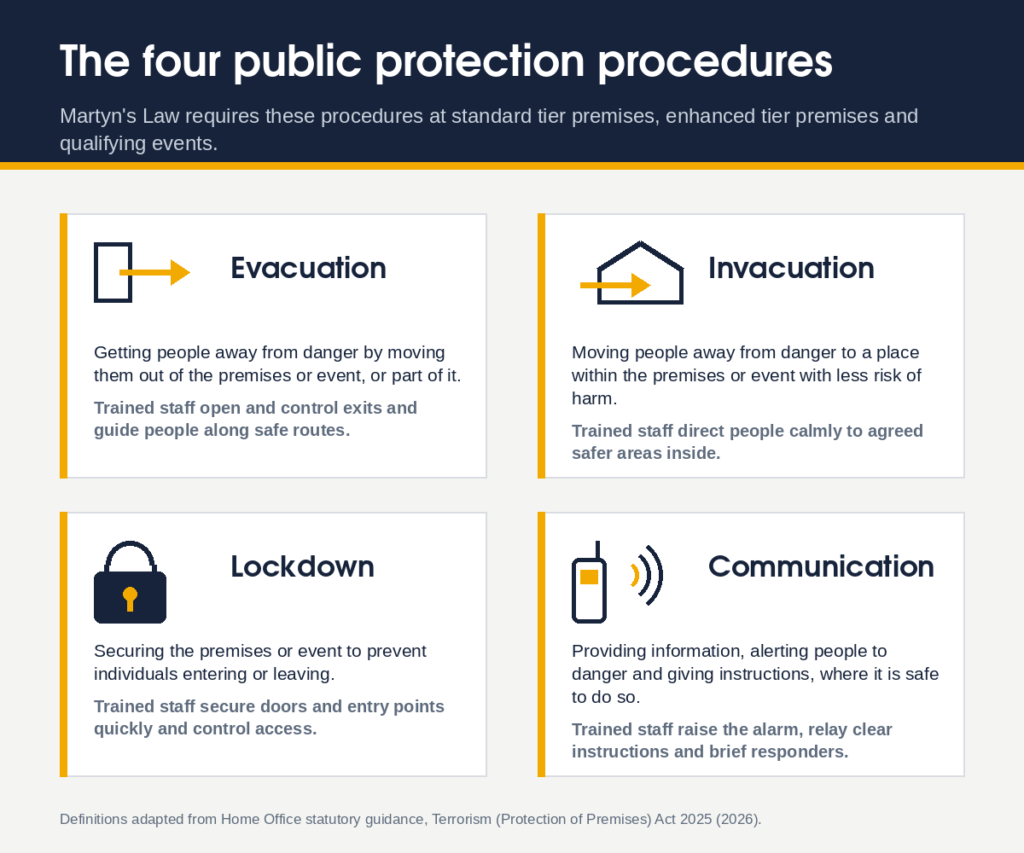
Martyn’s Law public protection procedures: evacuation, invacuation, lockdown and communication
Public protection procedures are actions staff can take if they suspect a terrorist attack is happening or about to happen at the premises, at the event or nearby. Trained security staff can help make each one work in practice.
| Procedure | What It Means | How Trained Security Staff Can Help |
|---|---|---|
| Evacuation | Moving people away from danger and out of the premises or event, or part of it | Know the routes, open and manage exits and guide people away from danger |
| Invacuation | Moving people to a place within the premises or event where there is less risk of harm, including bringing people in from outside | Direct people calmly to agreed safer areas |
| Lockdown | Securing the premises or event to prevent people entering or leaving | Secure doors and entry points quickly and manage access |
| Communication | Providing information, alerting people to danger and giving instructions, where it is safe to do so | Raise the alarm using agreed methods and pass on clear instructions |
Evacuation
In an evacuation, security officers who know every route and exit can help people leave quickly. Because the danger may not be where people expect, officers need clear instructions on how to choose safe routes, practised in advance.
Invacuation
Sometimes staying inside is safer than leaving. Security staff can help identify suitable areas in advance, guide people there calmly and help keep those areas secure until it is safe to move.
Lockdown
Lockdown secures the premises or event so people cannot enter or leave. Security officers who manage entry points every day are well placed to close doors quickly and support staff in keeping people safe inside.
Communication
Clear communication connects every procedure. Trained security staff can raise the alarm using agreed methods, share updates with colleagues by radio and give people simple instructions. Government counter-terrorism training for staff is built on core principles such as RUN HIDE TELL.
Supporting Martyn’s Law Enhanced Tier Measures
Enhanced tier premises and qualifying events must also consider public protection measures. These cover monitoring, movement, physical safety and security, and security of information. This is where a professional security team can make a significant difference.
| Measure | Practical Examples | How Security Staff Can Help |
|---|---|---|
| Monitoring | CCTV, patrols, observation | CCTV monitoring, visible patrols, noticing and reporting suspicious behaviour |
| Movement | Entry points, queues, searches | Ticket and bag checks, queue management, controlling access |
| Physical safety and security | Doors, barriers, perimeters | Checking perimeters and doors, reporting weak points |
| Security of information | Plans and procedures | Handling sensitive site information on a need-to-know basis |
Monitoring
Monitoring helps detect potential threats early. Trained CCTV operators and patrolling officers can watch for unusual behaviour and share observations quickly with supervisors.
Movement
Well-briefed event security and door supervision teams can carry out consistent entry checks, manage queues and control access points throughout opening hours or an event.
Physical Safety and Security
Physical measures only help if someone checks them. Security officers can inspect doors, barriers and perimeters before opening and report problems to venue management.
Security of Information
Detailed security plans should not be shared more widely than necessary. Professional security teams are used to handling site information and assignment instructions on a need-to-know basis.
Supporting the Designated Senior Individual
Where required, the senior individual must be designated to ensure compliance. Security supervisors can support them with incident logs, briefing records, patrol reports and feedback from exercises.
The Skills That Make Security Staff Effective
Recognising Hostile Reconnaissance
The National Protective Security Authority (NPSA) describes hostile reconnaissance as deliberately observing a target to gather information that helps plan a hostile act. ProtectUK guidance points out that you cannot identify a hostile from their appearance, age, ethnicity, gender or clothing, but you can identify and report suspicious behaviour.
Trained officers focus on behaviour, such as unusual interest in security arrangements or loitering in non-public areas, and report concerns promptly.
Counter-Terrorism Awareness Training
Free training resources are available and suitable for security teams and wider venue staff.
| Training | What It Offers |
|---|---|
| ACT Awareness e-Learning | Free counter-terrorism awareness course for staff, refreshed in June 2026 |
| ACT Security e-Learning | More detailed free course aimed at security operatives |
| See, Check and Notify (SCaN) | Free training that helps organisations use their people to spot and respond to threats |
The SIA has also proposed changes to licence-linked qualifications. These include refreshed counter-terrorism awareness content and awareness of Martyn’s Law, with new qualifications planned for later in 2027.
Escalation and Reporting
Noticing a concern only helps if it reaches the right person. Trained security staff follow agreed escalation routes, keep accurate records and know when to call 999. You can also report suspicious activity to the Anti-Terrorist Hotline on 0800 789 321.
Calm Communication and Crowd Management
In an emergency, people respond to clear and confident instructions. Experienced security officers are used to managing crowds, reducing tension and giving simple directions under pressure.
Practical Steps to Prepare Your Security Team Before Spring 2027
Step 1: Confirm Your Tier and Responsible Person
Work out the greatest number of people reasonably expected at the same time, including staff. ProtectUK has flowcharts to help, and the SIA plans to launch an online scope tool in the new year.
Step 2: Match Each Procedure to Named Roles
Decide who raises the alarm, who secures which doors, who guides people to safer areas and who speaks to emergency services. Include both in-house staff and contracted security officers, and add these roles to your security team’s assignment instructions.
Step 3: Brief Every Member of Staff
Security officers cannot be everywhere. Bar staff, stewards, reception teams and cleaners all need to know the procedures and their role. Free ACT and SCaN training is a practical starting point. For events, our guide on how to conduct a risk assessment for event security guards is a useful companion.
Step 4: Test and Practise Your Procedures
The statutory guidance recommends considering how procedures will be tested and practised so staff can carry them out effectively. Start with short discussion-based exercises, then walk-through drills at quiet times.
Step 5: Keep Records and Plan Your SIA Notification
It is good practice to document even the simplest procedures. The SIA is developing optional templates to help you record procedures and measures, and its notification portal will be accessed through GOV.UK.
Martyn’s Law Readiness Checklist
| Action | Suggested Owner | Done |
|---|---|---|
| Confirm capacity and likely tier | Venue management | ☐ |
| Identify the responsible person | Senior management | ☐ |
| Write evacuation, invacuation, lockdown and communication procedures | Venue and security leads | ☐ |
| Assign named roles to in-house staff and security officers | Security supervisor | ☐ |
| Complete free counter-terrorism awareness training | All staff | ☐ |
| Test procedures with an exercise or drill | Venue and security leads | ☐ |
| Keep records of briefings, training and changes | Venue management | ☐ |
| Decide who will notify the SIA | Responsible person | ☐ |
Martyn’s Law Security Staff: Frequently Asked Questions
Does Martyn’s Law require venues to hire security guards?
The Act requires appropriate, reasonably practicable procedures, plus measures for enhanced tier premises and qualifying events. It does not name a particular provider or product, and the government has said no third-party product is endorsed. Security officers can help deliver procedures, but the responsible person decides how to meet the requirements.
Do security staff need special Martyn’s Law training?
The guidance focuses on staff knowing the procedures and being able to carry them out effectively, with instruction and/or training as needed. Free resources such as ACT Awareness and SCaN are available.
When does Martyn’s Law come into force?
Martyn’s Law is expected to come into force in spring 2027. There is no legal requirement to comply before the Act comes into force.
Who is responsible if security is contracted out?
The responsible person remains legally responsible. They can delegate tasks to a contracted service provider, but not the legal responsibility itself.
What is hostile reconnaissance?
Hostile reconnaissance is information gathering by people planning a hostile act, such as a terrorist attack. Staff should focus on suspicious behaviour, not appearance.
What are the penalties under Martyn’s Law?
The maximum non-compliance penalty is £10,000 for standard tier premises. For enhanced tier premises and qualifying events, it is the greater of £18 million or 5% of qualifying worldwide revenue. Daily penalties can also apply for ongoing contraventions.
Can a security company make my venue Martyn’s Law compliant?
The government has strongly advised against using third-party providers who claim they can make premises or events compliant at this time. A professional security company can support your preparation and help deliver procedures, but responsibility stays with the responsible person.
Prepare Your Venue with GSS Security Services
How GSS Security Services Can Support You
GSS Security Services provides trained, professional security teams for venues, events and businesses across England and Wales. We do not claim to make premises compliant. We help your procedures work in practice. With GSS, you get:
- an SIA Approved Contractor, which you can check on the SIA register
- officers vetted to BS7858 standards, with ISO 9001 certified quality management
- site assessments and tailored assignment instructions that set out each officer’s role
- event security, door supervision, manned guarding and corporate security
- security camera installation to support monitoring
- a 24/7 support desk and detailed incident reporting
Speak to Our Team
If you manage a venue, workplace or event, talk to us about how trained security staff can support your Martyn’s Law preparation.
- Address: CEME, Office 280–281, Marsh Way, Rainham, London RM13 8EU
- Phone: 0203 599 8122
- Email: info@gsssecurities.co.uk
Request a quote or explore our security guard services.
This article is for general information only and is not legal advice. Information was checked against the sources below in September 2026. Always refer to the latest Home Office and SIA guidance for your premises or event.