
Ask three security companies for a quote, and you may receive three very different numbers. That can feel confusing, but it usually comes down to hours covered, risk level, and what each price includes. Security guard services are sold by the hour, yet the hourly rate hides a lot of cost. Knowing what goes into it helps you compare quotes fairly and avoid paying for cover you don’t need.
This article explains what security guard services cost in the UK for 2027. We start with the National Living Wage, which sets the legal floor for pay from April 2027. We then work through employer National Insurance, VAT, and the hidden costs a charge rate must cover. You will also find published price ranges, three worked examples and practical tips for checking a quote. Where a figure comes from an official source, we link to it, and where we have made an assumption, we say so.
Full Disclosure: GSS Securities provides security guard services across the UK, so we have an interest in this topic. We do not publish a fixed price list, because the right price depends on your site, your hours and your risk. We do believe you should be able to check any quote you are given, and this article is written to help you do exactly that.
The Short Answer for 2027
Published UK provider guides quote static guarding commonly somewhere between £18 and £28 per hour before VAT, with door supervision usually priced higher. We could not verify those ranges against an official source, so treat them as a starting point, not a benchmark. A more reliable anchor is the wage floor, which rises to £13.21 an hour on 1 April 2027. Every price you are quoted is built on top of that wage, so it is worth understanding the build-up before you sign anything.
Why the Wage Floor Sets the Starting Point
The National Living Wage is the legal minimum hourly pay for workers aged 21 and over. It is reviewed every year, and the new rate applies from 1 April. According to a summary of the April 2027 rates, the government confirmed on 28 October 2026 that it accepted the Low Pay Commission’s recommendations in full, raising the rate from £12.71 to £13.21 an hour, an increase of 3.9%. You can check the official rates on the GOV.UK National Minimum Wage rates page.
Most security guards are paid above the legal minimum, particularly those with licences, experience or specialist skills. However, the minimum is the floor for every provider, and it moves most directly when the rate rises.
The April 2027 Rates at a Glance
| Rate | From April 2026 | From April 2027 | Change |
|---|---|---|---|
| National Living Wage (21 and over) | £12.71 | £13.21 | +3.9% |
| 18 to 20-year-old rate | £10.85 | £11.27 | +3.9% |
| Under 18 rate | £8.00 | £8.31 | +3.9% |
Table 1. Source: Policy Pros summary of April 2027 rates. Confirm against GOV.UK before budgeting.
What One Full-Time Guard Costs an Employer
To make the numbers concrete, consider one guard working a standard 40-hour week all year, which is 2,080 paid hours. The figures below assume the National Living Wage of £13.21 applies. Real wages are often higher, so treat this as the minimum cost of employing one guard, not the final figure.
| Item | Calculation | Annual amount (£) |
|---|---|---|
| Gross pay | £13.21 × 2,080 hours | 27,476.80 |
| Employer National Insurance | 15% × (£27,476.80 minus the £5,000 secondary threshold) | 3,371.52 |
| Total payroll cost before extras | Gross pay plus employer NICs | 30,848.32 |
Table 2. Employer NICs use the 15% rate and the £5,000 secondary threshold for 2026 to 2027, the latest rates we could confirm (GOV.UK). Figures are our own calculation.
The employer’s National Insurance bill can be reduced by the Employment Allowance, which is £10,500 for 2026 to 2027. Eligibility depends on the employer’s circumstances, so we have not applied it here.
Costs That Sit on Top of the Wage
The payroll cost is only the start. A provider also has to fund the following:
- SIA licensing and training. Security guards doing licensable work need an SIA licence, and the regulator and training providers set the licence and training costs. Check the current figures on the GOV.UK guidance on renewing an SIA licence.
- Vetting. Pre-employment checks, including screening in line with the British Standard BS 7858, take time and money before an officer starts.
- Uniform and equipment. This includes radios, body-worn cameras where used, torches, and vehicles for mobile patrols.
- Supervision and management. Someone has to roster, check and support the officers, and handle incidents and complaints.
- Insurance. Public liability and employer’s liability cover are essential for any provider.
- Cover for leave and sickness. Holiday pay is part of the paid hours, but the shifts still need filling.
- Pensions. Eligible workers must be enrolled in a workplace pension, and the employer must pay a minimum contribution.
From Wage Cost to Charge Rate
A charge rate is the hourly price the client pays. It must cover payroll costs, overheads, and the provider’s margin. Using the figures above, the loaded wage cost for a full-time guard at the 2027 floor is about £14.83 per paid hour, before supervision, equipment, insurance and profit.
| Component (per paid hour) | Amount | Notes |
|---|---|---|
| Base wage at the National Living Wage | £13.21 | April 2027 floor |
| Employer NICs | £1.62 | 15% above the threshold |
| Loaded wage cost | £14.83 | Subtotal used in this guide |
| Supervision, vetting, training, uniform, insurance and management | Varies | Provider-specific |
| Provider margin | Varies | Provider-specific |
| Charge rate before VAT | Set by provider | Compare with published ranges |
Table 3. Our calculation. The loaded cost excludes the provider’s own overheads and profit, which we cannot verify for any individual company.
The gap between £14.83 and a charge rate of £18 or £20 is where the other costs and the provider’s profit sit. That gap is not automatically a sign of overcharging. A charge rate close to the loaded wage cost, however, leaves little room for supervision, insurance, or training, and that should prompt questions.
Published Price Ranges by Service
Table 4 summarises the indicative ranges in one published provider guide dated June 2026, Securicoguards’ guide to security guard costs. The guide names no source for its figures, and its introduction quotes a slightly different static range, so treat these numbers as a rough guide only.
| Service | Indicative range (2026) | How it is usually charged |
|---|---|---|
| Static manned guarding | £18 to £28 per hour (introduction says £18 to £30) | Per officer, per hour |
| Door supervision | £20 to £35 per hour | Per officer, per hour |
| Mobile patrols | £12 to £25 per visit | Per visit or route |
| Keyholding and alarm response | From £15 per month plus call-out | Retainer plus per response |
Table 4. Source: Securicoguards guide, last modified 16 June 2026. Ranges are indicative and unverified.
Each service carries different cost drivers, so comparing them on what you actually need usually works better than comparing the cheapest hourly rate. Our pages explain what each includes: static manned guarding, door supervision, mobile patrol security, keyholding security and event security.
Worked Examples for a 2027 Contract
The examples below use an illustrative charge rate of £20 per hour, excluding VAT. This is an assumption chosen to keep the arithmetic clear. It is not a GSS Securities price, and your actual rate will depend on the factors covered later in this article.
Three Contract Patterns Compared
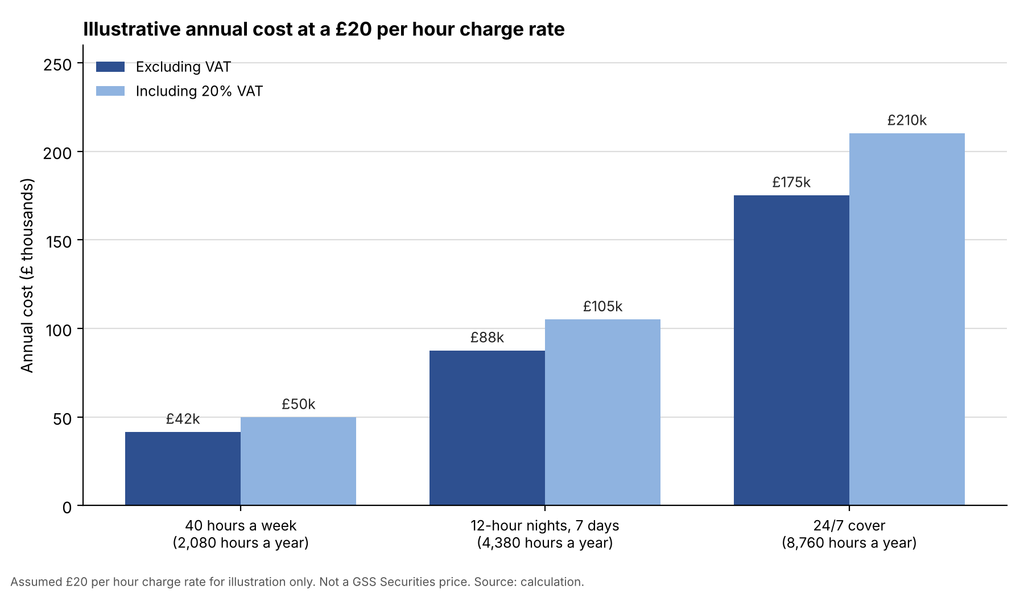
Figure 1. Our calculation assumes a £ 20-per-hour charge rate. Hours are based on 52 weeks a year for the first pattern and 365 days for the others.
| Pattern | Hours a year | Cost excluding VAT | Cost including 20% VAT |
|---|---|---|---|
| One guard, 40 hours a week | 2,080 | £41,600 | £49,920 |
| 12-hour nights, seven nights a week | 4,380 | £87,600 | £105,120 |
| 24/7 cover | 8,760 | £175,200 | £210,240 |
Table 5. Our calculation. Hours multiplied by the assumed £20 rate.
One point is often missed. A 24/7 post is 8,760 hours of cover, not 8,760 hours of one person’s work. A single officer cannot work that pattern, so round-the-clock cover needs more than four full-time people, and usually a little more once leave and sickness are included.
On VAT, the standard rate is 20%. Security guard services are usually charged at that rate, and a VAT-registered business can often reclaim the VAT it pays on services bought for business purposes. Check the GOV.UK VAT rates page and speak to your accountant about your own position.
What the 2027 Rise Adds to a Full-Time Post
Moving from £12.71 to £13.21 is an extra 50 pence an hour. Over 2,080 paid hours, the wage bill for one full-time guard paid the minimum rises by £1,040 a year. Employer NICs at 15% add another £156, so the total increase is about £1,196 a year for one guard. If you buy cover from a provider with ten full-time guards on the floor rate, that is roughly £11,960 a year of extra cost before any change to charge rates. A fixed-price contract should set out clearly how that rise is handled.
Factors That Push Your Price Up or Down
- Hours and shift pattern. Nights, weekends and bank holidays usually carry a premium because they are harder to staff.
- Risk level. A site holding cash, high-value stock or with a history of incidents needs more experienced officers or more frequent patrols. Retail security and corporate security cover show how different risks are handled.
- Licence type. Door supervisors hold a different licence from security guards, and some sites need both, which affects who can be rostered and at what rate.
- Contract length. Longer commitments often allow better planning and can support more competitive rates.
- Location and travel. Travel time and local wage levels affect costs. London and the South East often cost more to staff.
- Number of officers. Larger teams can spread supervision costs, but the officers still need checking and support.
- Type of service. Static guarding, patrols, keyholding and event work each carry different costs, so a like-for-like comparison matters.
Practical Tips for a Fair Quote in 2027
1. Ask for an itemised quote. It should show hours, the hourly rate, supervision, VAT and any call-out fees.
2. Compare cost per covered hour. Count the hours each quote actually includes, and check whether the weekend and night hours are priced the same.
3. Check licences before you agree a price. Ask for licence numbers and check them on the SIA public register rather than relying on a verbal assurance.
4. Ask how the April 2027 rise will be handled. A rate fixed until March 2027 may change afterwards, so find out the review date and the notice period.
5. Be cautious of rates far below the loaded cost. A charge rate close to £14.83 suggests that something important, such as supervision or insurance, may be missing.
6. Clarify notice periods and minimum hours. You need to know what happens if you reduce cover or end the contract early.
7. Review your cover every year. Many sites carry cover that no longer matches their risk. A patrol or keyholding arrangement may suit a lower-risk site better than static cover.
If you would like a quote based on your own hours and risk, talk to the GSS Securities team. Bring your current hours, your site type and any incident history, and ask for a clear breakdown in return.
Frequently Asked Questions
Here are answers to the questions we hear most often.
How much do security guard services cost per hour in the UK?
Published UK guides commonly quote static guarding from about £18 to £28 per hour before VAT. The exact figure depends on hours, risk, licence type and location, so ask for a quote based on your own site.
Will security guard prices rise in April 2027?
The wage element almost certainly will. The National Living Wage rises to £13.21 an hour from 1 April 2027, and that increase flows into the cost base of every provider that pays the minimum or above. Check how your contract handles pay changes.
Does VAT apply to security guard services?
Yes, the standard rate of 20% usually applies to security guard services. A VAT-registered business can often reclaim the VAT on services bought for business purposes, but check with your accountant first.
Are the cheapest security guard services always the best choice?
No. A low hourly rate can mean fewer checks, less training or less supervision. Compare what each quote includes, and ask for evidence of licences, vetting and insurance.
Do security guards need an SIA licence?
Security guards doing licensable manned guarding work need an SIA licence, and door supervisors need their own licence. Check the GOV.UK guidance on SIA licences and the SIA public register before you agree a contract.
How can I reduce security costs without losing protection?
Review your risk and hours, avoid paying for cover when risk is low, and consider whether mobile patrol or keyholding security suits a lower-risk site. A site assessment helps identify the right mix.
Final Words
Security guard services are priced by the hour, but the real cost depends on everything that sits behind that hour. For 2027, the National Living Wage rises to £13.21, employer National Insurance adds to every paid hour, and VAT and provider costs complete the picture. With these figures, you can ask better questions, compare like with like, and plan your budget with confidence.
Start by listing your hours, your site type and your main concerns. Then ask for a clear breakdown of what you are paying for. If you would like a quote built around your own needs, GSS Securities is ready to help.