
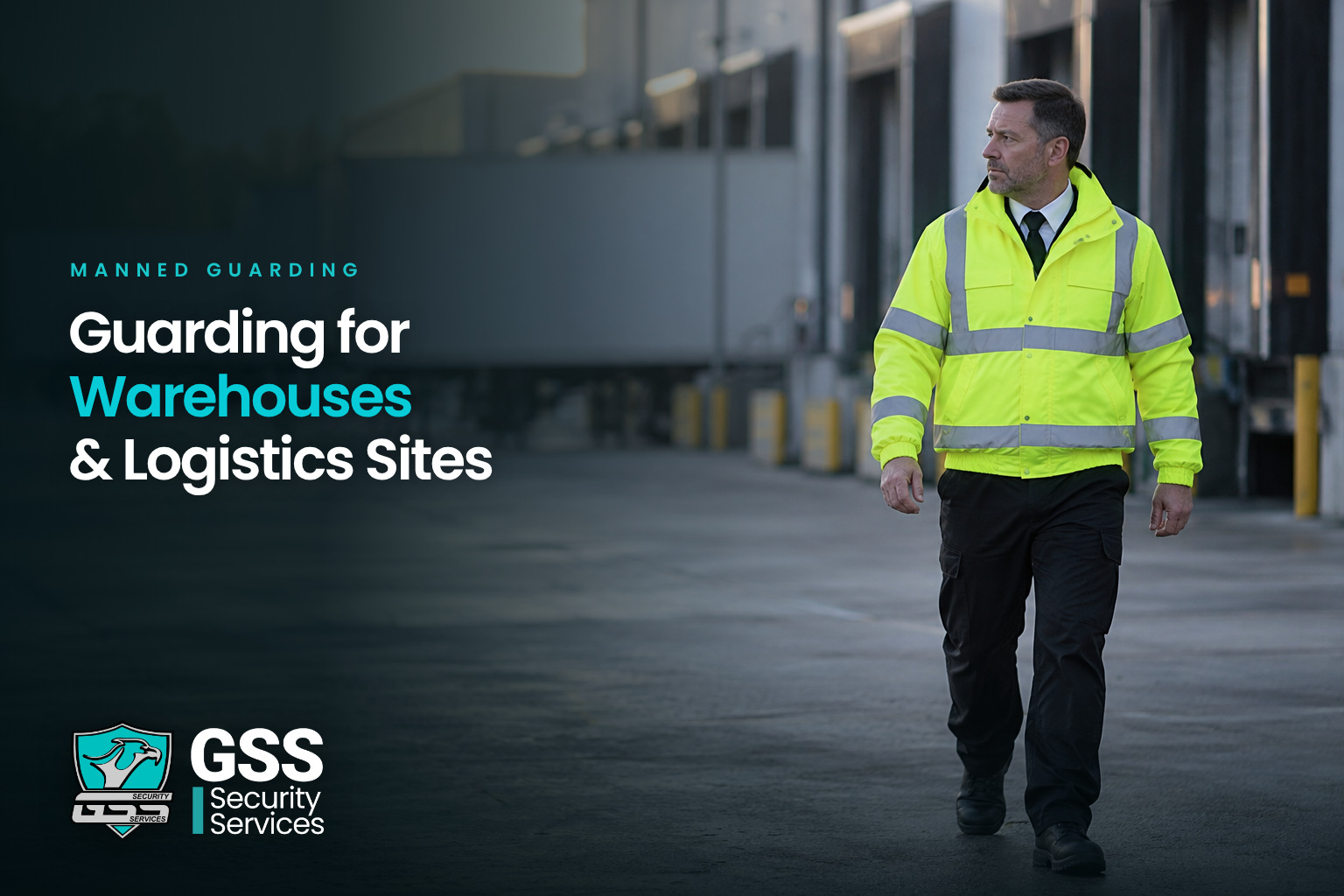
Picture a distribution centre at 3.40am in the run-up to Christmas. Trailers sit at half the dock doors, the yard lights hum and the day shift is hours away. Near the far fence, a stranger in a hi-vis jacket crosses the yard as if he belongs there.
Whether anyone challenges him comes down to one thing: is a trained person on site?
That is the case for manned guarding. Cameras record, alarms sound and patrols visit, but only an on-site officer can stop a vehicle at the gate, question an unfamiliar face and check a trailer seal before a loss becomes an insurance claim.
This guide covers how manned guarding works on UK warehouses and logistics sites: what officers actually do on a shift, the risks they manage, how to choose a provider and what it costs. It is written for site and operations managers who want practical answers, not a sales pitch.
What is manned guarding on a warehouse or logistics site?
Manned guarding means SIA-licensed security officers stationed on your premises, usually at the gatehouse, the dock or reception, and often following set patrol routes. It differs from mobile patrol security, where one officer visits several sites in a shift.
The law matters here. A person who carries out licensable manned guarding without an SIA licence is breaking the law, so every officer on your site needs a valid licence (SIA guidance on GOV.UK). Separately, the SIA’s Approved Contractor Scheme is voluntary, approval applies to specific activities, and it is a criminal offence for a company to claim approval it does not hold (GOV.UK).
GSS Security Services is an approved contractor, and you can check our entry on the SIA register. Our manned guarding services supply vetted officers around the clock where your risk demands it.
Why warehouses and logistics sites are a target
Warehouses combine three things thieves like: valuable stock, large open yards and a steady flow of legitimate traffic that makes unfamiliar faces easy to miss.
The numbers back that up. Between October 2023 and September 2025, the TAPA EMEA intelligence system recorded 5,865 cargo crime incidents in the UK, and the UK regularly ranks in the region’s top five for thefts. Loss values were reported for only 9% of those cases, yet they still topped €72 million, with major thefts averaging around €775,736. A parliamentary group also put the cost of freight crime to the UK economy at £700 million in 2023. (Air Cargo Week)
Facilities themselves are a main target. In December 2025, theft from a facility such as a warehouse accounted for 268 of the 557 incidents reported to TAPA across Europe, the Middle East and Africa, about 48% of the total (Trans.info).
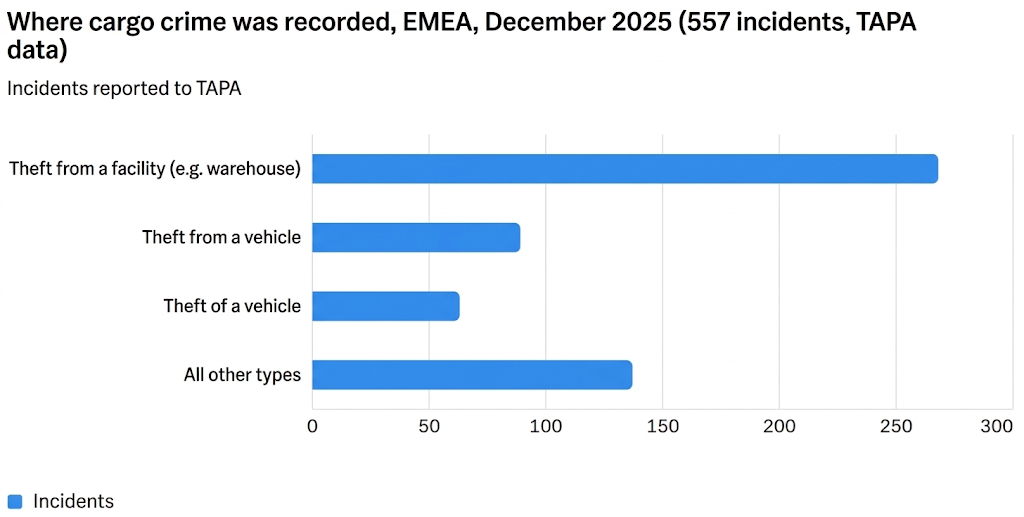
Cargo crime by type, EMEA, December 2025. Source: TAPA EMEA data reported by Trans.info.
The stolen goods are only part of the bill. One industry report estimates that each euro of direct loss brings four to seven euros of knock-on costs, from replacement and reshipping to disputes and unhappy customers (The Loadstar).
| Risk | What it looks like | How manned guarding helps |
|---|---|---|
| Yard and trailer theft | Loaded trailers or pallets taken at shift change or overnight | Officers log every vehicle in and out and watch the trailer park |
| Unauthorised access | A “driver” with no booking, or trespassers using a quiet gate | Booking and ID checks before anyone enters |
| Insider theft or collusion | Stock leaving with staff, drivers or contractors | Visible presence, agreed checks and accurate incident reports |
| Vehicle and pedestrian conflict | Reversing HGVs and forklifts on shared routes | Officers enforce routes and brief visitors |
| Out-of-hours break-in | Forced doors, fence breaches, alarm activations | Immediate response and escalation |
What do manned guards actually do on a warehouse shift?
A good officer does far more than sit in a gatehouse. Below is what we typically build into a site’s Assignment Instructions after a site assessment, adjusted for each client.
Gatehouse and vehicle control
The gate is where many losses are won or lost. Officers check each driver’s ID and booking against the day’s expected arrivals, record vehicle and trailer registrations with times in and out, issue visitor passes and give a short site-rules briefing. If details do not match, the vehicle waits while the officer calls your site contact.
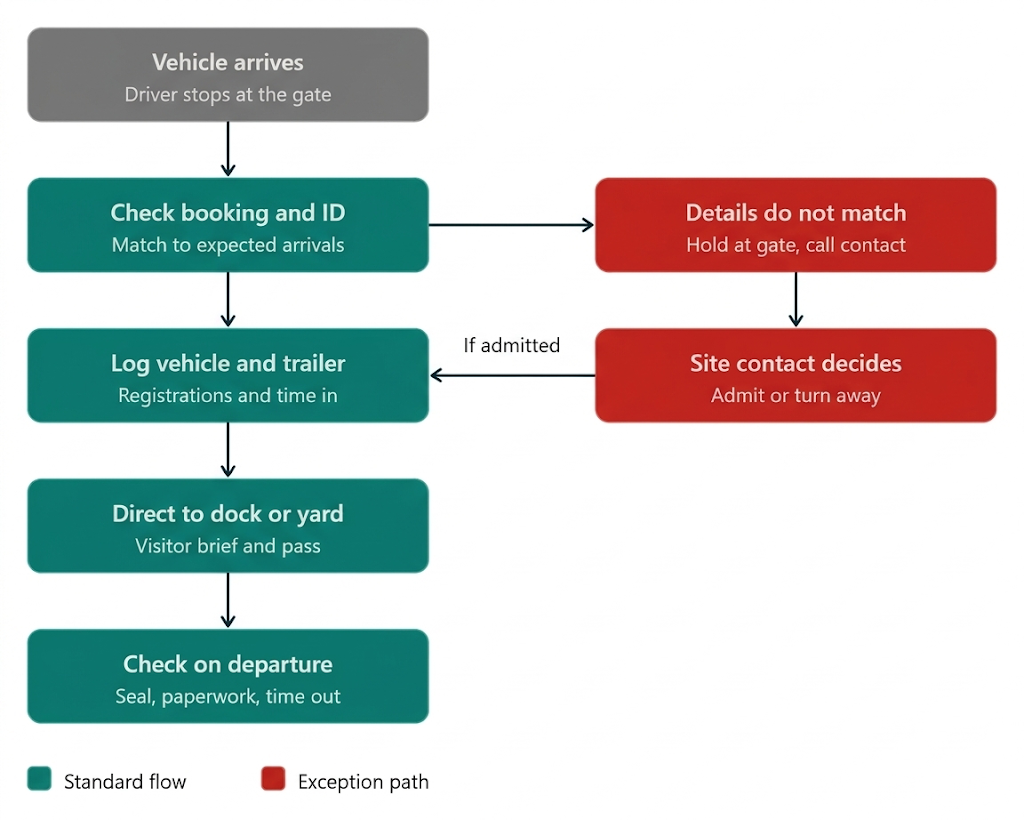
A typical gatehouse flow for an arriving vehicle, agreed in your Assignment Instructions.]
Yard and trailer awareness
A live trailer log shows what is parked where, loaded or empty. Officers notice a trailer that moved without authority, a dock door left open or a curtain that has been cut. Curtain slashing and the removal of whole loaded trailers from depots are both recognised methods, and TAPA’s UK lead says organised gangs will travel hundreds of miles to hit specific vehicles (The Loadstar).
Patrols and perimeter
Distribution sites often back onto open land, service roads or isolated yard areas, which leaves them exposed to perimeter breaches (WCCTV). Officers walk fence lines, gates and lighting, report defects the same night and vary their routes so nobody can learn the pattern. Checkpoint tags give you proof the rounds happened.
Safety support
The HSE expects your risk assessment to cover loading and unloading, to map where vehicles and pedestrians meet, and to separate them where possible (HSE workplace transport). Officers do not replace your traffic plan, but they can enforce it by directing visitors to pedestrian routes and raising the alarm fast. GSS officers are also trained in first aid and safety protocols.
Out of hours and emergencies
When an alarm triggers at 2am, someone must attend, check the building and liaise with police or fire. Paired with our keyholding services, officers can unlock for early deliveries and secure the building after late departures.
| Time | Task (illustrative night shift) | Why it matters |
|---|---|---|
| 18:45 | Handover and briefing | Nothing falls between shifts |
| 19:00 to 22:00 | Gate: booking-in, ID, trailer log | Every vehicle is accounted for |
| 22:30 | Full patrol of fence line, yard and dock doors | Confirms the site is secure after the working day |
| 01:30 | Second patrol on a different route | Stops the pattern becoming predictable |
| 04:00 | Reconcile trailer log with the yard | Spots a discrepancy before the day shift |
| 06:45 | Finish the incident report and hand over | Records are complete before the shift ends |
Two practical examples
These scenarios are illustrative, not client case studies.
Peak season at a 3PL site. A third-party logistics operator on an East London industrial estate sees vehicle movements double from mid-November. Agency drivers arrive unannounced and the gate backs up. The operator adds a gate officer for the peak, so unbooked vehicles are held, every arrival is logged and there is a clean record of who was on site if stock goes missing. In January, hours scale back, because contracts can flex.
A shared estate with one road in. Five tenants share a Midlands industrial estate. Each has its own cameras, but nobody owns the gate. One officer on the estate entrance, plus a night patrol, covers the common risk and the cost is split between tenants. This model suits shared sites in Birmingham, Manchester and the other areas we cover. If a unit sits empty between tenants, vacant property security deals with that separate risk.
Manned guarding, mobile patrols, CCTV and K9 compared
| Option | Best for | Main strength | Main limit |
|---|---|---|---|
| Manned guarding | Busy gates, high-value stock, shift work | Human judgement and access control | Covers one site; highest hourly cost |
| Mobile patrols | Quieter sites, spot checks after hours | Cost-effective across several sites | Nobody on site between visits |
| CCTV | Wide coverage and evidence | Records everything; can be monitored remotely | Needs someone to respond |
| K9 | Large yards and perimeters | Strong deterrent; covers ground fast | Needs a handler; legal and welfare duties |
| Keyholding | Out-of-hours alarms and access | A trusted person holds the keys | Responds after the event |
These measures do different jobs, so most logistics sites layer them: officers at the gate during operating hours, mobile patrols or K9 teams overnight, and CCTV across the whole yard. Our guide to security dog hire explains the legal side of K9.
How to choose a manned guarding provider
A logo on a website proves little. Work through this checklist before you sign.
- Verify SIA Approved Contractor status. Search the register rather than trusting a badge, and confirm the approval covers security guarding.
- Ask for BS 7858 vetting. The standard sets a minimum five-year screening period, and approved contractors must screen to it or an equivalent (TeamMatrix). You can see the BSI standard here.
- Ask which standards they follow. BS 7499 is the code of practice for static guarding, and ISO 9001 shows a managed quality system.
- Insist on a site assessment and written Assignment Instructions. Officers cannot follow rules nobody wrote down.
- Check how licences are verified. The SIA public register is free and shows status, sector and expiry date.
- Look at reporting and escalation. You want a 24/7 support desk, a named contracts manager and incident reports with times. Our guide to measuring guard performance shows what to ask for.
- Ask about cover. Who covers sickness and peak weeks, and does any officer come from a subcontractor?
GSS officers are SIA licensed and vetted to BS 7858, and we are ISO 9001 certified with a 24/7 support desk and dedicated contracts managers.
What does manned guarding cost?
Nobody can price a site without seeing it, so be wary of anyone who does. Three facts help you plan.
First, labour drives the price. The National Living Wage rose 4.1% to £12.71 an hour from April 2026 (GOV.UK), and our piece on rising labour costs explains why quotes have moved. Second, hours matter more than most buyers expect: one round-the-clock post is 168 hours a week, while a 12-hour night post is 84. Third, as a rough 2026 planning range only, our security dog hire guide puts a static SIA-licensed guard at £18 to £25 an hour before VAT. For that night post, that is about £1,512 to £2,100 a week. Treat it as a budgeting guide, not a quote.
| Factor | Effect on price |
|---|---|
| Hours of cover | A 24/7 post costs twice a 12-hour night post |
| Number of posts | Gate, yard and dock may each need cover |
| Site size and stock value | Higher risk usually means more officers or patrols |
| Extra duties | First aid, banksman or reception work add skills |
| Contract length | Longer terms can lower the hourly rate |
| Short notice | Urgent starts usually carry a premium |
Eight ways to get more from your guards
- Write Assignment Instructions around your real risks: who may enter, who to call and what to do in an emergency.
- Send the gate a daily expected-arrivals list so officers can challenge exceptions.
- Control keys and passes with a log, and retrieve passes on exit.
- Fix the basics: lighting, fence gaps and gate hardware. A guard cannot patch a broken floodlight.
- Brief for peak season. Add hours and share the agency driver and haulier lists.
- Back your traffic plan. Mark pedestrian routes and give officers authority to enforce them.
- Run a night-time drill. Simulate an alarm and time the response.
- Review monthly with a scorecard covering attendance, patrols, response times and reports.
Frequently Asked Questions (FAQs)
Here are answers to the questions we hear most often.
What is manned guarding?
It means SIA-licensed officers stationed on your site to control access, patrol and respond to incidents, as opposed to visiting patrols or remote cameras.
Do warehouse security guards need an SIA licence?
Yes. Anyone doing licensable guarding must hold one, and you can check any officer on the free SIA public register.
Is manned guarding better than CCTV?
They do different jobs. CCTV records and covers wide areas, while an officer can act on what they see. Most sites benefit from both.
How much does warehouse manned guarding cost?
It depends on hours, posts and risk. Use the planning range above, then ask for a written quote based on a site survey.
Can guards search vehicles or bags?
Officers do not have police powers, so checks rely on your site policy and consent. Agree in writing what is checked and how, and record it in the Assignment Instructions.
How quickly can GSS start?
It depends on the cover and location. Our management team is based in London, which helps response times, and we confirm timing once we understand your site. Cover can also scale up or down as your needs change.
Final Words
Manned guarding earns its place on a logistics site when it is built around how the site really works: who comes in, what leaves and where the gaps are at 3am. Done well, it deters theft, speeds up the gate and gives you records you can rely on when something goes wrong.
If you want a security partner that starts with a site assessment, GSS Security Services can help. Call 0203 599 8122, email info@gsssecurities.co.uk or request a quote, and we will reply within one business day.