


It is 4.50pm on a Friday. A visitor has waited forty minutes at reception and his voice is getting louder. The receptionist is on her own, the nearest manager is on a call, and everyone within earshot is pretending not to listen.
Nobody planned for this moment, yet most employers owe their staff a plan for it. Workplace violence is not only about punches and weapons. In the eyes of the law it also covers threats and abuse, and the responsibility to prevent it sits with you.
This article explains what UK employers owe their staff, and how practical corporate security turns legal duties into everyday protection. You will also find a checklist you can start using this week.
What Counts as Workplace Violence?
The Health and Safety Executive (HSE) defines work-related violence as any incident where a person is abused, threatened or assaulted in circumstances relating to their work. That includes verbal and online abuse as well as physical assault. The person responsible might be a customer, patient, visitor, contractor or colleague.
How Common Is It?
HSE’s latest figures, based on the Crime Survey for England and Wales, estimate 689,000 incidents of violence at work in 2024/25, made up of 370,000 assaults and 319,000 threats. Around 38% of assaults led to an injury. Some roles carry far more risk than others, as the chart shows. hse
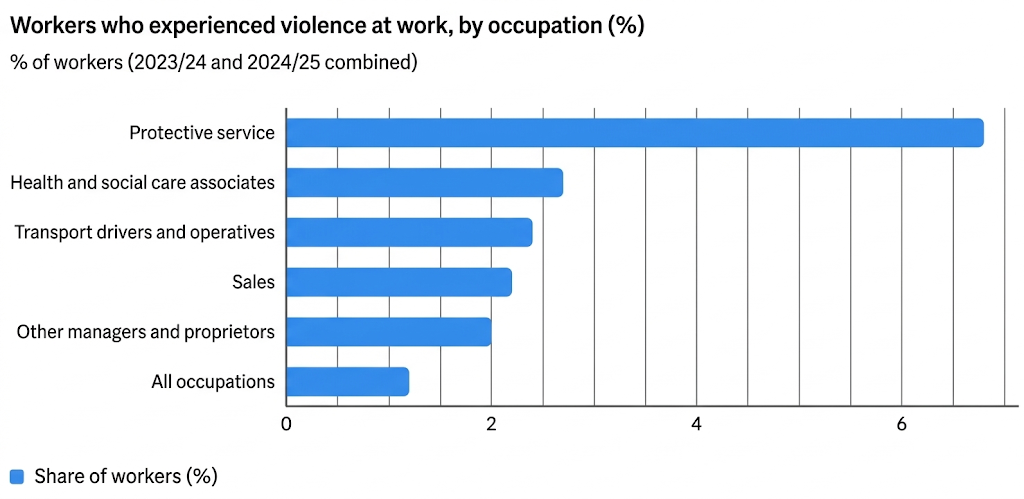
Source: HSE, Crime Survey for England and Wales.
Protective service roles, which include security officers, face a rate of 6.8%, against an average of 1.2% across all jobs. That is more than five times the average. Retail is under heavy pressure too, as the British Retail Consortium puts violence and abuse against shopworkers at about 1,600 incidents every day. Your team may not work in a high-risk sector, but any job that involves the public carries some risk.
What UK Employers Legally Owe Their Staff
There is no single workplace violence law. Several rules work together, and the table below shows how. This guide covers Great Britain, as Northern Ireland has its own health and safety regime.
| Law or rule | What it asks of you | In practice |
|---|---|---|
| Health and Safety at Work etc. Act 1974 | Protect workers’ health, safety and welfare so far as reasonably practicable | Treat aggression as a hazard, not “part of the job” |
| Management of Health and Safety at Work Regulations 1999 | Assess risks, appoint competent people, plan for emergencies, train staff | A written risk assessment and a named lead |
| RIDDOR | Report violence causing death, a specified injury or over seven days off normal duties | An accident book and clear thresholds |
| Consultation rules | Consult workers or their representatives | Ask frontline staff where they feel unsafe |
| Equality Act 2010, as amended by the Employment Rights Act 2025 | Take all reasonable steps against sexual harassment and third-party harassment | Policies, training and reporting routes for customer abuse |
| Crime and Policing Act 2026 | New offence of assaulting a retail worker, once commenced | Help retail staff report and give evidence |
The Core Duty: Assess the Risk, Then Control It
The Health and Safety at Work etc. Act 1974 requires employers to protect workers’ health, safety and welfare so far as is reasonably practicable, and that includes protecting them from work-related violence. The Management of Health and Safety at Work Regulations 1999 add duties to assess the risk of violence, appoint competent people, set up emergency procedures and provide information and training.
“Reasonably practicable” does not mean “whatever is cheapest”. It means weighing the level of risk against the money, time and trouble needed to control it, and HSE notes that no single measure is usually enough on its own. If you fall short, HSE can take enforcement action and injured staff may bring civil claims.
New in 2026: Harassment and Third Parties
Employers must take “all reasonable steps” to prevent sexual harassment, up from “reasonable steps”, and become liable for harassment of staff by third parties such as clients, customers and suppliers. The third-party duty covers all protected characteristics, and a single incident can be enough if you failed to take all reasonable steps.
The law does not yet spell out what “all reasonable steps” means, and regulations are unlikely before 2027. The safest course is to write down what you do: risk assessments, training, reporting routes and how you respond.
When You Must Report an Incident
You must report violence to HSE under RIDDOR if it causes a death, a specified injury, or an injury that stops a worker doing their normal duties for more than seven days. Injuries causing more than three days away must be recorded, and some cases are not reportable, such as a personal dispute between colleagues. Our advice is to log every incident, including verbal abuse, because patterns show where your controls are failing.
A New Offence for Retail Staff
The Crime and Policing Act 2026 received Royal Assent on 29 April 2026 and creates a standalone offence of assaulting a retail worker, but enforcement waits for regulations from the Home Secretary. In July 2026 the government said it was working to commence the offence as soon as possible. The offence carries a possible six-month prison sentence. Check the current commencement status before you brief your teams.
Your Five-Step Plan to Protect Your People
Think of this as a cycle, not a one-off project. Each step feeds the next.
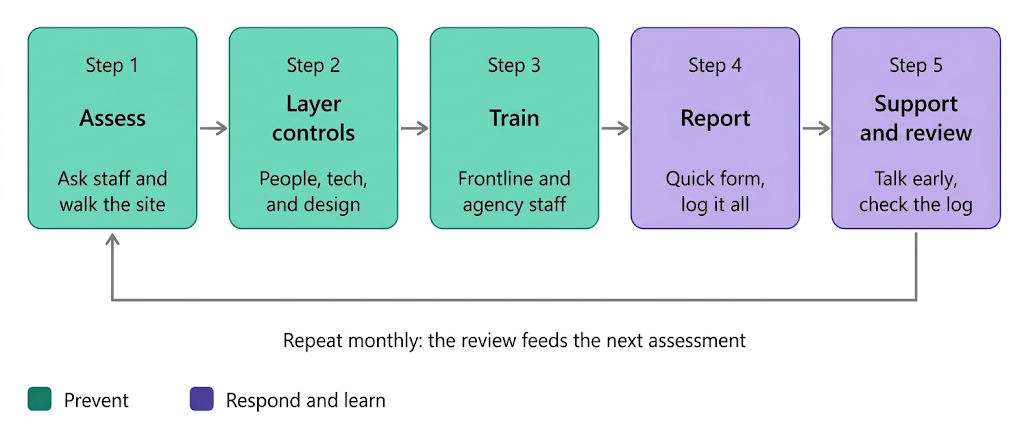
Step 1: Assess the Risk
HSE suggests asking workers about their experiences, looking around the workplace and reviewing past incident records. Lone workers, new starters and other vulnerable workers are often at greater risk.
Walk the route a visitor takes, from the front door to the person they have come to see, and note every point where tension could build: queues, closed doors, cash desks, car parks. Record your findings and review them regularly.
Quick win: ask staff one anonymous question: “When or where do you feel least safe at work?”
Step 2: Layer Your Controls
HSE’s examples include good lighting and visibility, sensible queuing systems, CCTV, trained security personnel, body-worn cameras, alarms and clear signage. Combine design, people, technology and procedure, so that if one layer fails another catches the problem. The next section shows where professional corporate security fits.
Step 3: Train Everyone at Risk
Training should reach everyone who may be at risk, including cleaners, maintenance workers and agency staff, with refreshers to keep skills current. Core de-escalation skills include a calm, clear voice, relaxed posture, a safe distance, listening with empathy and offering the person a way out other than aggression. Add physical intervention training only where your risk assessment shows a serious risk of physical aggression.
Step 4: Make Reporting Easy
People often stay quiet because they think abuse is part of the job, fear being blamed, find forms too complicated or believe nothing will change. Fix that with a two-minute form that works on a phone, and show staff what changed after they reported. A brief note of what happened, when and who was involved is enough to start.
Step 5: Support People and Review
After an incident, give people a chance to talk soon, offer counselling or details of services such as Victim Support, and consider adjusting the role of anyone badly affected. Then review your incident log every month. If the same corridor, shift or type of visitor keeps appearing, change the control rather than repeating the training.
Where Corporate Security Fits In
The law does not oblige you to hire guards. But HSE lists trained security personnel, CCTV and alarm systems among its control measures, noting they can deter offenders and provide evidence for police. That is where professional corporate security services earn their place. They put trained people and technology exactly where your risk assessment says tension builds.
| Risk | Control | GSS service |
|---|---|---|
| Tense reception or visitor disputes | Trained front-of-house officer, visitor management, clear escalation | Corporate security |
| Closing-time aggression in shops | Visible presence and confrontation management | Retail security |
| Tailgating and unauthorised entry | ID checks, search procedures, access control | Manned guarding |
| Empty buildings and car parks after hours | Patrols, alarm response, keyholding | Mobile patrols and keyholding |
| Blind spots and no evidence | CCTV with real-time feeds | Security camera installation |
Choosing a Provider You Can Trust
Ask any provider for proof: SIA Approved Contractor status, individual SIA licences, BS 7858 vetting and ISO 9001 certification. GSS Security Services is SIA approved, vets every officer to BS 7858 and builds each contract from a site survey and risk assessment. Customised Assignment Instructions then tell officers exactly what your site needs. Remember that guards support a good risk assessment; they do not replace one.
Three Scenarios (Illustrative, Not Client Case Studies)
The busy reception. A professional services firm sees repeat disputes about missed appointments. It adds a corporate security officer at reception during peak hours, introduces visitor pre-registration and logs every incident. Reception staff stop acting as door wardens, and the log shows whether the peaks move.
Closing time in a store. A mid-sized shop sees abuse after 5pm when queues build. A visible officer covers the evening rush, staff agree a simple escalation route, and managers encourage reporting of every assault so police have a record once the new offence is in force.
The lone night supervisor. A depot supervisor works alone after midnight. Mobile patrol check-ins, a personal alarm and a keyholder response plan mean help is no longer left to chance. HSE notes that lone workers may be at greater risk because support is not nearby.
Your 30-Day Starter Checklist
- Update your violence risk assessment to cover verbal abuse and lone working.
- Ask staff where and when they feel least safe.
- Review your harassment policy for the recent changes, including customers and clients.
- Book conflict management refreshers for frontline teams.
- Make incident reporting possible from a phone.
- Request a site security assessment and compare it with your risk assessment.
Frequently Asked Questions (FAQs)
Here are answers to the questions we hear most often.
Am I responsible if a customer or visitor is violent, not a colleague?
Yes, the duty covers risks arising from your work, including violence from the public. You can also be liable for third-party harassment if you failed to take all reasonable steps to prevent it.
Does verbal abuse count as workplace violence?
Yes. HSE’s definition includes being abused or threatened, not only physical assault.
Do I have to hire security guards?
Not automatically. The law requires you to assess the risk and reduce it so far as reasonably practicable. Guards suit higher-risk settings, and a site assessment will show whether your premises are one.
Must I report every incident to HSE?
No, only those meeting the RIDDOR thresholds described above. You should still record every incident internally.
What should I do for lone workers?
Assess the risk, agree check-in routines and provide alarms. HSE suggests keeping in touch with people who work away from base, for example by mobile phone and personal alarms. Mobile patrols and keyholding add a physical response.
What are “all reasonable steps”?
The law does not define them yet. What counts will depend on your size, resources and risks, so keep a written record of the steps you take.
Final Words
Workplace violence is a legal duty, a people issue and a business risk all at once. The good news is that the path is clear: assess the risk, layer your controls, train your people, make reporting easy and review what the log tells you.
Corporate security will not replace a sound risk assessment, but it turns a paper plan into a calm, visible presence on the day you need it. If you would like SIA-licensed officers who fit your site and culture, talk to GSS Security Services. Call 0203 599 8122, email info@gsssecurities.co.uk or request a site risk assessment, and we will shape a plan around your premises.
This article offers general information, not legal advice.