


Ask three people in the industry whether the UK security market is growing and you will get three different answers. One points to record numbers of licensed officers. Another waves a report showing flat revenue. A third mentions rising wages and says margins have never been tighter.
They can all be right, which is why this question deserves more than a headline. If you buy security for a shop, site or venue, the answer shapes your budget, your contract and your risk. If you work in the sector, it shapes your next career move.
So let’s look at the evidence, explain why the estimates disagree, and work out what it means for you. Everything below comes from published sources, listed at the end.
The short answer: growing in need, flat in revenue, shifting in shape
The UK security market is neither collapsing nor booming. IBISWorld’s May 2026 edition says private security services revenue fell by around 1% a year over the past five years, then recovered by 1.4% in 2026 to 2027 to reach £10.1 billion. Electronic security is growing faster, and the workforce is large and stable.
| Indicator | Latest reading | What it suggests |
|---|---|---|
| Private security services revenue | About £10.1bn, after a 1% yearly decline over five years | Flat, with a modest recovery |
| Electronic security system services | £2.1bn, forecast to grow 3.6% in 2026 to 2027 | Faster growth than guarding |
| SIA licence holders | More than 447,500 (September 2026) | A large, stable workforce |
| Retail crime | 5.45m detected thefts, with abuse down to 1,600 incidents a day | High, but easing from the peak |
| Wage floor | National Living Wage of £12.71 from April 2026 | Rising costs for providers and buyers |
| Martyn’s Law | Expected from spring 2027 | New compliance demand |
How big is the UK security market?
It depends on who is counting, and that is the first thing to understand before you quote any figure.
Why the estimates disagree
Published IBISWorld editions have put UK private security services anywhere between £8.9 billion and £10.1 billion for 2026. Wider definitions give much bigger numbers. A US government commercial guide estimated the overall UK security and resilience sector at $32 billion in 2024, covering far more than guarding.
Three things explain the gap: scope (guards only, or everything from CCTV to cyber), date (forecasts get revised) and method. Practical tip: always check what a statistic includes and when it was published.
A crowded field
IBISWorld counts 6,572 private security services businesses in 2026, growing by about 1.2% a year since 2021. That many competitors keeps prices tight and makes choosing a provider harder. By comparison, the SIA approves only around 750 security businesses under its voluntary Approved Contractor Scheme.
What is pushing the UK security market up?
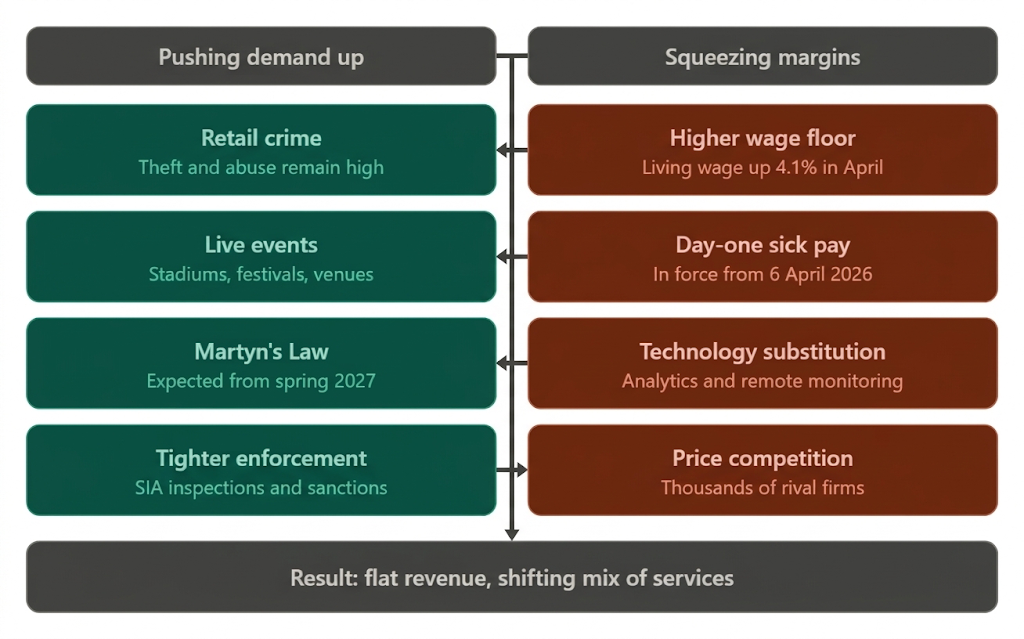
The below factors are pushing up the UK security market.
Retail crime
The British Retail Consortium’s 2026 survey recorded 5.45 million incidents of shop theft. Overall incidents of violence and abuse fell from 2,000 to 1,600 a day, but that is still far above the 455 a day seen before the pandemic. Retailers have spent more than £5 billion over five years on measures such as CCTV and security staff. The Crime and Policing Bill will add a standalone offence for assaulting a retail worker and remove the £200 threshold for low-level theft.
For retailers, retail security is now a standard operating cost, not an optional extra.
Live events
IBISWorld points to 79.4 million ticketed professional sport attendances in 2025 as a driver of demand for stewarding, door supervision and crowd management. Add festivals, concerts and conferences, and event security stays busy.
Martyn’s Law and tougher enforcement
The Terrorism (Protection of Premises) Act 2025, known as Martyn’s Law, is not yet in force and is not expected until at least April 2027. The Home Office published statutory guidance on 15 April 2026, and the SIA will regulate the new duties. Premises where at least 200 people may be present at once will have to comply. The SIA can impose penalties of up to £18 million or 5% of worldwide revenue, whichever is higher.
Enforcement is already visible. On 21 June 2026 the SIA inspected 224 licensed premises and carried out 450 licence checks, finding unlicensed operatives, a counterfeit licence and licence condition breaches.
What is holding growth back?
Labour costs
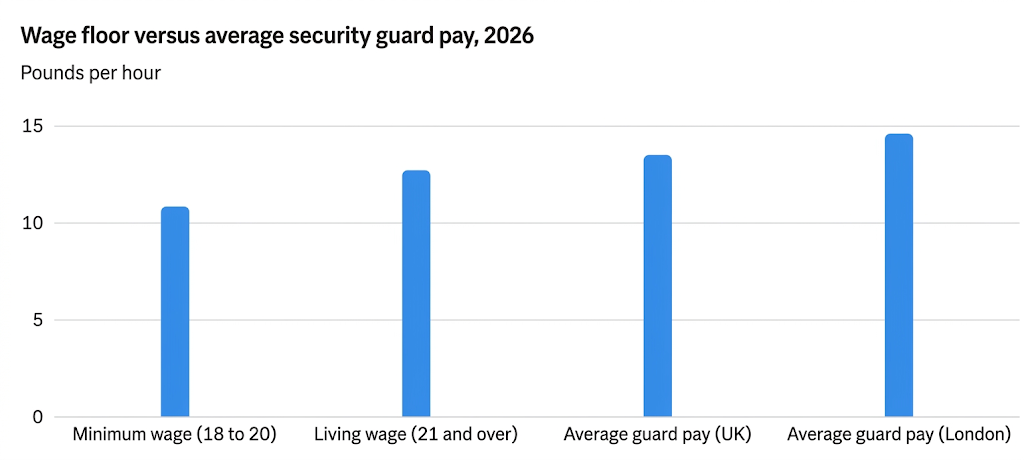
The National Living Wage rose 4.1% to £12.71 on 1 April 2026, and the 18 to 20 rate rose 8.5% to £10.85. The average UK security guard earns £13.51 an hour, according to Indeed data from March 2026. That is only about 80p above the legal floor. From 6 April 2026, Statutory Sick Pay is also payable from day one of absence.
Providers can pass those costs on to clients or absorb them. Most do a bit of both, which is why contract renewals look different this year.
What this means for UK buyers: three scenarios
These are illustrative examples, not case studies.
The multi-site retailer. Theft is up and staff feel unsafe on late shifts. Rather than guarding every store all day, the retailer places officers at peak risk times and backs them with CCTV. The provider shares incident data each month so the spend can be tuned.
The venue hosting 600 people. A venue that regularly holds events with 600 attendees would fall within Martyn’s Law. It starts now: a documented risk assessment, a named responsible person, and door staff briefed on procedures. It picks a provider whose officers hold current SIA licences and can show how they would support those procedures.
The empty construction or vacant site. Nobody is on site overnight, and thieves know it. A mix of mobile patrols, CCTV and a guard at the highest-risk hours costs less than 24/7 guarding. Our guide to construction site security shows how that mix works.
| If you are a… | Trend that matters most | Smart next step |
|---|---|---|
| Retailer | High theft and abuse levels | Target guarding to peak times and review incident data monthly |
| Venue or event organiser | Martyn’s Law | Start your risk assessment and check your capacity tier |
| Site or property owner | Labour costs and technology | Blend patrols, CCTV and guards instead of 24/7 cover |
| Any buyer | Price pressure | Verify licences and approval before comparing prices |
Five ways to buy security wisely in a flat but shifting market
- Budget for wage-driven increases. Ask providers to explain how the new wage floor and day-one sick pay affect your rate, so renewals do not come as a surprise.
- Blend people and technology. Use cameras and monitoring to cover the quiet hours, and officers where a human response matters.
- Verify licences and approval. Check operatives against the SIA register and look for SIA Approved Contractor status. Approved contractors may only subcontract to other approved contractors unless the SIA gives permission, so ask who will actually staff your site.
- Prepare for Martyn’s Law now. Work out which tier your premises fall into and start the risk assessment while there is time.
- Measure performance. Agree clear KPIs and review them regularly. Our guide to measuring security guard performance is a good starting point.
How GSS Security Services fits into the UK security market
At GSS Security Services, we are an SIA Approved Contractor, with BS 7858 vetting and ISO 9001 certification behind our guarding services. We are based in London, and are trusted by over 1,000 organisations.
We do not sell fixed packages. Every contract starts with a site survey and risk assessment, and we can scale guard numbers, patrol frequency or hours up or down as your risks change. That flexibility matters in a market where costs and threats keep moving. Our services include manned guarding, mobile patrols, vacant property security and security camera installation.
Frequently Asked Questions (FAQs)
Here are answers to the questions we hear most often.
Is the UK security industry growing?
Modestly. Revenue has been broadly flat, with a small recovery forecast, while demand drivers such as retail crime, events and Martyn’s Law are strong. Electronic security is growing faster than guarding.
How big is the UK security market?
IBISWorld puts private security services at about £10.1 billion in 2026, though editions have ranged from £8.9 billion upwards. Broader definitions that include technology and resilience give far larger figures.
How many people hold an SIA licence?
The SIA reports more than 447,500 licence holders in the UK as of September 2026.
Will technology replace security guards?
Not entirely. Technology is taking over routine monitoring, but sites still need trained people to respond to incidents, manage people and make judgement calls.
When does Martyn’s Law start?
It is expected to come into force in spring 2027, following a 24-month implementation period. The Home Office published statutory guidance in April 2026.
Why are security prices rising?
Mainly labour costs. The National Living Wage rose 4.1% in April 2026, and day-one Statutory Sick Pay adds further cost. Average guard pay is only about 80p an hour above the wage floor.
How do I know a provider is legitimate?
Check operatives against the SIA register, ask for SIA Approved Contractor status and request proof of insurance and vetting. A price far below the market average should prompt questions.
Final Words
So, is the UK security market growing or shrinking? Neither, in any dramatic sense. Revenue is roughly flat at around £10 billion, the workforce is at a high, technology is taking a bigger share, and costs are rising faster than many contracts allow for.
For buyers, that is a prompt to act rather than wait. Budget realistically, blend people with technology, verify who you are hiring and prepare for Martyn’s Law before it lands.
Want a security plan built around your actual risks, not a generic package? Request a quote or call us on 0203 599 8122, and we will survey your site and show you what makes sense.