It is 7.45am. A parent is arguing at the school gate, an ambulance is blocking the hospital car park, and a hotel receptionist is asking a guest to keep the noise down for the third time. Three very different buildings share one problem: someone has to keep people safe without making the place feel like a fortress.
That is where security guard services earn their keep. Yet a guard who is brilliant on a hotel door may be the wrong fit for a children’s ward or a primary school. Every sector has its own risks, rules and expectations.
This guide explains security guard services for schools, hospitals and hotels in plain English. You will see what officers do in each setting, which rules matter and what to ask before you sign, whether you run a site, sit on a governing body or manage a hotel.
Why Sector-Specific Security Guard Services Matter
Security is never one-size-fits-all. An officer’s manner, uniform, training and hours should suit the people they serve. Pupils need reassurance and safeguarding awareness. Patients and relatives may be frightened, unwell or angry. Hotel guests expect discretion and a warm welcome.
The law is moving too. Martyn’s Law, formally the Terrorism (Protection of Premises) Act 2025, became law on 3 April 2025 and is due to take effect around April 2027, according to Pinsent Masons. Schools, hospitals and hotels can all be in scope. Premises that can hold 200 to 799 people face the standard duty, which centres on simple procedures such as evacuation and lockdown. Venues of 800 or more face extra duties. Education settings always sit in the standard tier, however large they are.
The Act does not oblige you to hire guards, but trained officers help turn a written plan into something that works on the day. Here is the quick view before we go sector by sector.
| Sector | Main risks | What guards typically do | Rules to know |
| Schools | Unauthorised visitors, out-of-hours break-ins, vandalism, tense pick-ups | Gate and reception control, grounds patrols, event cover, keyholding | KCSIE contractor checks, DfE protective security guidance |
| Hospitals | Aggression towards staff, theft, car park safety, access to restricted wards | 24/7 presence, A&E support, de-escalation, staff escorts | NHS violence prevention and reduction standard, SIA licensing |
| Hotels | Theft, intoxicated guests, room access, event crowds | Lobby presence, night patrols, door supervision, event cover | SIA door supervisor licence at licensed premises, Martyn’s Law for larger venues |
Security Guard Services for Schools
Here is an in-depth analysis about the significance of security guard services for schools.
The risks that matter most
Most school security problems are quiet ones. A stranger slips in behind a delivery driver. A gate stays unlocked after an evening event. The Department for Education’s protective security and preparedness guidance asks every setting to name a security lead and to rehearse its plans, and it treats security culture as just as important as fences and cameras.
What school security guards do
- Control the main gate and reception, checking visitors against expected appointments
- Walk the grounds at break, lunchtime and home time to spot hazards and trespassers
- Cover parents’ evenings, lettings and school events
- Provide mobile patrol security and keyholding when the site is empty at night and during holidays
- Support lockdown and evacuation drills
Safeguarding comes first
Officers around children must be properly vetted. Keeping Children Safe in Education (KCSIE) expects schools to be satisfied that contractors’ staff have the appropriate level of DBS check for their role, and to supervise anyone who has not. Ask your provider to confirm BS 7858 screening, which GSS applies to every officer, and agree how DBS checks will be handled.
Example: a secondary school with two entrances
Picture a school of 900 pupils where the side gate is propped open for sixth formers and visitors sign in only when they remember. The school places one officer on the main gate for the morning and afternoon rush, adds a night patrol and arranges keyholder response. Visitors are now checked once, at the gate, and office staff stop acting as door wardens. This is an illustrative scenario, not a client case study.
Tips for schools
- Pay for cover at peak movement times rather than all day if the budget is tight
- Brief officers on your behaviour policy and introduce them to your designated safeguarding lead
- Run a lockdown drill with the officer present at least once a year
Security Guard Services for Hospitals
Here is an in-depth analysis about the significance of security guard services for hospitals.
The risks that matter most
Hospitals never close, and they are emotional places. In the 2025 NHS Staff Survey, 14.5% of NHS staff in England reported at least one incident of physical violence from patients, relatives or the public in the previous 12 months, the highest share since 2022. Add theft and car park incidents, and round-the-clock cover makes sense.
What hospital security guards do
- Maintain a visible presence in the emergency department, reception and car parks
- Respond to alarms and support clinical staff when patients become aggressive or distressed
- Control access to maternity, paediatric and pharmacy areas
- Escort staff to their cars after late shifts
- Manage visitor flow outside visiting hours and during major incidents
Public tender notices from NHS trusts describe much the same job: keeping the site secure, responding to incidents and offering reassurance.
Skills that set hospital officers apart
Physical intervention should be the last resort. The best hospital officers de-escalate with calm words, recognise that confusion, pain or a mental health crisis may sit behind aggressive behaviour, and step back so clinicians can lead. NHS England’s violence prevention and reduction standard takes a risk-based approach and encourages looking at why incidents happen. Ask providers how they train for conflict management. GSS officers are trained in first aid and safety protocols.
Example: weekend pressure in A&E
Imagine a district hospital where incidents cluster in the emergency waiting room late on Friday and Saturday nights. Instead of adding guards across the whole building, the trust places two officers in the department from 6pm to 4am at weekends and adds a car park patrol. Incident logs then guide a rota trim after two months. This is an illustrative scenario.
Tips for hospitals
- Agree in writing when officers may intervene physically and who decides
- Share incident reports with ward and department managers every week
- Add security to clinical induction so staff know who to call and how
Security Guard Services for Hotels
Here is an in-depth analysis about the significance of security guard services for hotels.
The risks that matter most
Hotels welcome strangers 24 hours a day. That brings unauthorised access to rooms, theft from rooms and cars, intoxicated guests, noisy gatherings and large events such as weddings and conferences. Reputation is at stake too, because one bad night can shape online reviews for months.
What hotel security guards do
- Provide a lobby and entrance presence that is welcoming but alert
- Patrol corridors, car parks, fire exits and back-of-house doors overnight
- Offer door supervision for hotel bars, restaurants and late events
- Cover weddings, conferences and parties through event security
- Provide keyholding and alarm response during quiet periods and closures
Licensing matters in hotels
Guards supplied under a contract need an SIA licence. A hotel bar or function suite that sells alcohol or provides regulated entertainment counts as licensed premises, so anyone doing door supervision there needs a door supervisor licence, even if the hotel employs them directly. Ask to see licences and check them on the SIA register.
Martyn’s Law and large function rooms
A hotel with a ballroom or conference suite for 800 or more people may fall into the enhanced tier, with duties to reduce vulnerability and report to the SIA. Smaller hotels can still reach 200 on a busy wedding weekend. The Home Office guidance says capacity includes staff, contractors and occasional peaks, so work out your numbers now.
Example: a city hotel after the bar closes
Picture a 120-room hotel that keeps hearing about late-night noise and strangers in corridors. It adds a door supervisor on Friday and Saturday evenings, a night officer who patrols floors and stairwells from 11pm to 7am, and keycard-only lift access after midnight. Staff have a named person to call. This is an illustrative scenario.
Tips for hotels
- Brief officers on service standards, not only security rules
- Give night staff a clear call list for guests, managers and emergency services
- Review CCTV coverage of entrances, car parks and corridors with your provider
How to Choose a Security Guard Company
Price matters, but proof matters more. A trustworthy security guard company should be happy to back up every claim with evidence you can check yourself.
The credentials checklist
| Check | What good looks like | How to verify |
| SIA Approved Contractor Scheme (ACS) status | Independently assessed against set criteria | The provider’s entry on the SIA register |
| Individual SIA licences | Right licence type for the role, valid and in date | SIA licence register and the photocard on site |
| Vetting | Screening to BS 7858 | Written confirmation and sample vetting files |
| Quality systems | ISO 9001 and a named contracts manager | Certificates and a call with the manager |
| Sector experience | Similar schools, hospitals or hotels | Two references you can phone |
| Reporting | Daily logs, incident reports and monthly reviews | A sample report and scorecard |
GSS Security Services is an SIA Approved Contractor and ISO 9001 certified, vets every officer to BS 7858 and backs each contract with a 24/7 support desk and dedicated contracts managers.
Match the cover to the risk
Not every site needs a guard on post all day. Work out where your risk actually sits, then buy the service that fits it.
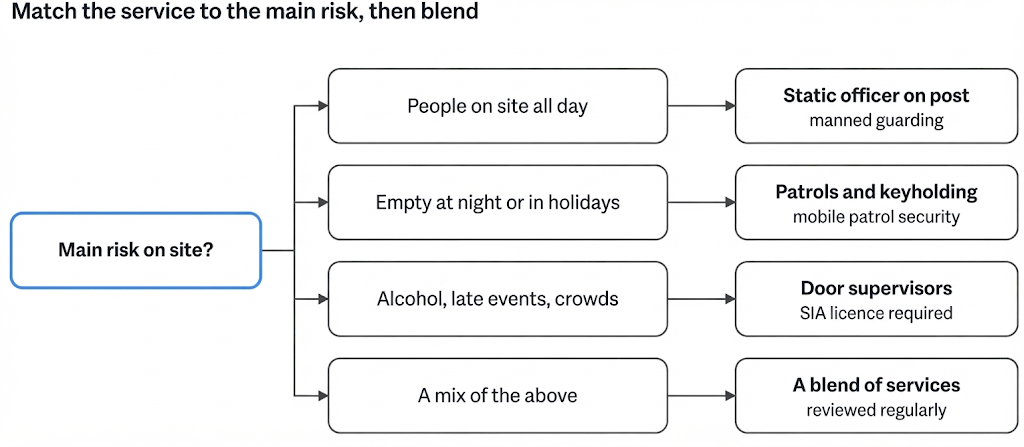
Most hospitals and hotels end up with a blend: static officers where people are, patrols and keyholding where they are not.
What drives the price
Wages typically make up 70 to 80% of a guarding contract, so a quote far below the others usually means something has been squeezed. Hours of cover, site size and risk level all shape the figure, which is why a 24/7 hospital post costs more than term-time gate cover. Ask for an itemised breakdown and a site-specific security risk assessment before you compare prices, then agree how you will measure performance once the contract starts.
Your Five-Step Plan to Get Started
Good security is a cycle, not a one-off purchase. These five steps show the order to work in, and why the last one loops back to the start.
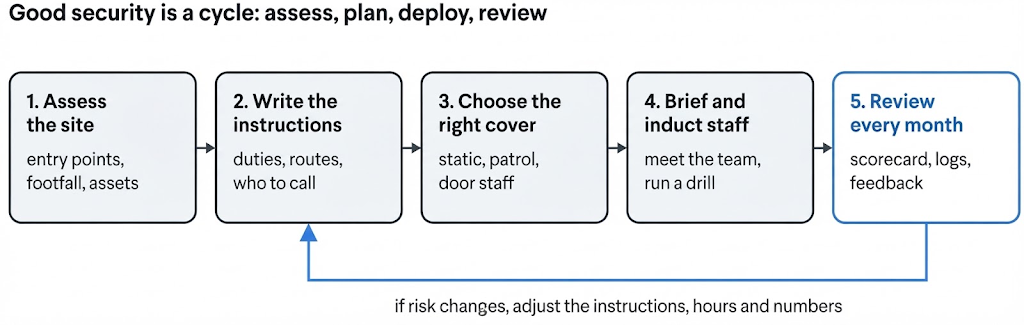
The final step feeds back into step two: if incidents, footfall or opening hours change, update the instructions and the cover.
Start with the assessment, because everything else follows from it. At GSS Security Services, we begin with a site assessment covering entry points, foot traffic and asset value, then write customised Assignment Instructions so every officer knows exactly what to look for. Before you call a provider, gather a site plan, a note of past incidents and your busiest and quietest hours.
Frequently Asked Questions (FAQs)
Here are the answers of your important queries.
Do security guards in schools need DBS checks?
It depends on the role and how much contact with children it involves. KCSIE expects schools to be satisfied that contractors’ staff have the appropriate level of check, or to supervise them. Agree the arrangement with your safeguarding lead first.
Can hospital security guards restrain patients?
Physical intervention should be a last resort. It must follow the law and the trust’s policy, and only officers trained for it should carry it out. Set the rules out in the Assignment Instructions.
Do hotel security guards need an SIA licence?
Guards supplied by a contractor do. Directly employed guards usually do not, with one big exception: door supervisors at licensed premises always need a licence. Check each officer on the SIA register.
How much do security guard services cost?
There is no standard rate. Cost depends on site size, hours, officer numbers and risk. GSS builds every quote from a site survey and risk assessment.
Is Martyn’s Law in force yet?
Not yet. It is expected to take effect around April 2027, and the Home Office published statutory guidance in April 2026. Use the time to work out your capacity and write simple evacuation and lockdown procedures.
Final Words
Great security guard services do not make a school, hospital or hotel feel locked down. They make it feel calm. The recipe is the same in all three sectors: understand your risks, choose cover that fits them, check credentials properly and review the results every month.
If you would like SIA-licensed security guards who understand how schools, hospitals and hotels really work, talk to GSS Security Services. Call 0203 599 8122, email info@gsssecurities.co.uk or request a quote, and we will shape a plan around your site.
Related reading: How to Measure the Performance of Your Security Guard Services