
It is 7.40 pm on a Thursday. A courier slips into the lobby behind a tenant, rides up to the fifth floor and leaves ten minutes later with a laptop. Nobody was reckless, exactly. The landlord assumed each tenant looked after its own doors. The tenants assumed the building looked after the lobby. And the officer on the front desk had finished at 6 pm.
In a multi-tenant building, corporate security belongs to everyone, which is exactly why it often belongs to no one. This guide explains who is responsible, who usually pays and how to close the gaps before an incident does it for you. It is written for landlords, managing agents, facilities managers and tenants across the UK.
Quick answers
- Who is responsible? Whoever controls the space. The landlord or managing agent controls the common parts, each tenant controls its own suite, and both share the overlap.
- Who pays? Your lease decides. Shared services usually go through the service charge. Extras for one tenant are usually paid by that tenant.
- What closes the gaps? A written responsibility matrix, a clear scope of cover and one point of contact.
Why multi-tenant office building security is so easy to get wrong
One front door, many businesses. A law firm on floor two has very different risks from a start-up on floor six, yet both rely on the same lobby, lifts and cleaning contractors. Add couriers, interview candidates, engineers and hybrid working, and the picture gets messy fast.
Reduced occupancy brings its own risks: unmonitored access points, unattended equipment and contractors working without supervision, as we explain in our guide to office security solutions. Technology adds another layer. Access control and CCTV are often installed by one party, run by another and paid for by a third. Law firm Cripps points out that landlords often keep significant responsibilities even when a managing agent or technology supplier runs building systems, and that the answer depends heavily on the contracts in place.
Three gaps appear again and again: the lobby, the lifts and stairwells, and out-of-hours access.
Who is responsible for corporate security in a multi-tenant building?
There is no single law saying “the landlord must provide guards”. Responsibility follows control, and it is set by your lease plus a handful of statutes.
Landlords and managing agents
They normally control the entrance, reception, lifts, stairwells, car park, loading bay and shared systems, so they usually arrange guarding, CCTV and access control for those areas. GOV.UK tells commercial tenants that landlords are responsible for health and safety matters written into the lease, such as communal areas, and that tenants should take reasonable steps to make sure those duties are met. Appointing a managing agent hands over the day-to-day work, not the underlying accountability.
Tenants
Each tenant controls its own suite: locks, internal fobs, visitor sign-in on its floor, laptops, paperwork and staff behaviour. Tenants also need to follow building rules, such as fob discipline and evacuation drills.
The security provider
A provider delivers what the contract says and no more. Officers work to assignment instructions written for the site. If the scope says “lobby, 8 am to 6 pm”, nobody is watching at 7.40 pm.
| Area | Usually controlled by | Typical security duties |
|---|---|---|
| Tenant suites | Each tenant | Locks, internal access, visitors on the floor, equipment |
| Lobby and reception | Landlord or managing agent | Guarding, visitor control, access control |
| Lifts, stairwells, riser cupboards | Landlord, with tenant cooperation | Restricted floors, fire door discipline, patrols |
| Car park and loading bay | Landlord or managing agent | Barriers, CCTV, delivery control |
| Vacant floors | Landlord | Locking down, patrols, keyholding |
Who controls what in a multi-tenant office building
Who pays for corporate security in a multi-tenant building?
Short answer: the lease. Commercial service charges are contractual and not subject to statutory control, so read the wording before assuming anything.
How the service charge usually works
A service charge lets the landlord recover the cost of running shared services from tenants, and security is a typical item alongside cleaning, lighting and maintenance. Costs are normally split by lettable area. The RICS standard, Service charges in commercial property, second edition, is effective from 31 December 2025 and promotes fairness and transparency. RICS guidance has long said that owners should recover no more than the actual cost, and only as the lease allows.
| Security item | Usually paid by | Notes |
|---|---|---|
| Lobby reception and guarding | All tenants, via service charge | Shared benefit |
| CCTV and access control on common parts | Service charge | Check the lease for capital items |
| Fobs, cameras and alarms inside one suite | That tenant | Within its own space |
| Extra patrols or guarding for one tenant | That tenant, by recharge or direct contract | Late working, events, high-value assets |
| Security for vacant floors | Landlord | Not a normal service charge item |
A worked example
Imagine a building with a £120,000 annual shared security budget, split by floor area. These figures are illustrative only.
| Party | Area share | Annual share |
|---|---|---|
| Tenant A | 30% | £36,000 |
| Tenant B | 25% | £30,000 |
| Tenant C | 20% | £24,000 |
| Tenant D | 15% | £18,000 |
| Landlord (vacant floor) | 10% | £12,000 |
| Total | 100% | £120,000 |
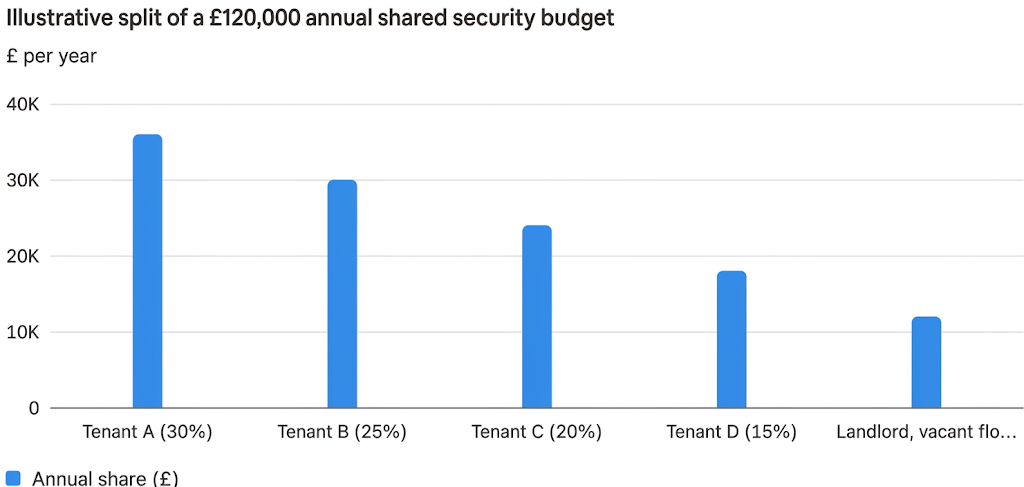
The vacant floor matters. Commentary on the RICS second edition lists costs for void premises among items that should not fall on tenants, so the landlord carries that 10%.
Four watch-outs
- Vague wording. Advisers warn that catch-all “sweeper” clauses generally cannot be used to recover a cost the lease never contemplated, particularly in shorter leases.
- Weak transparency. Ask for the budget, the contract scope and the year-end statement.
- Shared CCTV. The ICO notes that organisations may share surveillance information to help with joint running costs, but joint controllers all stay responsible under UK GDPR.
- Upgrades. New turnstiles or camera systems are often argued over: improvement or service charge? Settle it before you buy.
Legal points landlords and tenants often miss
Here are the key legal points that are usually missed by tenants and landlords.
Martyn’s Law
Martyn’s Law, the Terrorism (Protection of Premises) Act 2025, is expected to come into force in spring 2027, with the SIA as regulator. It applies to publicly accessible premises with a listed Schedule 1 use where at least 200 people may be present, according to Greenberg Traurig. Premises whose uses are not listed on Schedule 1 are outside the duty. A staff-only office will usually fall outside, but confirm this against the ProtectUK scope guidance.
A public-facing café, gym or event space in the same building could qualify. In that case, responsible persons for qualifying premises within other qualifying premises must coordinate so far as reasonably practicable. The responsible person cannot delegate legal responsibility, although contracts can allocate tasks and costs. Read the Home Office statutory guidance, and see how the tiers work in our Martyn’s Law guide for healthcare sites.
Fire safety and security must work together
Where there is more than one responsible person, they must cooperate and coordinate their fire safety measures, and for common areas the responsible person is the landlord, freeholder or managing agent. Access control must never trap people: doors must fail safe and escape routes must stay clear.
Duty of care to visitors
Under the Occupiers’ Liability Act 1957, an occupier must take reasonable care to see that visitors are reasonably safe. In a shared building, whoever controls an area is likely to be treated as its occupier, so duties can sit with the landlord for the lobby and with a tenant for its suite.
CCTV and data protection
Any surveillance system needs a documented lawful basis under UK GDPR. Agree who the data controller is, display signage and set retention periods. The ICO says its CCTV guidance is under review following the Data (Use and Access) Act, so check for updates before you finalise policies.
Three practical scenarios (illustrative)
The tailgater. In our opening story, three things failed: nobody challenged entry after 6 pm, there was no shared incident log, and each party blamed the other. The fix is reception cover that matches real building hours, visitor pre-registration and a shared log. The cost sits in the service charge. Our manned guarding services are built around this kind of lobby control.
Late nights on floor eight. A finance team works until midnight but the building desk closes at 8 pm. The tenant pays for extended cover, by recharge or its own contract, agreed with the managing agent so officers know the building rules. Scheduled mobile patrol services can be a cost-effective option where a permanent presence isn’t needed.
The empty fifth floor. A floor has been vacant since the summer, and contractors keep leaving doors unlocked. The landlord pays. Regular patrols, a keyholder for alarms and sealed access points protect the asset. Documented patrols and keyholding logs also help with insurance compliance. See our vacant property security services and keyholding services.
How to build a corporate security plan that works across tenants
- Read the lease and service charge schedule. Find the security wording, any cap and any sweeper clause.
- Commission a security risk assessment. Look at entry points, footfall, asset value and past incidents. GSS carries out a site assessment and then writes customised assignment instructions so every officer knows what to look for.
- Write a responsibility matrix. One page: area, owner, cost, backup. Have the landlord, agent and tenants sign it.
- Name one point of contact and a single incident-reporting route, with a shared log.
- Match cover to risk. Reception by day, patrols or remote monitoring by night, keyholding for alarms.
- Tidy access control. Audit fobs monthly, remove leavers promptly and pre-register visitors. Our guide to technology in corporate security explains the options.
- Get CCTV governance right. Agree the controller, signage, retention and how access requests are handled.
- Review every year. Test evacuation and lockdown procedures, compare budget with spend and look at incident trends.
| Problem | Service that helps |
|---|---|
| Unchallenged lobby entry | Corporate security services and manned guarding |
| Camera blind spots | Security camera installation |
| Out-of-hours alarms and lock-ups | Keyholding services |
| Quiet nights across several sites | Mobile patrol services |
| Empty floors or void units | Vacant property security services |
| Tenant events and building launches | Event security |
| Street-level retail units | Retail security services |
Choosing a security provider for a shared building
Ask to see officers’ SIA licences. The SIA licenses individual guards and runs a voluntary Approved Contractor Scheme for businesses. The regulator also warns that buying on cost alone is a risk. You can check a supplier on the SIA register of approved contractors. Also ask about vetting, insurance, 24/7 escalation and reporting.
GSS Security Services is an SIA-approved contractor, vets officers to BS7858, holds ISO 9001 certification, runs a 24/7 support desk and is trusted by over 1,000 organisations across England and Wales. For more on what to ask, read mistakes companies make when hiring corporate security services.
Frequently Asked Questions (FAQs)
Here are answers to the questions we hear most often.
Is a landlord legally required to provide security guards in a multi-tenant building?
No single law requires it. The lease, a risk assessment and duties such as fire safety and the duty of care to visitors shape what is reasonable, and many landlords provide reception cover through the service charge.
Can a landlord charge tenants for security?
Only if the lease allows it. Check the service charge clause, how costs are apportioned and whether capital items are covered.
Who is liable if a visitor is hurt or property is stolen in the lobby?
It depends on who controls the area, what a reasonable occupier would have done and the wording of the lease. Take legal advice on specific incidents.
Does Martyn’s Law apply to my office building?
A staff-only office will usually be outside scope, but public-facing parts such as a ground-floor restaurant may qualify. Check the Home Office scope guidance before spring 2027.
Can a tenant hire its own security?
Usually yes inside its own suite, but it should coordinate with the managing agent so officers follow building rules. Your lease may restrict alterations or access.
Who owns the CCTV footage in a shared building?
Whoever decides why and how the footage is processed is the data controller. That can be the landlord, the tenants or both jointly, so document it.
How much does corporate security cost?
It depends on hours, officer numbers and risk. GSS quotes follow a site survey rather than a fixed package. Our security guard cost guide explains what drives the price.
Final Words
Responsibility follows control. Payment follows the lease. And incidents happen in the overlap between the two. Whether you are a landlord, an agent or a tenant, the strongest corporate security plan is the one everybody has read, signed and can find when something goes wrong.
If you want a second pair of eyes on your building, GSS can assess the site, recommend the right mix of cover and put it in writing. Request a quote, call 0203 599 8122 or email info@gsssecurities.co.uk. We also cover Greater London and the wider UK.
This article is general information, not legal advice. Check your lease and take professional advice on specific situations.