
If your latest security contract quote landed with a bigger number than expected, that’s not one supplier trying to squeeze more out of a buyer. Wages, National Insurance, licensing fees and new employment law are all moving upward at the same time across the UK security market, and providers who follow the rules have little choice but to pass some of that on.
This article breaks down exactly what’s pushing up costs in the UK security market right now, what it means for a security budget, and how to buy services that are properly priced rather than dangerously cheap.
- Wages typically make up 70 to 80% of a guarding contract’s cost, so wage rises hit security pricing almost immediately
- The National Living Wage, employer National Insurance, SIA licensing costs and the new Employment Rights Act are all adding pressure at once
- A quote that hasn’t moved in the last two years is a bigger warning sign than one that has
Why Labour Costs Are Climbing Across the UK Security Market
Security is a people business first and a technology business second. Even the most tech-enabled providers still rely heavily on SIA licensed officers, so when the cost of employing someone rises, contract pricing follows closely behind. Four changes are driving most of the increase right now.
The National Living Wage keeps rising
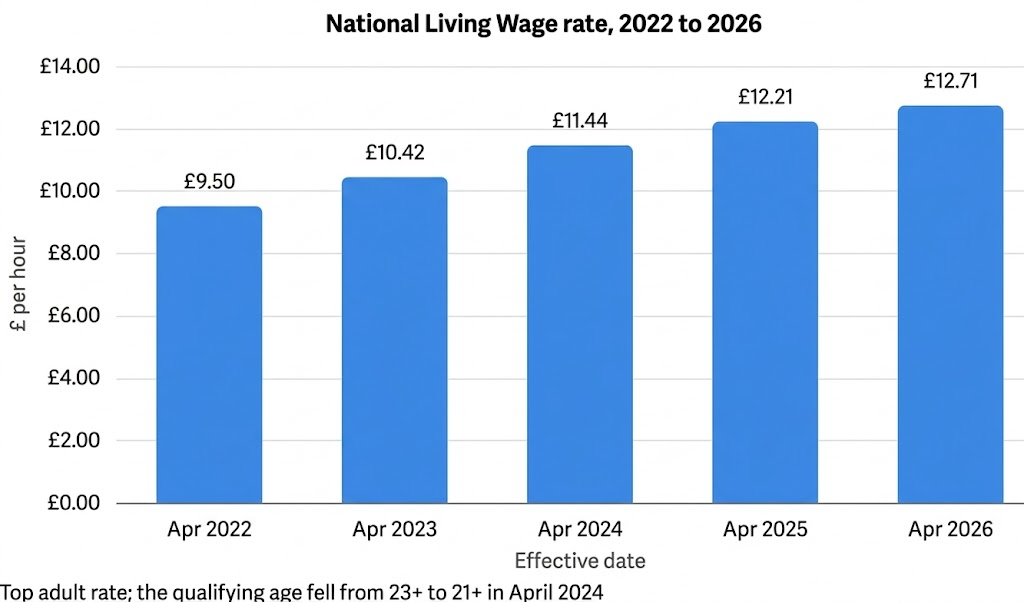
Most frontline officers are paid at or close to the National Living Wage (NLW), so this single figure has an outsized effect on the whole UK security market. From 1 April 2026 the NLW for workers aged 21 and over rises to £12.71 an hour, and the age threshold for that top rate fell from 23 to 21 back in April 2024, pulling more staff onto the highest rate at once (gov.uk).
Employer National Insurance jumped sharply
This change catches a lot of buyers off guard, because it does not show up on a payslip, only on an employer’s bill. From April 2025, the secondary Class 1 National Insurance threshold fell from £9,100 to £5,000 a year, and the employer rate rose from 13.8% to 15% (moneysoft.co.uk). For a firm employing hundreds of guards across multiple sites, that is one of the biggest single reasons contract pricing has moved this year, separate from the wage rise itself.
SIA licensing and training costs
Every guard, door supervisor and CCTV operator in the regulated UK security market needs a valid Security Industry Authority (SIA) licence, and the cost usually sits with the employer. From 1 April 2026 the SIA licence application fee reverts to £204 for both new applications and renewals, as the temporary £20 rebate that had applied since 2020 comes to an end (gov.uk). On top of the licence itself, providers cover refresher training and Emergency First Aid at Work certification for every licensed officer, and those costs have risen too.
The Employment Rights Act 2025 adds new obligations
Beyond pay, the regulatory picture is shifting. The Employment Rights Act 2025 received Royal Assent on 18 December 2025 and is being phased in from April 2026, with reforms to statutory sick pay and family leave, followed by changes to zero and low-hours contracts, unfair dismissal rules and fire-and-rehire practices through 2027 (gtlaw.com). For an industry that has relied on flexible shift patterns, this adds compliance and administrative cost on top of the wage bill, which reputable providers are already building into their pricing.
What Rising Costs Actually Mean for Your Security Budget
To see this in real terms, here is what employing a single full-time officer (40 hours a week, paid at the National Living Wage) actually costs once wages, employer National Insurance and minimum pension contributions are added together.
| Cost element (per guard, per year) | April 2024 | April 2026 | Change |
| Hourly rate | £11.44 | £12.71 | +11.1% |
| Gross annual wage | £23,795 | £26,437 | +11.1% |
| Employer National Insurance | £2,028 | £3,216 | +58.6% |
| Employer pension (minimum 3%) | £527 | £606 | +15.0% |
| Total employer cost | £26,350 | £30,258 | +14.8% |
Illustrative estimates based on standard NLW, NIC and auto-enrolment rates; actual costs vary by contract, shift pattern and pension scheme.
National Insurance rose nearly four times faster than the headline wage over these two years. That is why a security quote can jump more than the minimum wage increase alone would suggest, and it is the single most useful thing to understand before querying a renewal.
Why the Cheapest Quote Is Often the Costliest Mistake
When every legitimate provider in the UK security market faces the same wage, tax and licensing pressures, a quote that sits noticeably below the rest usually means one of a few things: shifts are under-resourced, SIA compliance is being cut, staff are misclassified to dodge National Insurance, or the provider will not stay viable long enough to see out the contract. None of that is good news for a buyer relying on that provider to protect people, premises or stock.
A well-priced quote today should reflect wages at or above the NLW, correctly applied employer National Insurance and pension contributions, licensing and training costs, supervision and management overheads, and a sustainable margin. If a number looks too good against that backdrop, it is worth asking why.
How to Budget Smartly for Security Services in 2026 and Beyond
- Ask for a cost breakdown, not just a headline rate. A transparent provider can show how wages, National Insurance, pension, licensing and supervision make up the price per hour.
- Build in an annual review rather than a long fixed-price lock. The National Living Wage changes every April, so a contract that reviews pricing against it avoids a provider quietly cutting service quality to protect margin.
- Consider a multi-year contract with agreed indexation. Linking annual increases to NLW or CPI movements gives cost predictability without renegotiating from scratch every year.
- Reassess coverage, not just price. Check whether every post genuinely needs 24/7 static guarding, or whether mobile patrols, remote CCTV monitoring or access control could cover lower-risk hours without reducing protection.
- If switching provider, ask about TUPE. Under the Transfer of Undertakings (Protection of Employment) regulations, incoming staff often transfer on existing terms, so understanding this avoids disruption and unexpected costs at handover.
- Check accreditation before checking price. SIA Approved Contractor Scheme status and proper insurance are strong signals of a provider pricing this properly rather than cutting corners to win the bid.
What to Look for in a Reliable Security Partner
| Green Flags | Red Flags |
| Clear, itemised cost breakdown | Vague, one-line pricing with no detail |
| SIA Approved Contractor Scheme status | No mention of SIA compliance or licensing |
| Quote reflects current NLW and NI rates | Price unchanged for two-plus years |
| Named account manager and supervision structure | No visible management or QA process |
| References or case studies from similar sites | Reluctant to provide references |
| Willing to discuss contract terms and review clauses | Pushes for a long lock-in with no flexibility |
Frequently Asked Questions
Why has my security services quote gone up this year?
Most increases trace back to the National Living Wage rise, higher employer National Insurance contributions since April 2025, and rising SIA licensing and training costs. A responsible provider can explain exactly which of these are driving a specific renewal.
Are all UK security companies raising prices at the same rate?
No. Providers with efficient operations, technology-assisted guarding or strong Employment Allowance eligibility may absorb more of the increase than smaller, less efficient firms, which is why detailed breakdowns are worth comparing rather than headline day rates alone.
Will security costs keep rising after April 2026?
Given the government’s stated direction on the National Living Wage and the phased rollout of the Employment Rights Act through 2027, further increases in the UK security market are likely, though probably at a steadier pace than the recent jumps.
Is it ever safe to accept a noticeably cheaper security quote?
Treat it with caution. If a quote sits well below what legitimate NLW, National Insurance and SIA compliance costs would require, either the provider is making an unsustainable margin or corners are being cut somewhere in delivery.
How much of a guarding contract’s cost is labour?
Typically 70 to 80%, which is why wage and tax changes move security pricing so directly compared with many other services.
Can technology reduce security costs without cutting protection?
In some cases, yes. Blending guarding with CCTV monitoring, access control or remote surveillance for lower-risk periods can reduce the hours of static guarding needed, while keeping cover where it matters most.
Final Words
Rising labour costs are not a temporary blip in the UK security market. They are the result of structural changes to wages, tax and employment law that are still being phased in. Buyers who understand what sits behind a quote, ask the right questions, and choose providers who price transparently will end up with better value and fewer surprises than those chasing the lowest number on the page.
At GSS Securities, pricing is built from the same wage, National Insurance and SIA compliance costs covered in this guide, not stripped back to win a bid. For a clear, itemised quote or a review of current security spend, get in touch and we will walk through exactly what is being paid for.