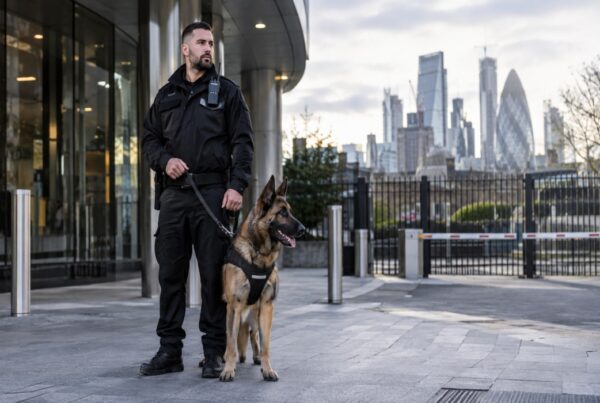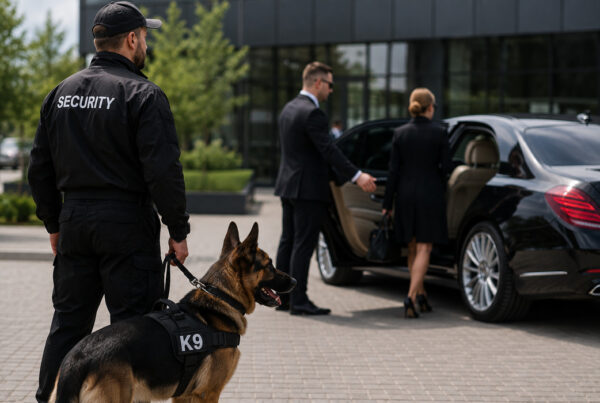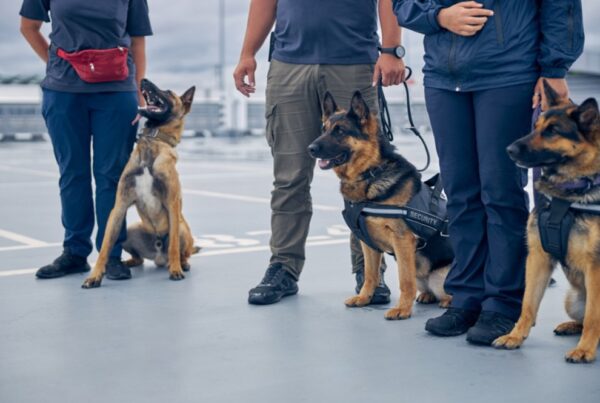

When it comes to security, you often have to make a basic choice: do you trust people or animals, or a mix of both? Property owners and businesses are always weighing the pros and cons of using K9 security dogs instead of traditional security guards. Both choices have their own pros and cons, and depending on the situation, one of them could make or break a security plan.
This article looks at how well K9 security dogs and regular guards work, how much they cost, how much training they need, and how the public views them. You can make a smart choice that keeps your people and property safe by knowing these differences.
The Traditional Security Guard: The Human Element
The private security industry is built on traditional security guards. They make people feel safer by being there, helping customers, and handling difficult situations that require talking.
Benefits of Traditional Guards
Some key advantages of traditional security guards are discussed below.
Complex Decision Making
People can think critically in ways that animals can’t. A security guard can look at a situation in detail. For instance, a guard can tell the difference between a harmless kid waiting for a ride and a possible vandal if a teenager is hanging out near a store. They can calm down fights, help visitors find their way, and take care of medical emergencies until help arrives.
Technological Integration
Most modern guards know how to use advanced surveillance systems. They keep an eye on CCTV feeds, control who can get in and out, and use digital reporting tools. A guard can sit in a control room and watch twenty cameras at once. Based on what they see, they can send a patrol to a certain place.
Customer Service Role
Security is also a part of customer service in many places, like hotels, corporate lobbies, and stores. A guard is usually the first person a guest sees. They smile as they open doors, check IDs, and answer questions. This dual role adds value beyond just safety; it makes the experience better for visitors.
Legal and Report Writing
A human guard gives the necessary paperwork if something happens. Detailed reports of incidents are very important for insurance claims and court cases. A guard can tell the court what they saw, heard, and did. No animal has this ability.
Limitations of Traditional Guards
Some key limitations of traditional guards are discussed below.
Human Error and Fatigue
People get tired, lose focus, and get bored. At 3:00 AM, a guard on a 12-hour overnight shift might have trouble staying awake. While watching static monitor screens, their attention can drift, which can cause them to miss security breaches.
Physical Vulnerability
Guards are not invincible, even though they have been trained. The guard is in a lot of danger if they confront a violent intruder or a group of criminals. A lone guard may be overpowered by determined attackers unless they are armed, which raises costs and risks.
Slower Reaction Times
A dog is better at chasing down a sprinting intruder than a person is. If a suspect runs away across a big construction site or through a dark warehouse, a human guard is at a speed and sensory disadvantage.
K9 Security Dogs: Sensory Superiority
K9 security dogs, which are often with handlers, keep people and property safe. These animals aren’t just pets; they are bred to work as protection, detection, and obedience animals.
Benefits of K9 Security Dogs
Some key advantages of K9 dogs are discussed below.
Unmatched Sensory Capabilities
People’s sense of smell is thought to be 10,000 to 100,000 times less sensitive than a dog’s. They can also hear much better. A K9 can find a person hiding in a dark warehouse long before a human guard would even know they were there. They can smell smoke, drugs, or explosives that people can’t see or hear.
Psychological Deterrence
A trained German Shepherd or Belgian Malinois can scare a lot of people. Criminals might be willing to argue with or even fight a human guard, but not many are willing to deal with a dog that is barking and snarling. Just having K9 security dogs around is enough to make most would-be intruders pick an easier target.
Speed and Agility
Dogs move quickly. If an intruder breaks through a perimeter fence and runs, a dog can catch up to them in seconds. They can easily jump over obstacles, navigate rough terrain, and catch a suspect who is trying to get away. Humans can’t do these things as well. This makes them great for big, open spaces like construction sites, solar farms, or car dealerships.
Loyalty and Lack of Corruption
You can’t pay a dog to do something. A security dog is only loyal to its handler and the training it gets. A K9 adds a layer of security that can’t be bribed or threatened in high-stakes situations where these things might be a problem.
Limitations of K9 Security Dogs
Some key limitations of K9 dogs are discussed below.
Cost and Maintenance
K9 units cost a lot of money. You are paying for more than just the handler. You are also paying for the dog’s ongoing training, food, vet care, and insurance. Because of the risk of bites, K9 units have to pay a lot more for liability insurance than unarmed guards do.
Public Perception and Liability
Dogs can keep criminals away, but they can also scare away real customers. A dog growling in a high-end store or a hospital lobby is usually not a good idea and is bad for business. There is also the risk of strict liability. If a dog bites someone, even by accident or because of a misunderstanding, the business owner could face serious legal problems.
Limited Scope of Work
A dog can’t write a report, answer the phone or show you where the toilet is. They can’t watch CCTV screens or make hard moral decisions. They are not for running the business or helping customers; they are for finding and protecting.
The Cost Factor: Budgeting for Safety
Cost is almost always a deciding factor for businesses.
Traditional Guards
You usually pay a security company by the hour. This rate includes the guard’s pay, the company’s overhead, and insurance. The cheapest option is guards without guns. Armed guards cost more because they need to be trained and get a licence.
K9 Security Dogs
These guards are usually more expensive per hour than regular unarmed guards. You are paying for a team that is trained in a certain area. But there is a small difference here. One K9 unit might be able to protect an area that would normally need three guards to patrol it properly.
For instance, three guards may be needed to cover the entire fence line at a big car lot. One K9 unit (a handler and a dog) might be able to cover that same area faster and better. In this particular instance, the K9 unit may be more cost-effective than compensating three distinct salaries.
But for a small store, a K9 is a lot more expensive than just one door guard, and the benefits get smaller over time.
Training Standards and Requirements
The training you get directly affects the level of security you get.
Guard Training
The rules for guard training are different in each state and country. In general, guards have to pass background checks and spend a certain number of hours in a classroom learning about the laws of arrest, observation, and reporting. Advanced guards might know how to do First Aid/CPR, use guns, and deal with crises. But “warm body” security companies often don’t give their guards much training, which makes them do a bad job.
K9 Training
This is a lot harder. Before they ever work a shift, K9 security dogs spend hundreds of hours training in obedience, agility, and protection. Handlers also need to know how to control the animal, read its body language, and know what the law says. A dog that isn’t well-trained is a huge risk because it could attack without being told to or not let go of a bite.
Making the Decision: A Strategic Framework
When choosing between K9 security and regular guards, ask yourself these questions:
1. What is the primary threat?
K9 security dogs are better if the threat is theft, vandalism, or trespassing in a large area. If the threat is stealing from inside the company, violence at work, or getting in through the front door without permission, people are better guards.
2. What is the environment?
Is it inside or outside? Is it bright or dark? Is it a public place or a private one? K9s do well outside and in closed buildings at night. People do well when they work inside or in public-facing roles.
3. What is the budget?
Can you pay the extra cost for a K9 unit? Or, on the other hand, can you afford not to use one if it means hiring several people to cover the same area?
4. What is the liability tolerance?
Are you ready for the look and possible insurance issues that having a guard dog on the property might cause?
The Rise of the Hybrid Model
More and more security experts are suggesting a hybrid model. This doesn’t mean that you have to have a dog and a guard standing next to each other. It could mean using both technology and people, or only using K9 security dogs during times of high risk.
For example, a shopping mall might hire regular security guards during the day to help customers and keep an eye on the stores. The plan changes after the mall closes. The friendly guards leave for the night, and a K9 unit patrols the inside and outside parking lots. This uses the dog’s ability to sense things at night and the person’s ability to help customers during the day.
Final Words
Neither the K9 security dogs nor the traditional security guards are universally “better.” Different jobs need different tools. For places that need cognitive judgement, customer service, and administrative work, the traditional security guard is still the best choice. They can see, hear, speak, write, and think.
In high-risk or large-scale situations, the K9 unit is the best choice for keeping people away, finding them, and protecting the perimeter. They have senses that technology still has trouble copying and a psychological barrier that people can’t match.
Business owners and security managers need to find out what specific weaknesses their site has. Don’t pick a K9 just because it looks tough, and don’t pick a human guard just because that’s what most people do. A thorough look at your needs will show you the best way to go, making sure your property stays safe and your budget stays intact.Do you want to protect your premises with K9 Security Dogs? Just contact us for a perfect security plan.